

Audio By Carbonatix
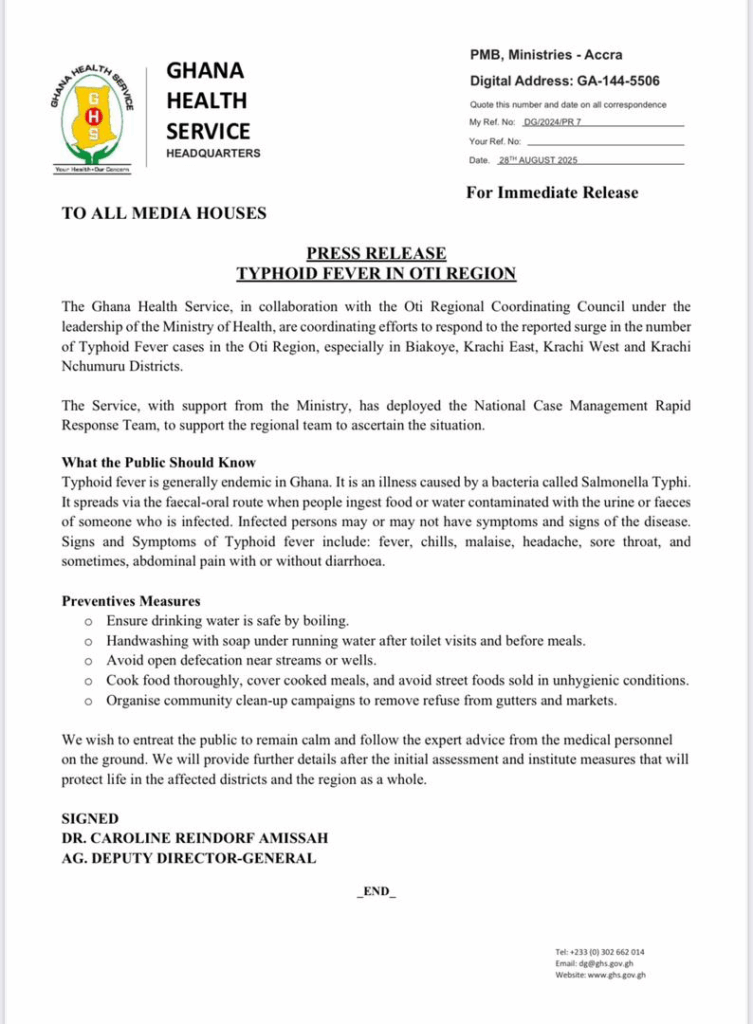
The Ghana Health Service (GHS), in collaboration with the Oti Regional Coordinating Council and under the guidance of the Ministry of Health, has launched an emergency response to a concerning rise in Typhoid Fever cases across several districts in the Oti Region.
According to GHS, the affected areas include Biakoye, Krachi East, Krachi West, and Krachi Nchumuru, where health authorities have reported a significant increase in suspected cases over the past weeks.
In a statement issued on Thursday, August 28, the GHS confirmed that a National Case Management Rapid Response Team has been deployed to support the regional health team in assessing the situation and coordinating a swift response.
“The Ghana Health Service, with support from the Ministry of Health, has deployed the National Case Management Rapid Response Team to support the regional team to ascertain the situation,” the statement read.
Typhoid fever is endemic in Ghana and is caused by the Salmonella Typhi bacteria. It spreads through the faecal-oral route, typically when people consume food or water contaminated with the faeces or urine of an infected person.
Health officials warn that individuals infected with the bacteria may not always show symptoms but can still spread the disease.
Common symptoms include:
- Persistent fever
- Chills
- General malaise
- Headache
- Sore throat
- Abdominal pain (with or without diarrhoea)
The GHS is urging the public, particularly residents in the affected districts, to observe the following preventive measures:
- Ensure all drinking water is safe, preferably by boiling.
- Wash hands with soap under running water after using the toilet and before eating.
- Avoid open defecation, especially near water sources.
- Cook food thoroughly, cover cooked meals, and avoid street food prepared in unhygienic conditions.
- Take part in community clean-up campaigns to eliminate refuse from public spaces, gutters, and market areas.
Authorities are encouraging residents to remain calm and cooperate with health personnel on the ground.
The GHS has assured the public that comprehensive measures will be rolled out following the team’s initial assessment to contain the outbreak and protect lives.
“We wish to entreat the public to remain calm and follow the expert advice from the medical personnel on the ground. We will provide further details after the initial assessment and institute measures that will protect life in the affected districts and the region as a whole,” the statement concluded.
Latest Stories
-
Power restoration fault suspected in Kumasi Central Market fire
5 hours -
The 7-foot giant of Ngleshie Amanfro: Seven-foot Ghanaian Ephraim Saawa dreams of joining the national basketball team
6 hours -
Government promises support for Kumasi Central Market fire victims
6 hours -
Vibes The Movie: Big Ghun’s Ghanaian film earns five nominations at 2026 REFFA
6 hours -
‘I’m a fulfilled man’—Justice Korbieh on missing out on Supreme Court despite two nominations
6 hours -
MamaCare CEO warns unresolved conflicts among health workers could undermine maternal and neonatal care
7 hours -
Health professionals urged to translate medical knowledge into practice to save mothers
7 hours -
Retired judge Justice Francis Korbieh charges 1,568 new lawyers to uphold integrity
8 hours -
Conflicts among care providers linked to maternal, neonatal deaths – Expert
8 hours -
GIS marks 10th TIME conference, champions improved teaching practices
8 hours -
BRICS Or Balance? What Ghana’s bid really means
9 hours -
GPRTU wants full TRAFFITECH-GH implementation to start in 2027
9 hours -
How 10-mile walks for basic education birthed a 50-year legal career for Justice Korbieh
9 hours -
Mahama announces plans to import electric wheelchairs for PWDs
9 hours -
KGL U17 Colts 2026: Western beat Prempeh Elite Academy to set up final final with Greater Accra Region
9 hours