

Audio By Carbonatix
The Minority in Parliament has accused the Mahama administration of prioritising political optics over long-term economic sustainability, arguing that recent gains being touted by government mask deeper structural weaknesses.
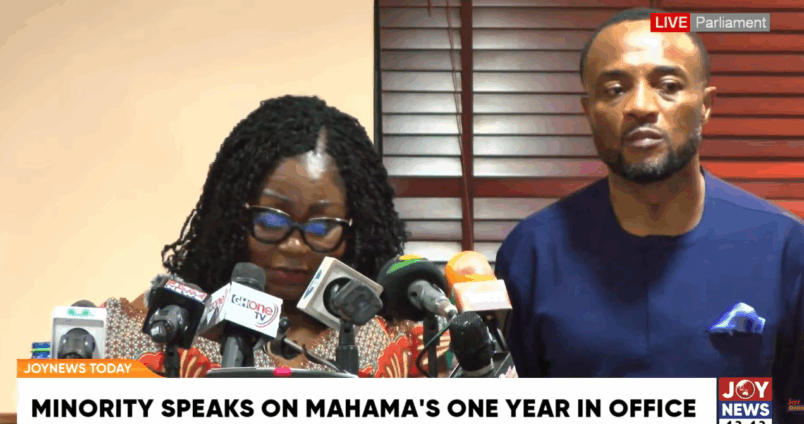
Speaking at a press briefing on Thursday, January 8, the Deputy Minority Leader and Member of Parliament for Asokwa, Patricia Appiagyei, dismissed the government claims of an economic turnaround as a “manufactured miracle” driven more by favourable headlines than sound policy foundations.
She questioned the narrative of success built around a reported 6 per cent GDP growth, falling inflation, and over 40 per cent appreciation of the cedi, asking what real benefits these gains have delivered to the ordinary Ghanaians.
According to her, much of the current recovery predates President John Mahama’s return to office and is largely anchored on external factors and policies initiated under the previous administration.
“Much of the recovery began before President Mahama returned to power. It is resting on an IMF programme we negotiated, fiscal consolidation we implemented, and a global gold boom we did not create,” she stated.
Madam Appiagyei further accused the government of selectively highlighting favourable aspects of the International Monetary Fund (IMF) programme while ignoring its cautionary notes.
She noted that while the government celebrates IMF-backed progress, the same reports also warn of fiscal risks, weaknesses in gold-related schemes, and underlying vulnerabilities within the economy.
“They publicise the headlines, but they downplay the warnings,” she said.
The Deputy Minority Leader also raised concerns about the sharp appreciation of the cedi, warning that such rapid gains, in the absence of strong structural fundamentals, could harm the productive sectors of the economy.
“A 40 per cent cedi appreciation in one year is not normal for an economy with structural weaknesses. It erodes competitiveness, hurts exporters, and damages farmers and manufacturers,” she argued.
She added that the government’s approach reflects a preference for short-term applause rather than policies aimed at securing long-term economic stability, insisting that sustainable growth must go beyond headline figures.
Latest Stories
-
Fire destroys head of tipper truck on Lower Volta Bridge
2 minutes -
Palmer signs new Chelsea contract until 2034
3 minutes -
World Cup visa scandal: Mahama will act on corruption allegations – Abass Nurudeen
5 minutes -
Abass Nurudeen accuses Minority of ‘scandal scavenging’ over World Cup visa controversy
6 minutes -
US Embassy recognised NSA, GFA and GTA as separate entities for visa applications – Sports Minister’s aide
13 minutes -
Only 30% of Ghanaian teachers satisfied with their jobs – CAPCOE data reveals
24 minutes -
Communities affected by construction of Akosombo Dam urge government to speed up compensation process
45 minutes -
World Cup visa scandal: Sports Ministry not shielding anyone – Sports Minister’s special aide
1 hour -
World Cup visa scandal: Over 30 people misrepresented as GTA board members to US Embassy – Vincent Assafuah alleges
1 hour -
Fire destroys wooden structure near Yesu Mo Villa at Bush Road
1 hour -
NDC threatens sanctions over oversized campaign posters, gives aspirants 5 days to comply
2 hours -
Star Oil paid GH¢2.7bn in taxes, levies in nine months of 2026
2 hours -
Samson’s Take: The rule of law is cheaper before the bulldozer
2 hours -
GRA blames system failure for delay in issuing receipt over passenger’s customs duty
3 hours -
Livestream: Newsfile discusses World Cup visa scandal, beach demolitions, education strikes, BRICS bid
3 hours