

Audio By Carbonatix
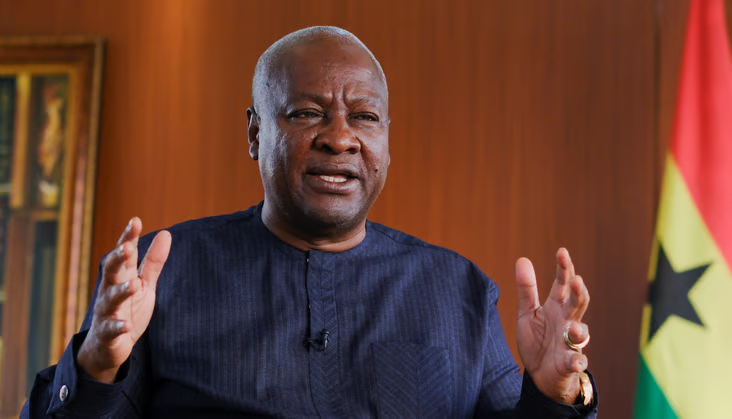
President John Dramani Mahama has warned that Ghana is not immune to the escalating global crude oil prices triggered by the recent exchange of missiles between Israel and Iran in the Middle East.
Speaking during his 'Thank You Tour' in the Savannah Region on Saturday, June 14, the President acknowledged the potential economic fallout and outlined steps his administration is taking to mitigate the impact on domestic fuel prices.
"Despite the work we have done in stabilising the economy, Ghana is not immune from the shocks of global events," President Mahama stated, highlighting the nation's vulnerability to international geopolitical developments.
He specifically pointed to "recent events in the Middle East which involve an exchange of missiles between Israel and Iran," noting that these developments "have started to escalate crude oil prices dramatically."
Global crude oil benchmarks, such as Brent crude, have seen significant surges in response to heightened tensions in the Middle East, a region critical to a substantial portion of the world's oil supply.
This instability directly impacts countries like Ghana, which, despite being a crude oil producer, remains a net importer of refined petroleum products.
Data from the International Energy Agency (IEA) indicates that oil constitutes a significant portion of Ghana's total energy supply, with the transport sector being the largest consumer of refined oil products.
To safeguard Ghana's economy and protect consumers, President Mahama revealed that he has issued directives to his key ministers.
"I've asked our Minister of Finance and Minister of Energy to keep a close eye on the development and model the possible impacts on our petroleum prices," he disclosed.
The current Minister for Finance is Dr. Cassiel Ato Forson, while the Minister of Energy is John Abdulai Jinapor.
The President's directive underscores a proactive approach to potential economic headwinds.
Ghana is currently engaged in an Extended Credit Facility (ECF) programme with the International Monetary Fund (IMF), aimed at achieving macroeconomic stability and fiscal discipline.
The government's 2025 budget targets a 1.5% primary surplus, making the management of external shocks like rising oil prices crucial to maintaining these hard-won economic gains.
The ministers have been tasked not only with monitoring the situation but also with preparing "measures to protect the recent gains that we have made."
These measures could potentially include strategic reserves, targeted subsidies, or other fiscal interventions to cushion the Ghanaian public from sharp increases at the pump.
Latest Stories
-
GES threatens removal of SHS heads over illegal fees
2 minutes -
Youth power to explode at 2026 Global Changemakers Summit in Accra
9 minutes -
SIU community remembers Kofi Akamani at vigil as memorial fund is announced
11 minutes -
Shot and killed in the US: Who was Dr Kofi Akamani?
19 minutes -
Sosu challenges EOCO’s basis for attempted arrest of Manhyia South MP
26 minutes -
KMA plans to convert Adum railway enclave into cargo truck terminal
27 minutes -
2026/27 cocoa season: COCOBOD engages international trading partners in London
45 minutes -
Fire contained at Dansoman’s Dayspring School, no casualties reported
49 minutes -
Nyankyerenease gets furnished CHPS compound to improve healthcare access
58 minutes -
Sky Train trial moves to defence as Asamoah, Ameyaw-Akumfi file witness statements
1 hour -
AFCON 2027Q: Ghana will face Ivory Coast, Gambia unscathed – Sports Minister
1 hour -
Heavy security at Accra High Court ahead of Salomey Baffoe bail hearing after EOCO’s attempted arrest of Manhyia South MP
1 hour -
Teen rocker Nene Royal becomes first Thai to win America’s Got Talent
1 hour -
Skills Bridge Ghana Foundation trains 50 professionals in solar energy
1 hour -
Photos: Mahama Ayariga inspects waste evacuation exercise at Agbogbloshie
1 hour