

Audio By Carbonatix
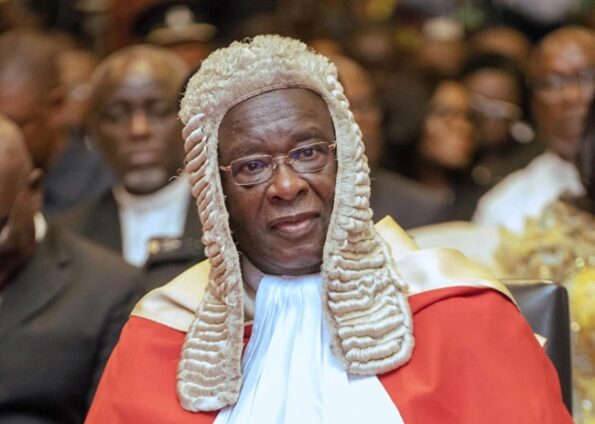
Ghana’s Judiciary will introduce electronic filing, authentication and service of court processes from October 1, 2026, Chief Justice Paul Baffoe-Bonnie has announced.
The reforms, to be implemented under the Judiciary’s E-Justice Plus Agenda, will also include the phased automation of courts nationwide, beginning with the Supreme Court.
The Chief Justice announced this at the grand durbar marking the climax of the Supreme Court’s 150th anniversary celebration at the Ohene Konadu Auditorium of the University of Professional Studies, Accra (UPSA).
“Again, beginning in October when the legal year starts, we commence automation of the courts across the country, starting with the Supreme Court, to be followed by the Court of Appeal, and the High Court.”
Justice Baffoe-Bonnie said electronic filing, electronic authentication and electronic service of court processes would become the standard for the administration of justice from October 1, 2026.
He described the reforms as a significant institutional step rather than merely a technological innovation.
“It reflects our determination to ensure that access to justice is no longer unnecessarily constrained by geography, bureaucratic or avoidable delay,” he said.
The Chief Justice said the administration of justice must continue to evolve to meet the demands of the twenty-first century.
“Technology should never replace justice, but it should make justice more accessible, more efficient, and more responsive to those it exists to serve.”
He said the reforms formed part of the broader E-Justice Plus Agenda aimed at building a modern judicial system while preserving its enduring values.
Justice Baffoe-Bonnie said the Judiciary had also completed a review of the Rules of Court.
“But procedure must never become an obstacle to justice. The Rules exist to facilitate the fair determination of disputes, not to frustrate them.”
The Chief Justice said the revised Rules would be laid before Parliament at the beginning of the next legal year in October.
He said the revised Rules would simplify court procedures, reduce unnecessary technicalities, improve efficiency and better reflect the realities of contemporary litigation.
“They represent another important step towards a justice system that is both principled and practical,” he said.
Justice Baffoe-Bonnie said the Judiciary looked forward to working with stakeholders to ensure the successful implementation of the reforms.
He acknowledged that delays in the justice delivery system remained a challenge that required continued attention to sustain public confidence.
“Acknowledging these challenges is not a sign of institutional weakness. It is evidence of institutional maturity. Institutions that believe they have nothing left to improve often begin, unknowingly, to decline,” Justice Baffoe-Bonnie said.
Latest Stories
-
UK identified as leading destination for Ghana’s illicit cannabis exports – Report
2 minutes -
Drug money allegedly finances Ghana’s political parties and real estate – Global Organised Crime Index
7 minutes -
NSA outlines seven steps for successful posting and validation of national service personnel
8 minutes -
GPRTU taskforce clamps down on unapproved fares at Kasoa
9 minutes -
Prime Insight: Making room for meaningful national conversations on Joy Prime
20 minutes -
FABAG commends Ato Forson’s over removal of 20% excise duty on locally manufactured fruit juices
27 minutes -
HIV stigma discourages testing, prevention and treatment in Ghana – Ghana AIDS Commission
29 minutes -
Blocking cocaine probe lends weight to claims of political protection for traffickers – Assin South MP
33 minutes -
NPP Vice Chair race: I may be the youngest, but most experienced – Nana B
35 minutes -
Last UK and US troops leave Iraq as anti-Islamic State mission ends
35 minutes -
Don’t stay home idle, embrace entrepreneurship while awaiting posting – Unemployed nurses urged
47 minutes -
Aayalolo buses not speeding on contra-flow lanes – GAPTE assures commuters
49 minutes -
Effia MP calls for Kurt Okraku’s removal, overhaul of Ghana football structure
50 minutes -
CAS hearing on AFCON final appeal by Senegalese Football Federation set for October 8
51 minutes -
STC fares to go up by up to 8% this week – Deputy MD
52 minutes