

Audio By Carbonatix
Kumasi and six other African cities are expected to grow at a much faster pace, supported by infrastructure development, urbanisation and the emergence of megacities.
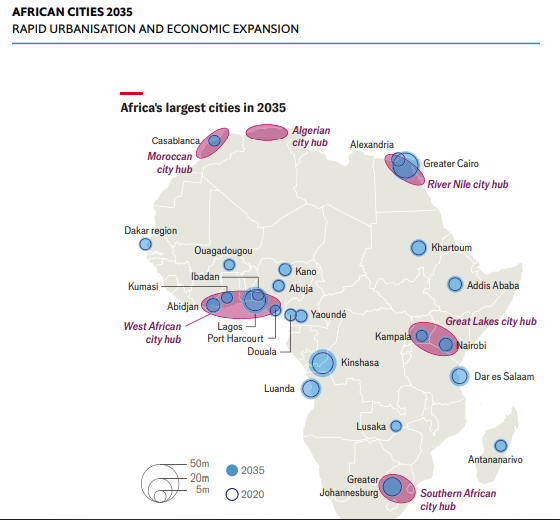
According to the Economist Intelligence Unit, the continent’s established urban heavyweights and megacities including Cairo, Lagos and Johannesburg will still sit at the head of the Africa100 city economies in 2035.
The other six African cities that would grow quickly are Kinshasa, Dar es Salaam, Addis Ababa, Abidjan, Kampala and Dakar.
In a report, the London based firm said it expect rapid urbanisation across Africa to help to create more dynamic and wealthier consumer markets, better connected and more sophisticated commercial and distribution hubs, and larger bases for industrial production and import-export operations.
However, overcrowding, informal settlements, high unemployment, poor public services, stretched utility services and exposure to climate change are just some of the major challenges that city planners will have to grapple with in their drive for sustainable urban economic growth in the next decade
It continued that Africa has and will continue to have the fastest rate of urbanisation of the world’s major regions through to 2035.
Africa’s urban population to hit 1.0bn in 2035
It projected that Africa’s urban population will rise from about 650 million in 2023 to almost one billion in 2035, which represents a compound annual growth rate (CAGR) of about 3.5% and will take the proportion of Africans living in towns and cities to over 50% in 2035.
“Africa’s urban population will continue to grow rapidly in the 2030s, in contrast to other major regions; urban population growth in Asia is expected to decelerate, and the rate in the Americas and Europe will level off during the 2030s. In Africa, the East, Central and West African subregions will record the fastest rate of urban population growth in 2023-35”, it added.
Emergence of megacities to be a major feature of Africa’s demographics
The report stated that the emergence of new urban heavyweights and megacities, the rapid expansion of city clusters and the rising importance of megalopolises will be a major feature of Africa’s demographic and economic future.
It said the continent is projected to have six megacities by 2035—Luanda and Dar es Salaam will join the current giants of Greater Cairo, Kinshasa, Lagos and Greater Johannesburg with a population of more than 10 million resident.
A further 17 cities will have a population that exceeds 5.0 million residents and another 100 or so cities will have populations in excess of one million inhabitants.
Latest Stories
-
Ghana eyes stronger trade ties as Australia hosts multicultural trade and investment forum
4 minutes -
Margaret-Marie Krakue
7 minutes -
Ayariga announces plans for live broadcast of MMDAs’ meetings on local radio stations
10 minutes -
Mrs Anna Tackie
12 minutes -
Ghana links Afghan heroin and Brazilian cocaine to global drug markets – Global Organised Crime Index
19 minutes -
NHIA launches nationwide inter-school quiz to deepen students’ knowledge of NHIS
26 minutes -
Political protection could be masking Ghana’s cocaine trade – Global Organised Crime Index
31 minutes -
AFCON 2027Q: ‘We have to dissolve the GFA’ – Effia MP after Black Stars lose to Gambia
33 minutes -
NPP announces voting schedule and ID requirements for October 3 national elections
35 minutes -
Lupus can mimic HIV symptoms and damage kidneys if untreated – KNUST expert
38 minutes -
Focus on Sickle Cell Foundation seeks to introduce sickle cell education through comics in Ghanaian schools
43 minutes -
NPP rewrites the campaign playbok as opposition reality shapes National Executive contest
45 minutes -
Road safety education will fail without enforcement – NRSA boss
46 minutes -
Daily Insight for CEOs: Finishing Q3 strong and entering Q4 with purpose
47 minutes -
National Ambulance Service begins ‘Operation Restore Fleet’ to restore grounded ambulances
47 minutes