

Audio By Carbonatix
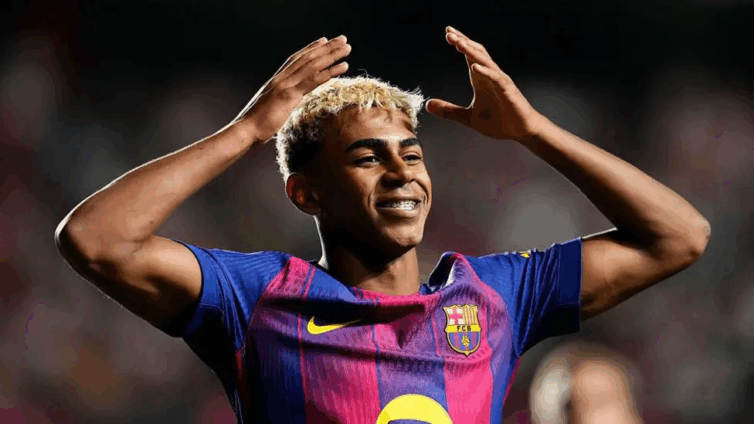
At just 18, Lamine Yamal stood on the cusp of rewriting history.
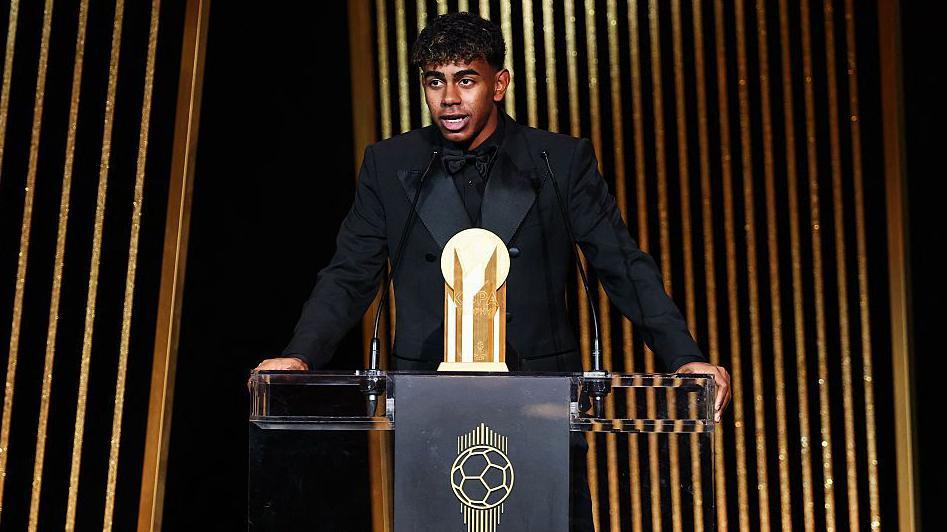
Had he lifted the Ballon d'Or in Paris, he would have become the youngest winner ever.
He didn't - Ousmane Dembele's collective triumph with PSG proved too much - but that hardly matters. The very fact the teenager was even a candidate is revolutionary. He seems destined to create an era.
Lamine Yamal, who did win the young player of the year award on Monday, is not simply a footballer; he is a mirror for his generation.
'Closer to a pop star than a traditional footballer'
For decades, football sold us the idea that greatness came through sacrifice and humility.
Lionel Messi spoke of the Ballon d'Or as a "consequence of the team's work". Cristiano Ronaldo turned discipline into theatre, sculpting his body into a monument of effort.
Lamine Yamal, by contrast, represents something new. He embodies a youth culture that does not hide its ambition. He has previously declared: "I don't dream of one Ballon d'Or, I dream of many. If I don't get them, it will be my fault."
That is neither Messi's humility nor Ronaldo's warrior mentality. It is something else: call it self-ownership, where destiny is assumed as a personal responsibility.
It is a philosophy that resonates with generations Z and Alpha. These are young people shaped by crisis - financial collapse, pandemic, climate anxiety - who distrust institutions. For them, success is not obedience to the system but independence from it.
Sacrifice is no longer the highest virtue; freedom is. Money is not taboo, but neither is it sacred: it is a tool for autonomy. Fun and visibility are not distractions - they are part of success.
That is why Lamine Yamal's summer in Monaco, his gangster-themed birthday party, or even his moments alongside Neymar - a player who fell out of love with the game long ago yet remains an icon for young people - are not moral slip-ups. They say: as long as you perform, no-one can tell you how to live.
In this sense, Lamine Yamal is closer to a pop star than a traditional footballer. He belongs to the same generational universe as American singer-songwriter Sombr, who went from bedroom recordings to chart hits when TikTok propelled his songs around the world.
Sombr's rise is less about vocal technique than about attitude, presence and identity. Young people see themselves in Sombr, in Lamine Yamal.
Breaking the mould
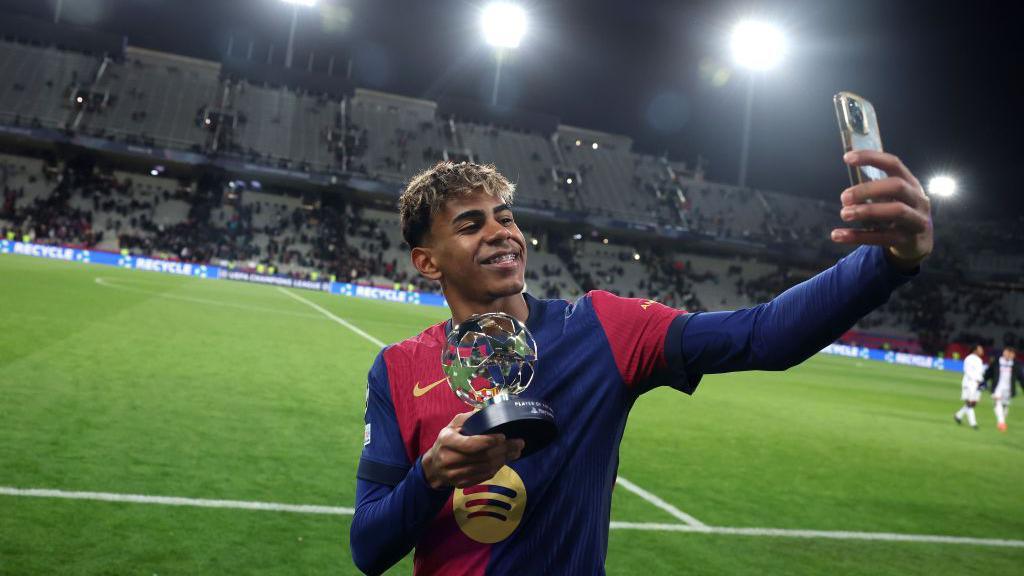
Social media has accelerated this shift. Where Messi was an enigma and Ronaldo a carefully curated rival to the world, Lamine Yamal offers raw immediacy.
He shares what he wants, when he wants. He posts dances and private moments with the world audience, and fans feel they know him beyond the pitch.
That transparency has made him the idol of young Catalans - not because he embodies La Masia's traditional virtues of discretion and hard work, but precisely because he breaks them.
The teenage Spain winger instead offers something more global. His charisma, his spontaneity, his flashes of genius - on and off the field - speak to a worldwide youth reconnecting with football through him.
'Having character helps me survive'
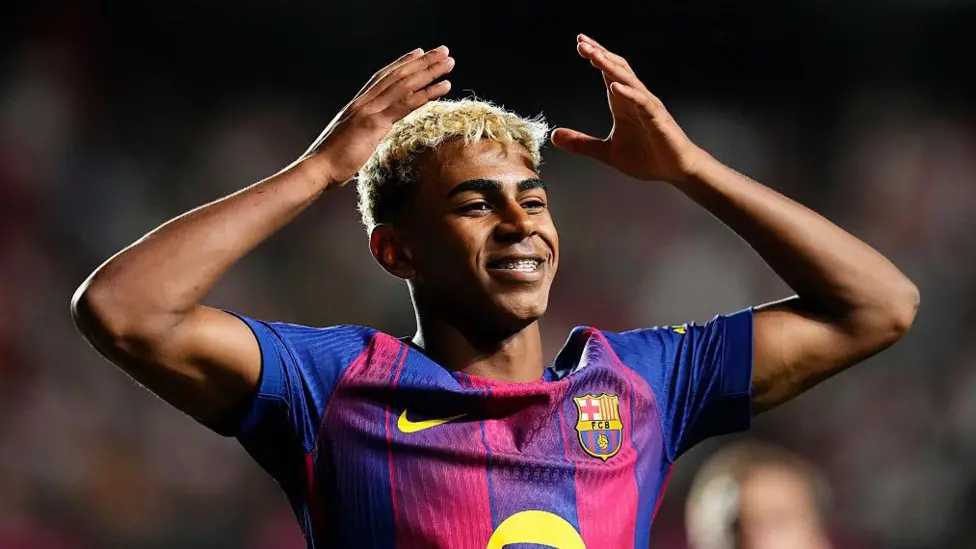
If his sociological role is symbolic, his psychology adds depth. Lamine Yamal is fiercely self-aware.
He knows he is a prodigy and does not pretend otherwise. He embraces responsibility, already taking free-kicks, penalties and wearing Barca's number 10 shirt. "Having character helps me survive," he says.
That resilience comes not only from talent but from life itself. He grew up in Rocafonda, a working-class neighbourhood of Mataro, the son of immigrants from Morocco and Guinea. His grandmother once sneaked on to a bus to cross into Spain and his mother raised him while working multiple jobs.
When his father was stabbed, Lamine Yamal was just 16. At La Masia he struggled at first with social displacement, moving from humble surroundings into an elite environment. All of this toughened him.
He is now intent on giving back. The first thing he did with his earnings was buy his mother the house she wanted. "For me, she is my queen," he says. He recalls how, despite the late shifts, she still came home to cook him dinner.
And despite the scrutiny, he treats fame with detachment. When his birthday party made headlines, he laughed it off: "Do you know any 18-year-old who goes out and it's news?" Criticism washes away as long as he performs. His real fear is not living up to his own ambition.
Football, though, has a way of humbling.
He played only eight minutes at the old Nou Camp before its renovation, a reminder of how much still lies ahead.
And crucially, Barcelona are showing they can win while he is out injured. The "Laminedependencia" that once haunted them is fading; Marcus Rashford, Pedri and others are carrying the team when needed in recent games.
That is good news for both club and player. It allows Lamine Yamal to grow inside a collective, not under the suffocating expectation of being saviour.
On the pitch, he is evolving. His defensive work, his intensity, his duels all show growth. Both Hansi Flick and Luis de la Fuente are moulding him into a total footballer.
'Redefining what it means to be a star'
So what comes next? The question is not whether Lamine Yamal has the talent to dominate - he does. It is how he will react when the Ballon d'Or does not arrive next time round, when he is benched, when injuries come, when the spotlight turns cruel.
These are the natural lessons of youth careers, but they will test a boy who already carries himself like a man.
We are, in truth, at the start of the story.
Shakespeare wrote that the eve of battle is as dramatic as the fight itself: full of anticipation, promises and theatre. Lamine Yamal's career today feels like that. He is not yet the king of football, but he already walks the stage like one.
If he learns to turn ambition into endurance and survives the inevitable storms, he may well create an era. And that era will not only change Barcelona or Spain, but football itself, redefining what it means to be a star in the 21st century.
Latest Stories
-
MamaCare CEO warns unresolved conflicts among health workers could undermine maternal and neonatal care
21 minutes -
Health professionals urged to translate medical knowledge into practice to save mothers
27 minutes -
Conflicts among care providers linked to maternal, neonatal deaths – Expert
2 hours -
GIS marks 10th TIME conference, champions improved teaching practices
2 hours -
BRICS Or Balance? What Ghana’s bid really means
3 hours -
GPRTU wants full TRAFFITECH-GH implementation to start in 2027
3 hours -
Mahama announces plans to import electric wheelchairs for PWDs
3 hours -
KGL U17 Colts 2026: Western beat Prempeh Elite Academy to set up final final with Greater Accra Region
3 hours -
Late Solanke strike salvages 10-man Spurs draw at Man United
3 hours -
Gender Ministry to monitor welfare of Nana Akua Addo’s children amid domestic violence case
4 hours -
Benedict Okyere Yeboah: Ghana’s football problem goes beyond sacking a coach
4 hours -
GPL 2026/27: Darkwah Wiafe’s winner sees All Blacks beat Kotoko
4 hours -
ITF World Tour : Patel Wins Boys’ Singles Final at J100 Accra
4 hours -
Ghana must pursue BRICS partnership if it brings economic benefits – Kpebu
4 hours -
Success and Wright Claims J100 Accra Girls’ Doubles Championship
4 hours