


Audio By Carbonatix
The Member of Parliament for Madina, Francis-Xavier Sosu, has criticised a recent High Court directive requiring the Office of the Special Prosecutor (OSP) to transfer all ongoing prosecutions to the Attorney-General’s Department.
The directive, which forms part of a legal challenge concerning the prosecutorial authority of the OSP, has sparked renewed debate over its potential implications for Ghana’s anti-corruption framework.
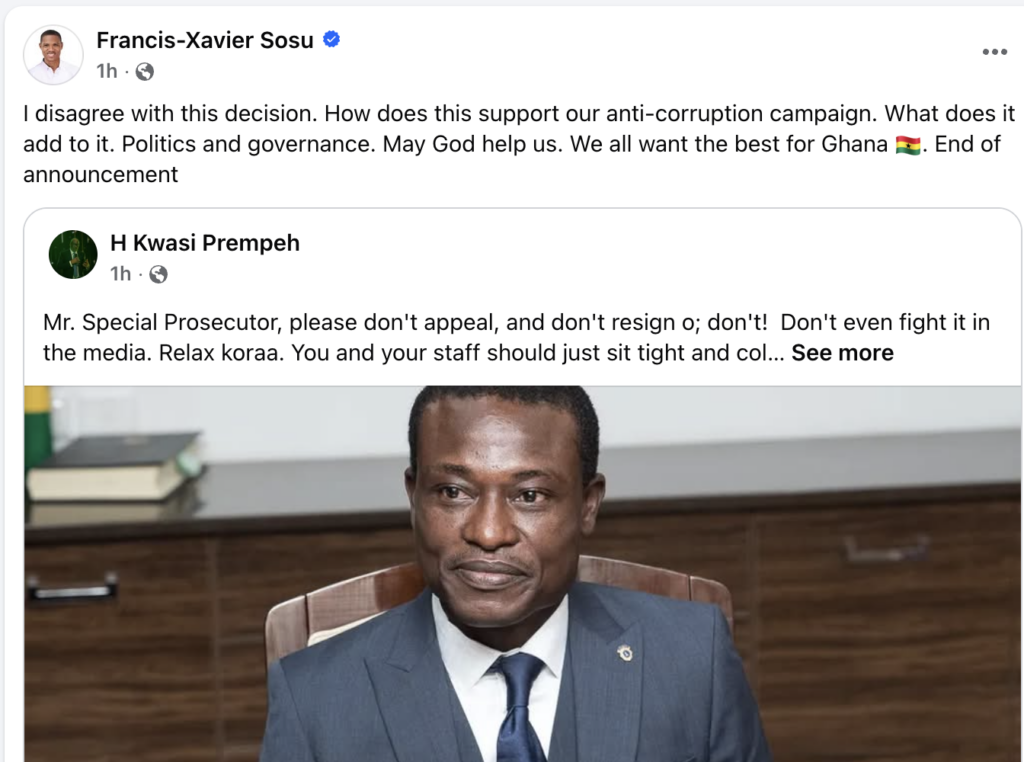
Reacting in a social media post, Mr Sosu, a lawyer, raised concerns about the likely impact of the ruling on efforts to combat corruption, suggesting that the decision could undermine progress made so far.
“I disagree with this decision. How does this support our anti-corruption campaign? What does it add to it? Politics and governance. May God help us. We all want the best for Ghana,” he wrote.
Background to the High Court ruling
The directive follows a ruling by a High Court, which held that the OSP does not have the constitutional authority to independently prosecute criminal cases.
Presiding judge, Justice John Eugene Nyadu Nyante, ruled that while the OSP is empowered to investigate corruption-related offences, prosecutorial authority under Article 88 of the 1992 Constitution is vested solely in the Attorney-General.
The ruling arose from an application for quo warranto filed by private citizen Peter Achibold Hyde, who challenged the legality of the OSP’s authority to undertake prosecutions without recourse to the Attorney-General.
The court consequently directed that all ongoing prosecutions initiated by the OSP be referred to the Attorney-General’s Department, creating uncertainty over several active corruption cases.
Pending Supreme Court suit deepens legal uncertainty
The High Court ruling comes amid a separate constitutional case already pending before the Supreme Court of Ghana, which is challenging the legality of the OSP’s independent prosecutorial powers.
The suit, filed by private citizen Noah Ephraem Tetteh Adamtey, argues that Parliament exceeded its constitutional mandate by creating an independent prosecutorial body outside the authority of the Attorney-General.
In filings before the Supreme Court, the Attorney-General has reportedly aligned with the plaintiff’s central argument, maintaining that provisions in the OSP Act allowing the office to initiate prosecutions without authorisation from the Attorney-General may be unconstitutional under Article 88 of the Constitution.
Legal analysts say the outcome of the Supreme Court case could have far-reaching implications, potentially redefining the mandate of the OSP and determining the future structure of anti-corruption prosecutions in Ghana.
Mr Sosu’s reaction adds to the growing public and legal debate over the independence of the OSP and the broader implications of the High Court ruling for Ghana’s fight against corruption.
Latest Stories
-
Mahama commends Trade Minister for championing Ghana’s industrial growth
9 minutes -
Public cautioned against transactions over Borteyman land as Supreme Court rules in favour of Sino Africa
11 minutes -
Ghana Air Force mourns with Nigeria over 25 citizens killed aircraft accident
13 minutes -
Minority demands permanent scrapping of GSA’s $300 PVoC charge on imported vehicles
18 minutes -
White vs traditional marriage: Aesthetics above culture?
56 minutes -
Tumu Municipal Hospital receives new delivery bed to boost maternity care
1 hour -
Telecel Ghana unveils Project X with Black Sherif partnership
1 hour -
Rev. Kwadwo Bempah defies restriction on preaching on buses; warns it won’t succeed
1 hour -
French Embassy to partner Kobby Kyei Media for bloggers’ training
2 hours -
Nestlé and NBA announce multi-year international marketing partnership
2 hours -
Mahama sends condolences to Nigeria over plane crash that killed 25
2 hours -
Our lifestyles may be killing us but our spatial planning is too
2 hours -
12 arrested as police seize firearms, suspected drugs in Tamale
2 hours -
Chamber of Mines challenges Reuters report on proposed mining law
2 hours -
LA 2028: Black Queens take first leg advantage with 3-0 win over Mauritius
2 hours