

Audio By Carbonatix
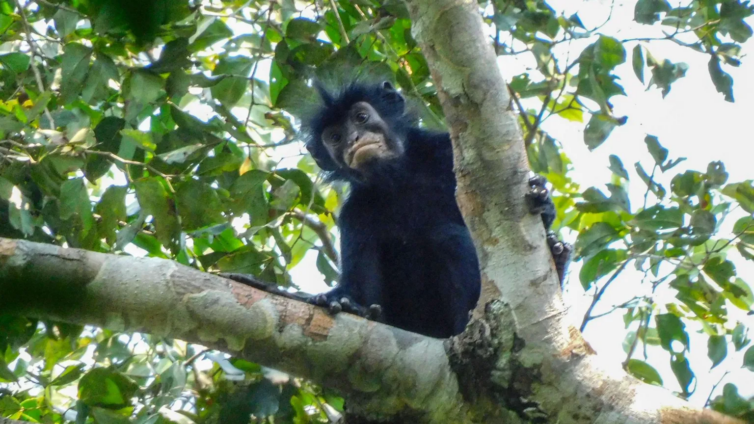
A monkey that has striking pinkish-orange lips and a black face - and lives in the forests of the Democratic Republic of Congo - has been confirmed as a new species to science.
The black-furred primate was spotted and photographed hidden away in the high tree canopy of dense tropical forests in Lomami National Park, in the central east of the country.
Conservationists working there first reported seeing this unusual-looking animal back in 2008. But they captured just one blurry photograph.
After another sighting 10 years later, an international team set out to find and study the monkey and revealed that it was a previously unknown species.
This is only the fifth African monkey species to be discovered in the last 75 years.
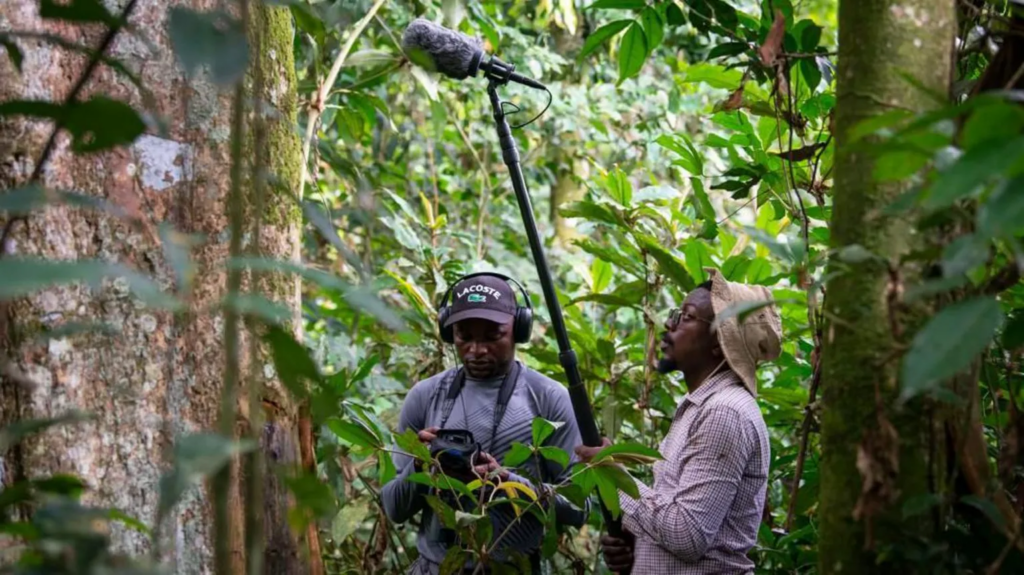
Junior Amboko, a PhD student at Florida Atlantic University, played a leading role in the search, which involved audio recordings, photography and detailed genetic studies.
The findings were published in the journal PLoS One.
Amboko told BBC News it was an "amazing feeling" to look into the face of an animal that so few people knew existed.
Secretive species
"Discovering" a species, in this context, means officially recording and confirming it has evolved to be genetically distinct. Some local people already knew of the monkey's existence and refer to it by a common name - Likweli.
But Amboko said the monkeys were "kind of shy" - and tended to hide high in the trees.
"As part of our search, we interviewed people in 52 villages close to where the animals live. And only people in eight villages [had ever seen] them," he recalled.
The research team - from DRC, the US and Germany - gave the animal the Latin name Colobus congoensis in recognition of the natural diversity in the country.
It belongs to the larger group of colobus monkeys. "These are really important African monkeys that don't have thumbs," explained Prof Kate Detwiler from Florida Atlantic University.
"They're these herbivores of the canopy that are a critical part of the ecosystem. We think they have a lot to do with processing seeds and germination in the forest."
Prof Detwiler speculates that their unusual, bright facial markings could be a visual signal to other animals, potentially attractive to a mate or that it could allow the animals to identify each other.
The monkeys also have a distinctive "roaring" call. "You often hear them, but don't see them," said Amboko.
They think the animals are rare and restricted to a part of the forest where they can find the food and habitat they need.
The animals are hunted for meat, so the researchers hope that now that Colobus congoensis is classified as a distinct species it can be officially protected.
The researchers say they still have a lot of questions about this newly described, secretive species. They plan to carry out a more detailed survey to estimate their population and study their behaviour.
Latest Stories
-
Nigeria launches rescue after military plane crashes with 32 aboard
2 minutes -
GES digitalisation already exists; restore discontinued platforms – Adutwum spokesperson
2 minutes -
Police launch manhunt for 7 after deadly Bunkprugu violence
4 minutes -
GTEC directs UDS to immediately cease unauthorised mode of delivering accredited LLB programme
8 minutes -
We must address the role of boys in impregnating young girls, not just blame girls – Kobby Kyei
10 minutes -
Mahama grants presidential pardon to 863 convicted persons
20 minutes -
Tema Central MP assaulted my driver – Ebi Bright alleges
36 minutes -
Gbande’s arrest directive confirms NPP’s claims of selective justice – Miracles Aboagye
48 minutes -
US to announce $150 million for Alaska power lines as Vance campaigns in Senate battleground
48 minutes -
Two CHPS compounds, educational facilities under construction in Keta – MP
51 minutes -
Not every difficult season means you’re in toxic love – Counsellor Adofoli explains
53 minutes -
Badminton: Ghana wins bronze, two silver medals at All Africa U-19 Champs
58 minutes -
Black Star Experience announces national choral music contest to discover new Ghanaian talent
1 hour -
Melcom serves 1,000 meals to children in selected orphanage homes
1 hour -
Miracles Aboagye questions Mustapha Gbande’s authority to direct EOCO arrest of Manhyia South MP
1 hour