

Audio By Carbonatix
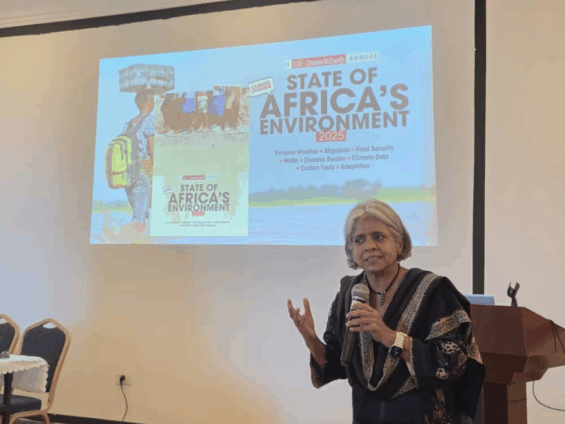
A new report by the Centre for Science and Environment (CSE) in India, titled “State of Africa’s Environment Report 2025”, has painted an alarming picture of Africa’s climate and environmental future.
The report released today in Ethiopia warns that the continent is facing its most devastating five-year period yet, as weather, climate, and water-related disasters intensify.
The 152-page report highlights that between 2021 and 2025, Africa experienced unprecedented losses—marked by rising temperatures, deadly floods, prolonged droughts, and food system shocks.
Africa’s climate crisis is intensifying. In only 15 years, extreme weather has touched the lives of 412 million people, with over half of those cases concentrated in the past five years. Since 2021, more than 41,500 deaths have been recorded, while droughts alone have devastated 178 million lives.
For instance, in Kenya and Ethiopia, repeated droughts have left pastoralist communities unable to feed their herds, wiping out livelihoods and forcing mass migrations. In West Africa, flash floods in Nigeria and Ghana submerged entire communities, displacing families overnight.
Director of CSE, Sunita Narain, said it is time to fulfill commitments, take responsibility, and bring others into the fight against global environmental challenges driven by climate change.
The report warns that Africa could face the world’s highest rate of climate-related displacement if urgent measures are not taken. Nearly 265 million people were forced into internal migration in the past year alone, and projections show up to 5 per cent of Africa’s population of some two billion people could become environmental migrants by 2050.
Director of the Addis Ababa Liaison Office to the AU and UNECA, Dr. Rita Bissoonauth, emphasized that climate change is not only an environmental crisis but also a question of inequality.
She called on journalists to “humanize climate stories, track financing, and amplify local solutions,” noting that the communities hardest hit are often those least responsible for the crisis.
Experts stressed the importance of turning Africa’s vulnerabilities into strengths. Director General of Ethiopia’s Bio and Emerging Technology Institute, Professor Kassahun Tesfaye, highlighted the potential of a sustainable bioeconomy that harnesses Africa’s crops, forests, livestock, and microorganisms within a circular, regenerative system.
While the continent bears the heaviest costs of a crisis it did little to create, the report says, it is also uniquely positioned to lead with homegrown solutions.
Latest Stories
-
Mobile Money Fintech LTD, UMB train hairdressers and beauticians
32 minutes -
Asylum votes show people want help, says Kemi Badenoch
2 hours -
Badenoch welcomes expanded grooming gangs inquiry
2 hours -
GACL MD sues Samuel Buabeng over alleged Facebook defamation
2 hours -
Christa Pike in critical condition after surviving two lethal injections, lawyer says
2 hours -
Kemi Badenoch backs face covering ban at protest
2 hours -
Man City not ‘above the rules’, says No 10 after backlash to Burnham remarks
2 hours -
Real Madrid submit ‘substantial’ dossier in Barca payments case
2 hours -
Messi completes purchase of second Spanish club
2 hours -
Government must engage horticulturists on tomato crisis – GhIH
3 hours -
King Promise’s ‘Can’t Tame Us’ becomes official Chelsea anthem
3 hours -
Afenyo-Markin demands Baffour Awuah’s release from EOCO’s custody, end to alleged political intimidation
3 hours -
Rapper Rick Ross arrested on domestic violence charges
3 hours -
Minority demands security review of Ghana-Colombia visa waiver and port deals
3 hours -
Pursue drug kingpins, not persecute political opponents – Afenyo-Markin tells EOCO
3 hours