

Audio By Carbonatix
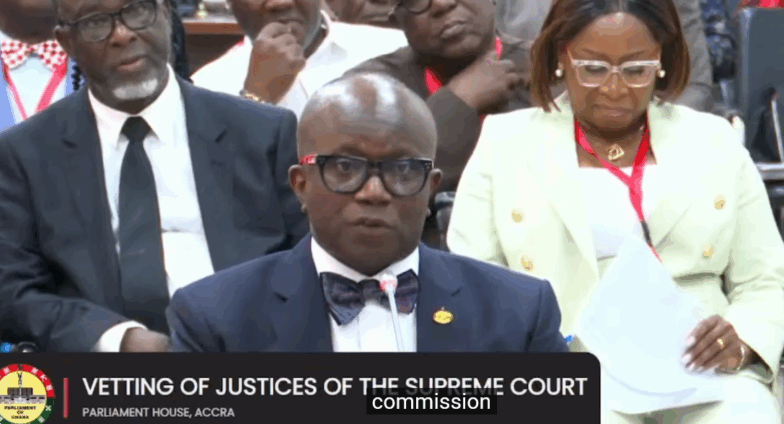
Supreme Court nominee, Justice Eric Kyei Baffour Ackaah-Boafo, says the country’s justice system must not tolerate arrests that are not supported by proper investigations and credible evidence.
Appearing before the Appointments Committee of Parliament on Friday, June 20, Justice Ackaah-Boafo was responding to questions on his previously stated legal opinion criticising the police for arrests made solely on the basis of association or unverified claims by co-accused persons.
“My view is that there is a need to have proper investigations and not a co-arrestee's say-so be the basis for prosecution,” he stated.
Referring to a case in which he gave a concurring opinion, he explained: "Apart from those who were arrested with him, saying that he was part of us, there wasn’t any investigation that was conducted to link the individual. These statements were actually not repeated in court apart from a caution statement.”
Justice Ackaah-Boafo stressed that arbitrary arrests, especially those not backed by credible evidence, undermine public trust in law enforcement and the justice system.
Asked how the judiciary can prevent arrests used to settle personal scores or suppress dissent, he said, “The only way the judiciary can confront this is when presented with a compendium of evidence, assess it and say that there was no basis for this arrest and no basis for the prosecution. If ultimately there’s no evidence, there’s no evidence.”
On institutional reforms needed to prevent abuse of police powers, the nominee urged the Attorney General’s Department and prosecutorial services to develop clearer ethical and operational guidelines for investigators.
“These guidelines ought to come from the Ministry of Attorney General and the prosecutorial services. In other jurisdictions, no matter the charge, if a matter has been unduly delayed, it could be stayed. Should someone stand trial for five years without calling any evidence? These are conversations that we can have,” he added.
Justice Ackaah-Boafo also acknowledged that until a case is formally filed in court, the judiciary’s power to intervene in investigative excesses is limited, but emphasized the need for broader legal reforms to uphold justice and human rights.
Latest Stories
-
51,000 teachers’ promotion arrears to be validated for October payment – Education Minister
26 minutes -
Kwabena Boamah appointed Board Chair for Impact Investing Ghana
33 minutes -
Striking teacher unions to meet Fair Wages and Salaries Commission on October 6
47 minutes -
EOCO working with AG to arraign Nana Baffour Awuah before weekend court
51 minutes -
Duraplast reassures customers after fire, announces October 5 reopening
59 minutes -
Call off strike, gov’t will not renege on promotion arrears pledge – Haruna Iddrisu appeals to teacher unions
1 hour -
Committee set up to validate teachers eligible for 20% deprived-area allowance – Education Minister
1 hour -
Five-member committee to search for new Black Stars coach after Sports Ministry-GFA meeting
2 hours -
Pinktober: Breast cancer survival exceeds 90% when detected early – Breast Society of Ghana
2 hours -
TCDA to adopt Upper West’s MATCO mango farm as northern prototype, issues warning against felling shea trees
2 hours -
‘Fear delegates’ tag: Afoko touts genuineness among delegates ahead of NPP delegates conference
2 hours -
John Boadu: The leader our party needs at this time – Amb. Edward Akwasi Boateng
2 hours -
Baffour Awuah: EOCO arrested, detained MP after hours of waiting, questioning – Afenyo-Markin
2 hours -
EOCO court warrant authorised search of Baffour Awuah’s law firm, not residence – Afenyo-Markin
3 hours -
NPP delegates conference: 3,000 to 4,000 police personnel deployed for security in Kumasi – Anthony Karbo
3 hours