

Audio By Carbonatix
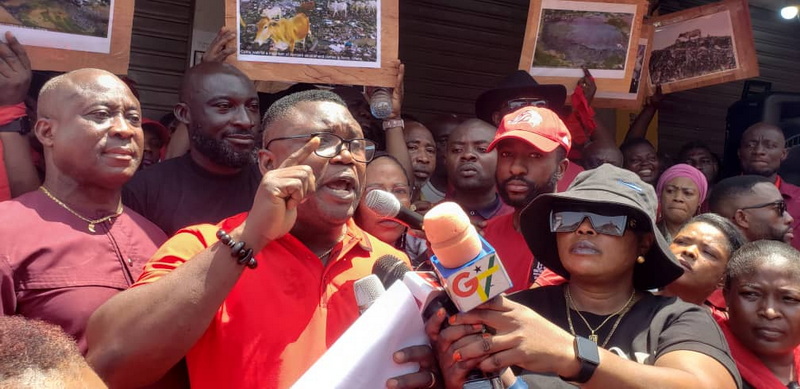
Members of the Ghana Used Clothing Dealers Association on Wednesday organised a sit-down strike to protest against OR Foundation over its claim that the association’s business is a form of waste that poses a danger to people.
The association, which is a member of the Ghana Union of Traders Association (GUTA), warned the foundation and its local collaborators to stop negative campaigns against their business because second-hand cloth dealership is a globally recognised business.
The foundation, under its Stop Colonialism campaign, published an article on its website which says Kantamanto sees 15 million garments every week, and 40% of the average bale leaves Kantamanto as waste, causing a public health crisis and destroying livelihoods and the environment.
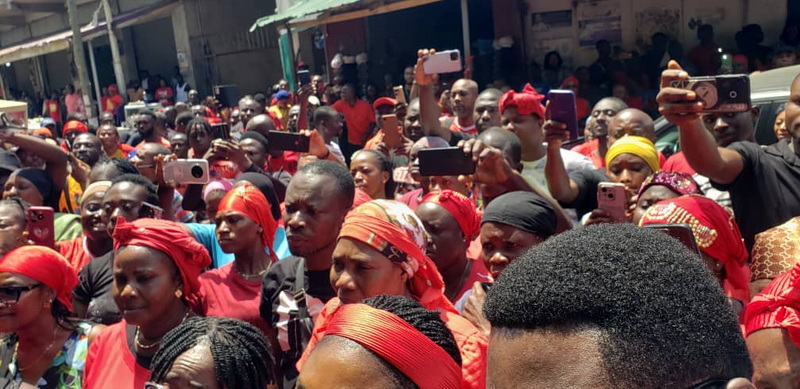
The association rejected that claim, describing the widely circulated report as not only misleading but an attempt to collapse the thriving used clothing industry in Ghana.
To counter that claim, the association, with the support of its mother organisation, the Ghana Union of Traders Association (GUTA), embarked on a sit-down strike to show their anger about the development.
In an interview, an executive member of the association, Mr Aikins Boakye Mensah, said the OR Foundation has, over the years, circulated inaccurate and damaging reports that portray the Kantamanto Market and Ghana’s secondhand clothing trade as a dumping ground for textile waste.
“They’ve claimed in international publications that over 15 million garments enter Kantamanto weekly and that 40% end up as waste. We find these figures highly exaggerated, misleading, and not representative of the realities on the ground,” he said.
Mr Mensah stressed that the majority of used clothing imported into Ghana is sorted, reused, reworked, and resold, forming the backbone of a circular economy that sustains more than 30,000 direct traders and over 100,000 livelihoods.
These include head porters (kayayei), tailors, truck pushers, transport operators, loaders, and food vendors, who operate daily around the Kantamanto Market.
He added that the used clothing trade is not a waste problem, but a livelihood solution, providing affordable clothing for millions of Ghanaians and employment for thousands of families.
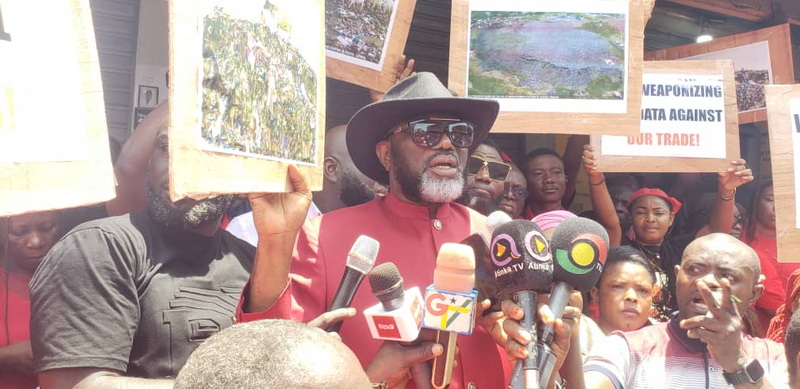
Addressing the media, the President of the Ghana Union of Traders Association (GUTA), Dr Joseph Obeng, said any attempt to ban second-hand clothing will cause GUTA to embark on nationwide demonstrations.
Dr Obeng disclosed that the traders’ union is putting things together to go into the recycling of second-hand clothing.
“The OR Foundation’s portrayal of our trade as a global environmental hazard is not only an attack on the dignity of hardworking Ghanaians, but also an attempt to undermine a vibrant sector of the informal economy,” he said.
He further emphasised, “The OR Foundation does not speak for us, nor do they represent our lived experiences or interests. We reject the portrayal of Ghana as a global dumping site — it is false, harmful, and disrespectful.”
Mr Mensah called on the government, civil society organisations and Ghana’s development partners to independently investigate the claims.
He therefore urged the media to engage the leadership of the association concerning their activities.
OR Foundation is a public charity in the USA and a registered charity in Ghana that has been operating in both countries since 2011.
Working at the intersection of environmental justice, education and fashion development, its mission is to identify and manifest alternatives to the dominant model of fashion – alternatives that bring forth ecological prosperity, as opposed to destruction, and that inspire citizens to form a relationship with fashion that extends beyond their role as consumer.
Its goal is to catalyze a justice-led circular economy. There are many layers to this work, including immediate relief through direct action on human rights and environmental abuses, educational programming and awareness in order to shift individual actions, and research and institutional advocacy to steer systems-level policies and investments.
Latest Stories
-
It was humiliating, who takes another country’s medical records? – Mahama on Ghana’s rejection of US health compact
3 minutes -
Mentorship critical to survival and growth of MSMEs – Sinapi Aba Trust
4 minutes -
Nsawam Adoagyiri MP joins residents to oppose Agbogbloshie waste relocation to his constituency
16 minutes -
New monitoring system rolled to step up fight against child labour in Ghana
17 minutes -
Patrick Donkor
19 minutes -
GHS, Oxfam sensitise young people in Ekon on contraception, reproductive health to mark World Contraception Day
20 minutes -
Let private sector drive economic transformation – Alan Kyerematen
23 minutes -
GoldBod changes gold assay regime, makes XRF testing definitive from October 1
27 minutes -
Ghana sees geopolitical tensions as opportunity to end dependence – Ablakwa
29 minutes -
Empower community radio stations to strengthen public engagement – Former Sports Minister
38 minutes -
La Dade-Kotopon MP calls for Ga language programmes in schools and on radio
38 minutes -
Families welcome guilty verdict over Mali crash that killed 116
38 minutes -
Until we see concrete action, we will stay home – Striking teachers
41 minutes -
Studio 7 Clinic & Med Spa marks 10 years with ‘Beyond the Mirror’ event
46 minutes -
AmaliTech and Ghana TVET Service partner to enhance digital skills training in Western Region
51 minutes