

Audio By Carbonatix
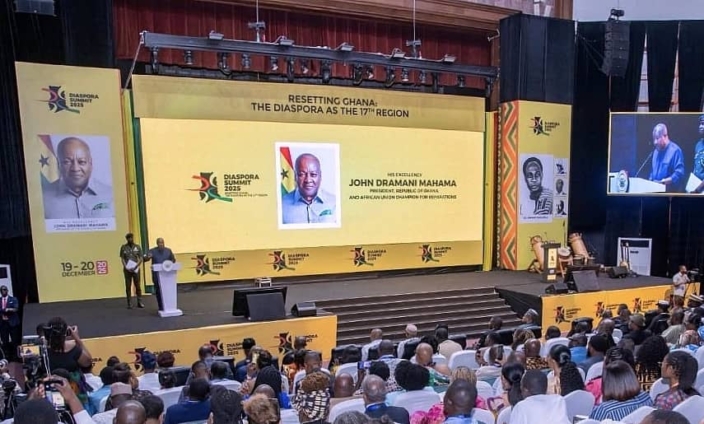
The Diaspora Summit, held on 19–20 December 2025 at the Accra International Conference Centre, reaffirmed reparatory justice as a central political question confronting Africa and its global diaspora. Beyond symbolism, the summit revealed a growing convergence among continental actors, Caribbean reparations movements and Pan-African political organisations committed to historical accountability and material redress. Within this political space, the Pan-African Progressive Front (PPF) intervened as an organised force seeking to translate moral claims into concrete political demands.
One of the most substantive contributions came from Mr Arley Nichau Salimbene Gill, Chairman of the Grenada National Reparations Committee, who spoke on behalf of CARICOM. Situating reparations within a long historical frame, Gill stated that “the Atlantic slave trade and chattel slavery perpetrated against our African ancestors were crimes against humanity.” He argued that the destruction of African societies across the continent, the Americas and the Caribbean produced lasting structural harm “that needs to be repaired”, and insisted that “the cost of this repair must be borne by those who did it”.
Gill rejected narratives that frame reparations as dependency or charity. “We are not sitting idly by waiting for anyone to help us. We are a proud and dignified people,” he said. At the same time, he stressed that self-determination does not negate historical obligation. “Just because we aspire to look after ourselves, that does not mean that the debt owed to us must not be paid.”
Referring to the CARICOM Ten-Point Plan, Gill outlined concrete demands: a full and formal apology; repatriation for members of the diaspora who wish to return; restitution of stolen cultural property; repair of public health and education systems; debt forgiveness; technology transfer; psychological healing; and monetary compensation. He emphasised that healing requires acknowledgement. European states, he argued, must admit the crimes committed, express sincere remorse, commit to non-repetition and seek forgiveness.
These positions closely aligned with the political direction advanced by the Pan-African Progressive Front during the summit. The PPF used the occasion to consolidate a clear argument: reparations are not a moral appeal or a symbolic gesture, but a political demand arising from historical crime, material extraction and an international system that continues to reproduce inequality. This position was formally articulated in the Special Accra Declaration on Reparatory Justice, adopted at a conference convened by the PPF in November this year to commemorate the 80th anniversary of the historic Manchester Congress. The declaration calls for the establishment of a reparations fund, the return of stolen resources and cultural heritage, the cancellation of illegitimate debts, and the creation of binding international mechanisms to enforce reparatory justice.
The summit took place against a backdrop of renewed state-level engagement on the issue. Earlier this year, at the 80th United Nations General Assembly, President John Dramani Mahama described slavery as one of the greatest crimes against humanity and committed Ghana to submitting a motion at the United Nations to formalise this recognition. Gill welcomed this intervention, observing that “Africa’s call for reparatory justice is no longer a whisper; it is a unified demand.” At the same time, the summit underscored the continued role of organised movements in pushing states beyond declaration towards action.
Within this political context, a coordinating member of the Pan-African Progressive Front used the summit to advance a grounded Pan-African position on reparations. Kwesi Pratt Jnr., also a coordinating member of the PPF, served as a panellist on the session titled “Reclaiming the African Future: The Quest for Reparative Justice and Healing.” His intervention situated reparations within political economy and historical struggle, arguing for organised Pan-African resistance—rather than elite diplomacy—as the pathway to justice.
The PPF also extended its engagement beyond the formal sessions. As part of its political outreach, the organisation presented a copy of Pratt’s book on reparations to Fred Hampton Jr. and Benjamin Crump, reinforcing reparations as a transnational justice project that connects African struggles with the Black radical tradition and contemporary legal battles against racial capitalism.
As Gill concluded in his address, the struggle for reparatory justice must be waged “standing on our feet and not on our knees.” The Accra Diaspora Summit demonstrated that reparations are no longer confined to rhetorical acknowledgement. Through deliberate political intervention, ideological clarity and organised Pan-Africanism, the Pan-African Progressive Front is contributing to the transformation of reparations from historical grievance into a programme of collective action.
Latest Stories
-
Conflicts among care providers linked to maternal, neonatal deaths – Expert
55 minutes -
GIS marks 10th TIME conference, champions improved teaching practices
1 hour -
BRICS Or Balance? What Ghana’s bid really means
1 hour -
GPRTU wants full TRAFFITECH-GH implementation to start in 2027
2 hours -
Mahama announces plans to import electric wheelchairs for PWDs
2 hours -
KGL U17 Colts 2026: Western beat Prempeh Elite Academy to set up final final with Greater Accra Region
2 hours -
Late Solanke strike salvages 10-man Spurs draw at Man United
2 hours -
Gender Ministry to monitor welfare of Nana Akua Addo’s children amid domestic violence case
2 hours -
Benedict Okyere Yeboah: Ghana’s football problem goes beyond sacking a coach
3 hours -
GPL 2026/27: Darkwah Wiafe’s winner sees All Blacks beat Kotoko
3 hours -
ITF World Tour : Patel Wins Boys’ Singles Final at J100 Accra
3 hours -
Ghana must pursue BRICS partnership if it brings economic benefits – Kpebu
3 hours -
Success and Wright Claims J100 Accra Girls’ Doubles Championship
3 hours -
ITF J100: America’s Wright wins J100 Accra Girls’ Singles Title
3 hours -
Expedition hopes to find aviator Amelia Earhart’s plane on remote island
3 hours