

Audio By Carbonatix
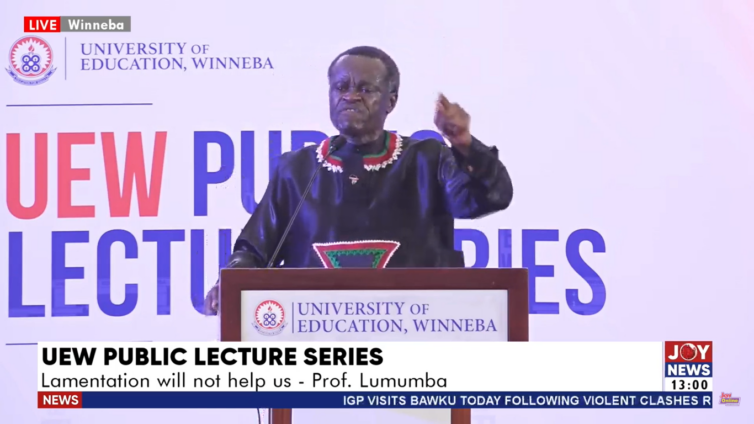
Pan-Africanist, legal practitioner and governance expert, Prof Patrick Loch Otieno Lumumba, has attributed the persistence of illegal small-scale mining, popularly known as galamsey, to failures in governance.
He cautioned that delays in addressing the issue are intensifying both environmental and human costs.
Speaking at a virtual environmental conference organised by the Institute of Governance Ethics and Religion (IGER-AFRICA) on Friday, December 5, Prof Lumumba highlighted the extensive damage galamsey is causing to water bodies, farmlands, and livelihoods, emphasising the need for urgent, emergency-level interventions.
The conference, held under the theme, “Navigating the Challenges of Illegal Mining in Ghana: Impact on Individuals, Communities, Health and Policy,” explored the societal and ecological consequences of unregulated mining practices.
Prof Lumumba noted that the lure of quick money has driven many away from productive employment and into illegal mining, with serious long-term repercussions for society.
He warned that unrestrained exploitation is degrading soil quality and the food chain, ultimately leaving everyone worse off.
“The time is now for us to do the right thing,” he said, stressing that delays only exacerbate the crisis.
He further urged governments to move beyond rhetoric, insisting that “results, not intentions, must be used to judge policies and laws.” He added that governments elected on promises to combat illegal mining must be held accountable for delivering measurable outcomes.
“This problem needs to be treated as an emergency,” he noted, asserting that effective implementation, rather than policy pronouncements, constitutes the true test of leadership.
Prof Lumumba also framed the discussion within the broader African mining sector, arguing that foreign dominance has left many countries without control over their natural resources.
“If you come to Ghana, the top mining companies are not Ghanaians. The same is true in the DRC, Botswana, Namibia, South Africa and Nigeria,” he said, emphasising the limited local influence over mining agendas.
He questioned why illegal mining continues to thrive despite ostensibly robust legal frameworks and policy commitments, pointing out that environmental destruction linked to galamsey persists in Ghana despite laws designed to regulate the sector.
“The question we must ask is: what is the problem?” he said.
IGER-AFRICA, the organisers of the conference, promote ethical leadership, good governance, and interfaith dialogue to advance peace, social justice, and sustainable development across Africa
Latest Stories
-
Inflation to average 11.3% in 2027 – Fitch Solutions
22 minutes -
I didn’t campaign for NDC to come and do this nonsense – Kpebu on EOCO
23 minutes -
Fitch Solutions maintains its policy rate forecast of 14% by December 2026
29 minutes -
Diaspora Nasara Caucus congratulates Mohammed Ali Suraj, new NPP executives
2 hours -
Dr Antwi-Boasiako’s cybersecurity book showcased at UN crime prevention congress
2 hours -
We will empower the grassroots and protect every vote – NPP’s 1st Vice Chair Kojo Bamba
2 hours -
I do not see myself as better than anyone – NPP’s 1st Vice Chair Kojo Bamba
3 hours -
Police blur the line between invitations and arrests – Reindorf Twumasi Ankrah
3 hours -
Turning invitations into arrests is making citizens reluctant to assist police – Twumasi Ankrah
4 hours -
The Traffitech-GH SMS spot-fine system: The good, the sad, and the funny – Bright Simons writes
4 hours -
Hawa Koomson pledges experienced and mature leadership of NPP women’s wing
5 hours -
Young woman found dead at Kasoa Peace Town
6 hours -
Playback: The Law examined lawful arrest in Ghana
6 hours -
Mahama urges African governments to treat healthcare as an investment, not budget cost
7 hours -
Bawumia congratulates John Boadu and new NPP executives, pledges support ahead of 2028
7 hours