

Audio By Carbonatix
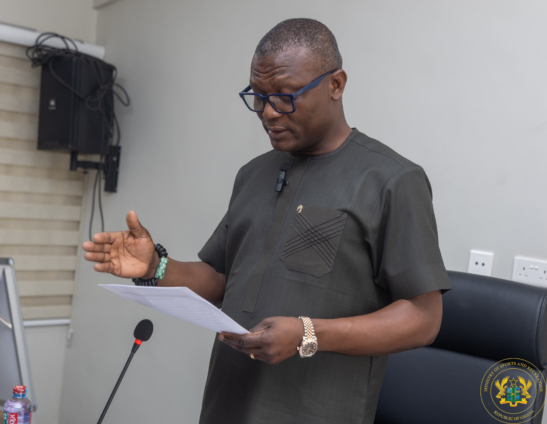
Sports and Recreation Minister Kofi Adams has defended proposals to channel a percentage of athletes’ earnings into Ghana’s proposed Sports Fund.
According to him, the move is a strategic investment designed to significantly increase the long-term value of Ghanaian sports talent.
The proposal has attracted criticism from sections of Parliament, including former Sports Minister Mustapha Ussif, who argues that the model is not feasible because many athletes already earn modest incomes.
Similar concerns have been raised by the President of the Ghana Weightlifting Federation, who fears the deductions could burden athletes.
But speaking in an interview with Muftawu Nabila Abdulai, Adams said the criticism misunderstands both the intent and structure of the fund.
“How can that be problematic? That they are asking that the work that you do, which we the fund is going to enhance, as a result of the enhancements that will be coming, you must also continue to contribute," Adams said.
He explained that: “What the sports fund is going to do is going to make sure that there will be data-driven decisions.
"It will invest in research. They will invest in technology. They will invest in innovation.”
He stated that the fund will prioritise areas he believes Ghana has historically underinvested in, to the detriment of its athletes.
"So an athlete or a football person, let me put it that way so people understand. When you use athlete, people think that you are only referring to those runners. But it's not just track and field. I'm talking reference including footballers. You see, you transfer a footballer to sometimes a third rated team say Europe.
“When you transfer a footballer to sometimes a third-rated team in Europe, in a few months the value suddenly shoots up,” the Buem MP explained.
“Not because the player has suddenly become faster or more skilful, but because data has been built around that player and used to sell him.”
The minister argued that Ghana’s failure to invest in sports data and analytics means local athletes are often transferred at undervalued rates.
“We don’t do that because we haven’t invested in such areas. The Sports Fund is going to create a funding line for us to invest in research, invest in innovation, and invest technology. So even the first transfer of an athlete, if we so desire, the value will be very high. That is value addition.”
Drawing parallels with Ghana’s traditional export model, Adams likened the current system to exporting raw materials without processing.
“It's like what we used to do by sending our cocoa beans raw. And then they will go and make chocolate and bring it to us to buy for high. Or our gold, we carry everything raw, then it will be processed into all kinds of things, ornaments, and then they will bring it for us to buy.
“You observe that when we started adding value, we started getting a lot more. That is what the fund is going to do to our athletes..”
He stressed that athletes would not be the primary source of funding, and that any contribution from transfers would be minimal and indirect.
“Contributing a little—not a major amount—will let you also appreciate what your country has done for you.
“The country builds the pitches you play on, provides infrastructure, and supports development.”
He dismissed claims that athletes themselves oppose the idea.
“I believe the sports people themselves are happy. Those talking don’t know what it is that they go through,” he added.
Adams further clarified that deductions would be made through existing transfer mechanisms, not directly from athletes’ pockets.
“Already, club owners and federations get a percentage when transfers happen. Is that wrong?” he asked.
“So what is wrong with a country that builds the infrastructure? And the country that is going to be investing in school sports more for all these talents to be identified. What is wrong if part of what comes in is also contributed into the fund?
And do you want oil farmers to contribute into the fund that is going to support athletes?”
When quizzed whether there's an arrangement with the GFA on how to get players contribute, and what percentage he was looking at, government will find way of getting the contribution, and there was no specific percentage under consideration.
"Well, how does FA get their percentage? Same medium will send it directly then? How the FA gets, government will use same medium to get the players to contribute.
“Is FIFA coming to build all the stadia that we use in this country?” he questioned. “If we tell FIFA that this is how we want to develop our infrastructure and this is what our law provides, I don’t think they would refuse it.”
Latest Stories
-
GPRTU wants full TRAFFITECH-GH implementation to start in 2027
49 seconds -
Mahama announces plans to import electric wheelchairs for PWDs
5 minutes -
KGL U17 Colts 2026: Western beat Prempeh Elite Academy to set up final final with Greater Accra Region
23 minutes -
Late Solanke strike salvages 10-man Spurs draw at Man United
33 minutes -
Gender Ministry to monitor welfare of Nana Akua Addo’s children amid domestic violence case
40 minutes -
Benedict Okyere Yeboah: Ghana’s football problem goes beyond sacking a coach
49 minutes -
GPL 2026/27: Darkwah Wiafe’s winner sees All Blacks beat Kotoko
55 minutes -
ITF World Tour : Patel Wins Boys’ Singles Final at J100 Accra
1 hour -
Ghana must pursue BRICS partnership if it brings economic benefits – Kpebu
1 hour -
Success and Wright Claims J100 Accra Girls’ Doubles Championship
1 hour -
ITF J100: America’s Wright wins J100 Accra Girls’ Singles Title
1 hour -
Expedition hopes to find aviator Amelia Earhart’s plane on remote island
1 hour -
US seeks changes to rejected $109m health compact with Ghana – Mahama
2 hours -
Nine dead in mass shooting at Pennsylvania home
2 hours -
‘Time for Ukraine to get new president,’ says Trump after Zelensky condemns diesel deal
2 hours