

Audio By Carbonatix
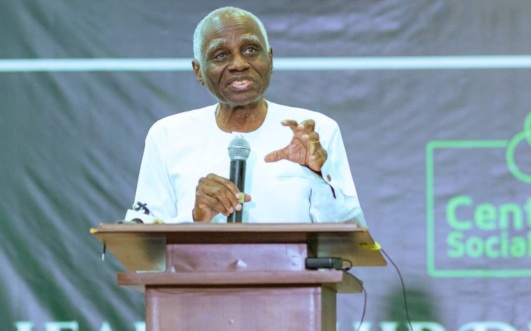
Renowned legal practitioner Tsatsu Tsikata is worried about what he describes as a worrying decline in public confidence in Ghana’s judiciary.
According to him, this situation has the propensity to trigger dire implications for the country’s democratic framework.
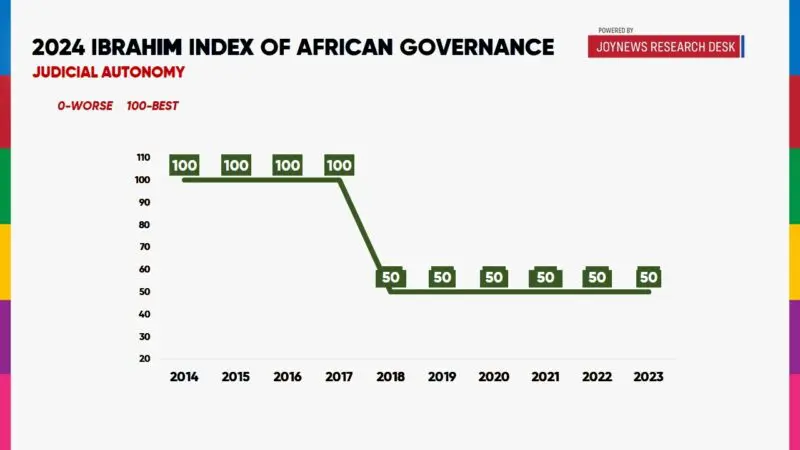
His comments come amid findings from the 2024 Mo Ibrahim Index on African Governance, which reported a stark drop in Ghana’s judicial autonomy from 100% to 50% over the past seven years, reflecting a significant shift in perceived judicial independence.
Speaking on Accra-based GHOne TV, Mr Tsikata explained the broader impact of this perception on the legal profession and the overall adjudication process.
“If people lose confidence in the judiciary, it is also a loss of confidence in the legal profession,” he noted.
“The judiciary is made up of individuals who have risen through the ranks of the legal profession, and when confidence in the judiciary wanes, it directly impacts the entire process of adjudication, which is what lawyers practice in the court.”
Tsatsu Tsikata highlighted a troubling public perception that aligns the judiciary’s decisions with the ruling New Patriotic Party (NPP), warning of the potential consequences.
“There’s a perception that the judiciary is acting in favour of the NPP,” he said, noting that this perception is becoming a common talking point among citizens.
“Ordinary citizens jokingly refer to the judiciary as a ‘unanimous football club,’ deciding cases in favour of one side. This creates a dangerous precedent where people lose faith in the judicial process altogether.”
He cautioned that allowing such perceptions to grow unchecked could erode the credibility of the judicial system, impacting both democracy and the administration of justice in Ghana.
During a recent youth engagement, the Vice President and New Patriotic Party’s presidential candidate, Dr. Mahamudu Bawumia highlighted that Ghana ranks as the seventh-best-governed country in Africa, according to the Mo Ibrahim Foundation.
- Read also: Ghana’s judicial impartiality index drops by 30% between 2017 and 2023 – Mo Ibrahim Foundation
Yet a closer look at the data from the Mo Ibrahim Foundation revealed the troubling trend in judicial independence—a key pillar of democratic governance.
The index shows that between 2014 and 2017, Ghana’s judiciary maintained a score of 100% autonomy. Starting in 2018, however, this rating dropped by half to 50%, where it has remained through 2023.
Judicial autonomy, as defined by the index, reflects the judiciary’s ability to interpret laws independently, free from political pressure or interference by other government branches.
The report’s findings come amid criticism from civil society groups, who point to the appointment of political actors to the judiciary and the remand of protesters as signs of potential influence on the courts.
The implications of the score drop are significant, suggesting a need for stronger safeguards around judicial independence.
Ensuring an impartial judiciary will be crucial to reinforcing public trust and is likely to become a focal issue in the run-up to the upcoming elections.
Latest Stories
-
President Mahama is not sincere with Ghanaians on LGBTQ bill matter – Hassan Tampuli
11 minutes -
Gov’t to establish Prison Industrial Hub to equip inmates with income-generating skills – Prison Service boss
29 minutes -
Alhassan Tampuli donates cement, roofing sheets to support storm victims in Gushegu
30 minutes -
Alhassan Tampuli appeals for urgent support for storm victims in Gushegu
33 minutes -
The hypocrisy must stop; pass Anti-LGBTQ+ Bill now – Alhassan Tampuli to Mahama
37 minutes -
Imprisonment should be rehabilitative, not punitive – Ghana Prisons boss at UNGA
58 minutes -
Ga Adangbe traditional priests petition Mahama over McDan aviation licence revocation
1 hour -
Anti-LGBTQ Bill: NDC’s arrogance is worrying – Hassan Tampuli
1 hour -
Let’s give OSP time to mature, not to scrap it – Hassan Tampuli
1 hour -
Nigeria convicts 386 Islamist militants in mass trials
1 hour -
Djibouti president wins election with 97.8% of vote, state media says
2 hours -
We don’t have mandate to deduct tax from rent allowance of security services personnel – Interior Ministry clarifies
2 hours -
Ablakwa receives Presidential Special Envoy on Reparations to advance global agenda
2 hours -
Christina Koch becomes first woman to travel around the moon on Artemis II
2 hours -
Epstein survivors’ calls to meet King Charles and Queen harder to ignore as US visit approaches
2 hours