

Audio By Carbonatix
The World Meteorological Organisation's (WMO) Executive Council has approved a Global Greenhouse Gas Watch (G3W) implementation plan to strengthen monitoring of heat-trapping gases which are driving climate change.
The plan will also facilitate data-driven decision-making for climate change mitigation strategies, adopting a phased approach that begins with a pre-operational phase from 2024 to 2027. The system will be developed on the foundation of the World Meteorological Organisation's (WMO) extensive experience in coordinating greenhouse gas research and observation efforts over the long-term.
Focus on top three greenhouse gases
The priority will be on three greenhouse gases most impacted by human actions - carbon dioxide (CO2), methane (CH4), and nitrous oxide (N2O). The approach considers both human and natural factors affecting atmospheric greenhouse gas levels.
According to the Chair of the Global Atmosphere Watch Programme, Greg Carmichael, speaking at the ongoing Executive Council meeting in Geneva, the Global Greenhouse Gas Watch is a culmination of extensive collaboration among experts over several years, enjoying robust backing from the scientific community specializing in greenhouse gases.
“Global Greenhouse Gas Watch is the result of a large teamwork that spans over several years and has strong support of the greenhouse gas science community,” Greg said.
The Global Greenhouse Gas Watch (G3W) supports WMO members in their Paris Agreement commitments by addressing key knowledge gaps and integrating all space- and surface-based observation systems, models, and data analysis tools under a single framework.
The Executive Council resolution stresses that any greenhouse gas monitoring should be conducted transparently, adhering to WMO's data policy that promotes free and unrestricted global sharing of Earth system data.
Record CO2 Concentrations
A recent report by researchers from the US National Oceanic and Atmospheric Administration and the Scripps Institution of Oceanography at the University of California, San Diego, underscores the importance of enhanced monitoring capabilities to support effective climate change mitigation strategies.
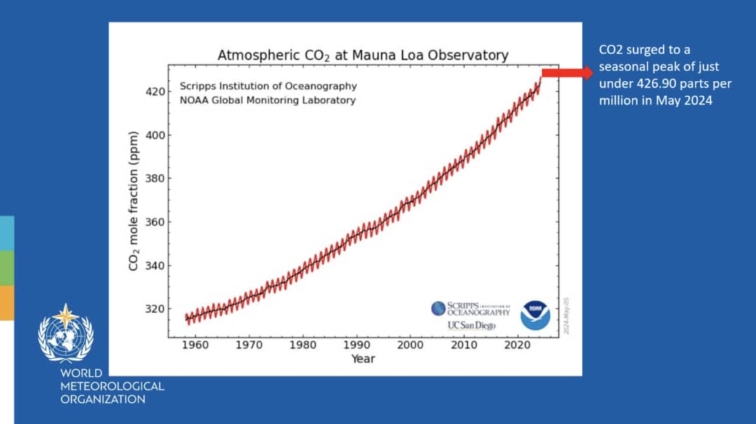
According to NOAA's Global Monitoring Laboratory, the Mauna Loa Atmospheric Baseline Observatory recorded a seasonal high of 426.90 parts per million (ppm) of CO2 in May, a 2.9 ppm increase from May 2023. This follows a 3.0 ppm rise from 2022 to 2023, making the two-year increase from 2022 to 2024 the largest ever recorded at the observatory.
Director of the Global Greenhouse Gas Watch (G3W), Gianpaolo Balsamo, emphasized that while CO2 levels are accurately measured at baseline observatories, more detailed and timely information is crucial to inform climate action.
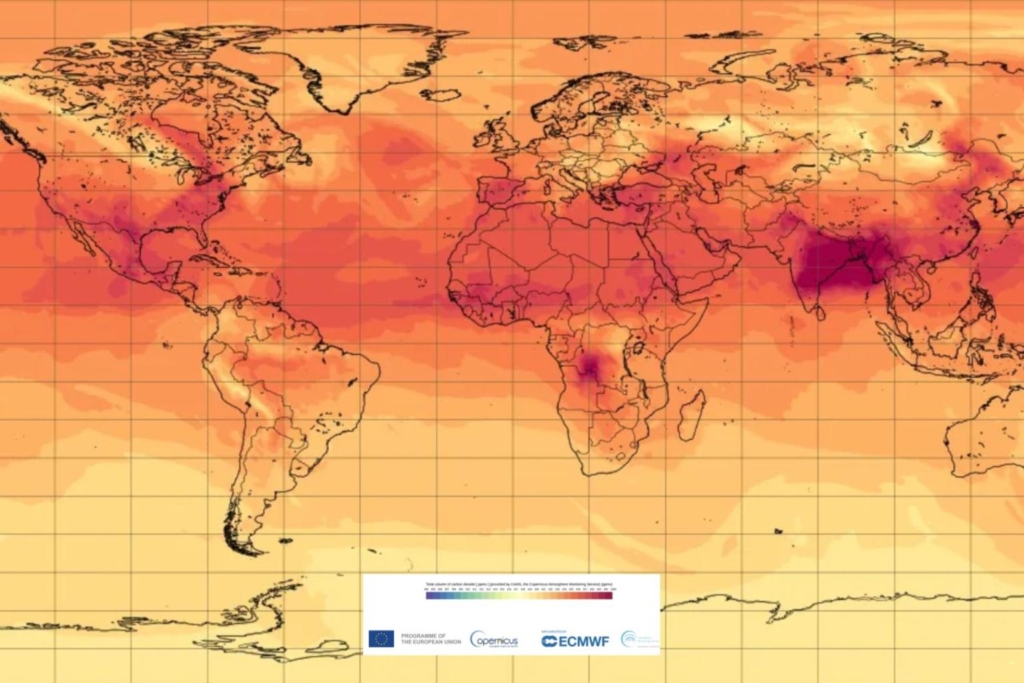
He stressed the need for monthly global maps of CO2 fluxes and concentrations with higher spatial resolution to provide actionable insights.
“The CO2 concentrations are well measured at the baseline observatories but to provide actionable information, more accurate and timely global maps of CO2 fluxes and concentrations are necessary at monthly frequency and with sufficiently resolved spatial details,” Gianpaolo said.
G3W to launch satellite network to track GHG emissions
The Global Greenhouse Gas Watch (G3W) plans to establish a network of surface-based monitoring stations and specialized satellites to pinpoint the location and timing of greenhouse gas emissions.
A team led by Greg Carmichael and Vincent-Henri Peuch, with support from the WMO Secretariat and ECMWF's Copernicus Department, developed the implementation plan. The WMO Infrastructure Commission (INFCOM) endorsed the plan in April, paving the way for its execution.
The Global Greenhouse Gas Watch (G3W) envisions a future beyond 2032 that aligns with the Paris Agreement's Enhanced Transparency Framework, providing regular progress assessments towards achieving net-zero emissions.
G3W aims to deliver practical insights that support countries in developing long-term strategies to reduce greenhouse gas emissions, guiding their Nationally Determined Contributions (NDCs) and fostering a low-emissions future.
Paris Agreement aims to limit global warming through GHG emissions reduction
In 2015, the Paris Agreement was adopted by 196 countries at the UNFCCC Conference of the Parties, setting specific goals to limit global warming and emphasizing the need to reduce greenhouse gas (GHG) emissions to achieve these targets. The agreement aims to restrict global temperature rise and promotes net reductions in GHG emissions as the primary means to achieve this objective.
The implementation plan seeks to enhance cooperation and coordination with WMO members, UN agencies, and international partners involved in greenhouse gas monitoring and modeling, leveraging their resources and ensuring equal access to WMO resources for all members. This includes facilitating the standardization of GHG monitoring data globally, enabling comparability across regions.
The plan emphasizes the importance of engaging with stakeholders at international forums, such as the UNFCCC's Conference of the Parties (COP), to promote the utilization of data and products generated by this infrastructure.
The Subsidiary Body for Scientific and Technological Advice (SBSTA) at COP28 in Dubai specifically recognized and addressed the WMO's initiative, highlighting its significance in the global response to climate change.
SBSTA acknowledged the launch of the Global Greenhouse Gas Watch initiative, which aims to establish a continuous and systematic global monitoring system for greenhouse gas concentrations and fluxes.
This initiative seeks to enhance the accuracy of tracking natural and human-generated greenhouse gas sources and sinks, and to supplement existing emission inventory reports, aligning with the guidelines established under the convention and the Paris Agreement.
Latest Stories
-
Kwaku Azar writes: A-G vs OSP
12 minutes -
Mfantsipim–Adisadel rivalry built excellence, not division – Sam Jonah
37 minutes -
Vice President launches Mfantsipim’s 150 years of shaping Ghana’s greatest mind
54 minutes -
I assure Otumfuo, Mahama will join him to commission KNUST Teaching Hospital by end of this year – Haruna Iddrisu
2 hours -
Gov’t to roll out free special education for persons with disabilities from July 1 – Education Minister
2 hours -
“We used it to test our officiating officials’ readiness” – Bawah Fuseini after CAA Athletics event
2 hours -
Volleyball emerges as Ghana’s fastest rising sport
3 hours -
National Sports Fund needs strong leadership from the top – Administrator David Wuaku
3 hours -
JoySports Exclusive: Steve McLaren in talks with GFA after expressing interest in Black Stars job
3 hours -
Fire guts auto parts warehouse at Bubuashie, one fire officer injured
3 hours -
I owe my victory to coach Ofori Asare – Allotey after winning WBA Africa Gold Super Flyweight belt
3 hours -
Church of Pentecost supports over 2,000 BECE candidates in Obuasi with career guidance seminar
5 hours -
Brandon Asante and Coventry all but promoted to Premier League despite Sheffield Wednesday draw
5 hours -
GPL 2025/26: Late Kwartemaa strike downs Hearts in Tema
5 hours -
Ghana Faces Sierra Leone Moment as Prosecutorial Powers come under strain
5 hours