


Audio By Carbonatix
A new survey by Global InfoAnalytics indicates a widespread belief among Ghanaians that the prices of goods and services will largely decrease within the next six months, signalling a robust sense of economic optimism among the populace.
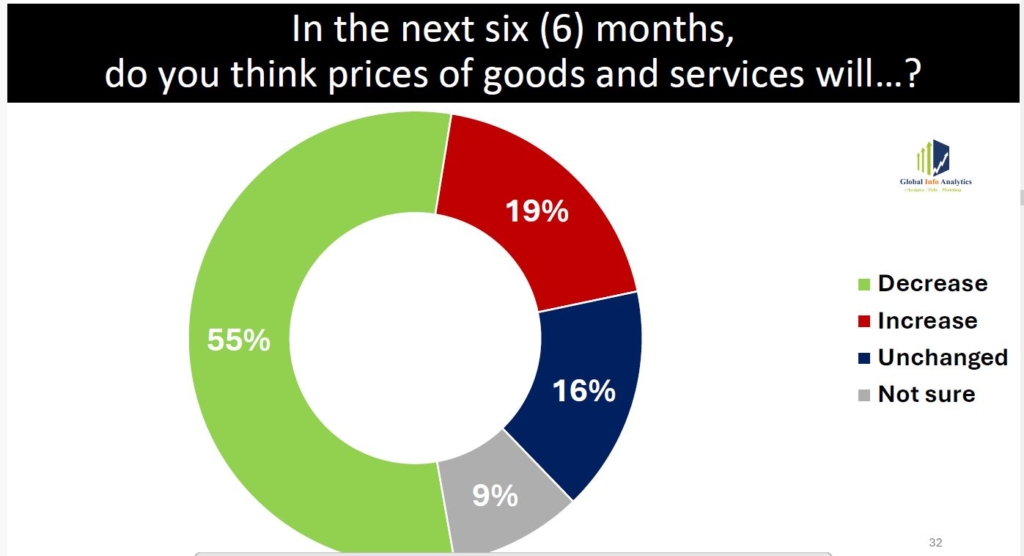
The poll, conducted by Mussa K. Dankwah, Pollster and Head of Research at Global InfoAnalytics, revealed that 55% of voters anticipate a decrease in the prices of goods and services in the coming half-year.
In stark contrast, only 19% expect prices to increase, while the remaining respondents either believe prices will stay the same or did not offer an opinion.
Furthermore, the survey highlighted a broader sense of future prosperity, with a significant 72% of voters expecting their standard of living to improve in the next 12 months, compared to just 16% who foresee a decline.
The online survey, conducted from May 10 to May 20, 2025, gathered responses from 1,092 individuals through probability random online sampling. It boasts a 99% confidence level with a margin of error of ±3.82%.
This strong wave of optimism is largely attributable to Ghana's recent macroeconomic successes. The Ghanaian Cedi has seen a remarkable appreciation, becoming one of the world's best-performing currencies in 2025, which directly impacts the cost of imported goods.
Ghana's inflation rate has also been on a consistent downward trajectory, reaching 18.4% in May 2025, its lowest level since February 2022.
This disinflationary trend has brought tangible relief to households by increasing their purchasing power.
Economic experts and international bodies like FocusEconomics and the African Development Bank (AfDB) have projected continued cooling of inflation throughout 2025, with some forecasting single-digit inflation by 2026.
The government's fiscal consolidation efforts under its IMF program, coupled with increased foreign exchange reserves driven by robust gold and cocoa exports, have contributed to a more stable economic environment.
While the government continues to implement policies aimed at easing the cost of living, such as the recent increase in Livelihood Empowerment Against Poverty (LEAP) grants to cushion vulnerable households against inflation, the public's confidence in future price stability appears to be significantly bolstered by the current economic trajectory.
The findings of this Global InfoAnalytics survey underscore a widespread expectation among Ghanaians that the positive economic trends observed in recent months will continue, leading to further improvements in their quality of life and a reduction in the burden of high prices.
Below is the detail of the survey.
Latest Stories
-
Trump says he will stop using taxpayer funds for ads after bipartisan pushback
59 minutes -
Nana Akomea explains why he ignored polls ahead of NPP election
1 hour -
‘Bamba’s message was clever, very clever’ – Akomea on NPP election upset
1 hour -
Nana Akomea reveals why he was disappointed after placing third in NPP election
2 hours -
Saudi Arabia urged to spare man sentenced to death over Facebook post
2 hours -
NPP to deliberately select candidates for orphan constituencies ahead of 2028 election
2 hours -
NPP wants early profiling of parliamentary candidates to avoid costly campaigns – Nana Akomea
3 hours -
At least 22 dead after two boats collide on Congo river, official says
3 hours -
Heavy rains lead to Senegal floods, government reports several deaths
3 hours -
FTBLRLIFE targets Ghana in expansion of global grassroots football network
4 hours -
NPP has secured the ‘blessing of time’ for 2028 election – Nana Akomea
5 hours -
NPP says early flagbearer selection has helped stabilise party reorganisation
5 hours -
Kennedy Agyapong disciplinary case awaits committee report, says Nana Akomea
5 hours -
Former ‘American Idol’ contestant sentenced to life without parole for wife’s murder
5 hours -
Education Ministry commends Ghanaian teachers on World Teachers’ Day 2026
6 hours