

Audio By Carbonatix
The Vatican has returned 62 indigenous artefacts to Canada, 100 years after they were taken from tribes to appear in a missionary museum in Rome.
The items were given by Pope Leo XIV on Saturday to the Canadian Conference of Catholic Bishops (CCCB), which says it plans to return them to their original native communities.
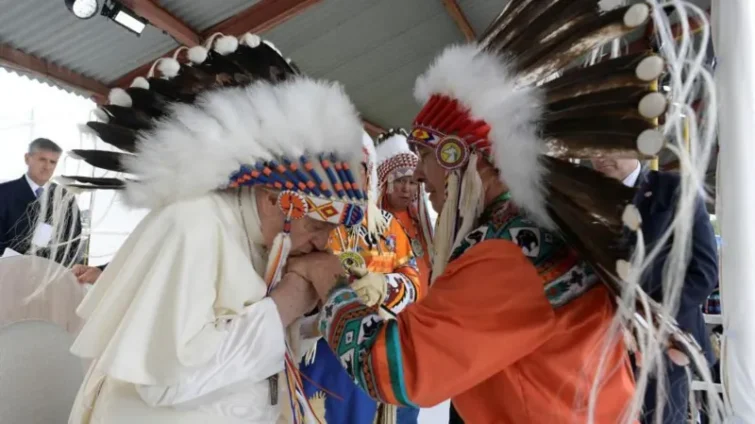
The move comes three years after Pope Francis issued a historic apology to Canada's First Nations for the church's role in the "genocide" and suppression of indigenous identity through the residential schools programme.
A joint statement from the Vatican and the CCCB says the Pope "desires that this gift represent a concrete sign of dialogue, respect and fraternity".
The statement adds that the artefacts "bear witness to the history of the encounter between faith and the cultures of the indigenous peoples".
The items, which came from several different communities around Canada, had been sent by missionaries to Rome to appear in a 1925 exhibition that displayed over 100,000 items.
Among the artefacts being returned is an Inuit kayak that had historically been used to hunt whales in Canada's far north, and a set of embroidered gloves that came from the Cree Nation.
Canada's ambassador to the Holy See told CBC News that the items are currently in storage in Rome, and will be flown back to Canada on 6 December.
In 2022, Pope Francis made a "penitential pilgrimage" across Canada, where he offered an apology to local tribal leaders. During the trip, the communities requested the return of their artefacts.
The CCCB says the items will be transferred to Canada's National Indigenous Organizations which "will then ensure that the artefacts are reunited with their communities of origin".
The cost of repatriating the items has been prepaid by the tribes, which plan to hold ceremonies before they can be officially returned, according to CBC.
Canadian Foreign Minister praised the move, calling it, "an important step that honours the diverse cultural heritage of Indigenous peoples and supports ongoing efforts toward truth, justice, and reconciliation".
The items had been held in the Vatican Museum's ethnographic collection, known as the Anima Mundi museum. The church has described the items as "gifts" that were given by tribal leaders. Critics have disputed this characterisation, given the power imbalance at the time they were transferred.
The items were taken to Europe during a time when Canadian law, as well as Catholic decrees, prohibited native spiritual practices, leading to a ban on certain items used during ceremonies.
Latest Stories
-
Government has improved sanitation in one-and-a-half years — Salaga South MP
2 hours -
Nkwanta North Assembly to appear before Parliament over DACF sanitation spending
2 hours -
Mourinho prints out ‘red card’ incidents after Real lose derby
3 hours -
Atletico beat 10-man Real in feisty Madrid derby
3 hours -
Twelve Tribes of Israel Ghana to mark 40 years with anniversary celebration
3 hours -
GPL 2026/27: Hearts held by Bechem as Kotoko, Samartex share spoils
4 hours -
My Story (Kwaku Antwi-Boasiako)
4 hours -
We expect growth rate to re-accelerate in second-half of 2026 – IC Insights
4 hours -
The ungodliness and unrighteousness underlying the National Cathedral mess!
4 hours -
T-bills auction: Government fails to achieve target; yield on 91-day-bill remains unchanged
4 hours -
It’s Ghana’s shame to denigrate Nkrumah when the whole world honours him as African of the Century – Asiedu Nketiah
4 hours -
No other nationalist can compare to Nkrumah – Asiedu Nketiah
4 hours -
Collateral Registry: Foreign banks accounted for GH¢19.9bn of secured credit in quarter 2, 2026
4 hours -
This government should expect scrutiny – Asiedu Nketiah
5 hours -
Two-year-old girl dies in domestic fire at Cantonments
6 hours