

Audio By Carbonatix
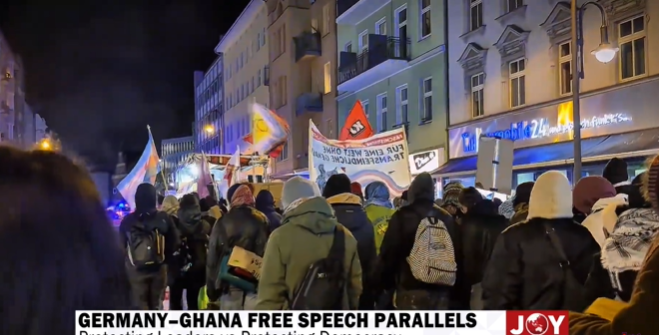
At a meeting with legal scholars in Berlin, JoyNews’ Jacqueline Ansomah Yeboah explores how Germany balances free speech, hate speech, and political accountability and what lessons Ghana can draw from Section 188 of Germany’s Criminal Code.
Germany is widely regarded as one of Europe’s strongest democracies, yet even here, defining the limits of free speech remains a constant struggle. During a session at the Freie Universität Berlin, Professor of public law, Torben Ellerbrok, examined how far citizens can go in criticising political leaders and where the law steps in.
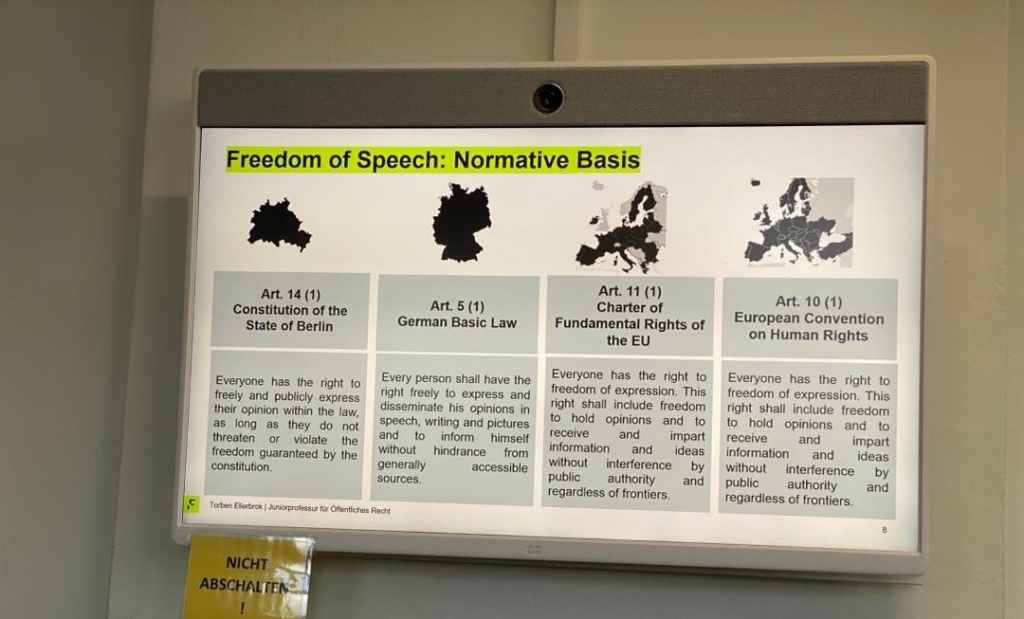
A key part of that debate is Section 188 of the German Criminal Code, which makes it a criminal offence to publicly insult a political figure if the attack could obstruct their work. The penalty: a fine or up to three years in prison.
To understand its implications, JoyNews engaged Professor Torben Ellerbrok, a leading expert in Public Law.
He acknowledges the complexity: “Freedom of speech must be guaranteed for everyone. Political leaders have to be criticised, that’s essential to democracy. But they are human as well. Criminal law can help, but we must focus on protecting free speech first,” he said.
Prof Ellerbrok noted that Germany still struggles to draw a clear boundary between harsh democratic criticism and hate speech. In his words, “The line is thin and it hasn’t been fully drawn.”
Could Section 188 Work in Ghana?
Ghana’s political culture is vibrant, emotionally charged and often polarised. The idea of criminalising insults against political leaders raises difficult questions.
In response to JoyNews’ question on whether a law like Section 188 could work in Ghana, Prof Ellerbrok warned that such laws risk being misused if the boundaries are unclear.

He explained that democracies should prevent hate speech “not aggressively, but in clear situations where legal action is justified.” Anything beyond that, he said, risks criminalising public frustration a crucial part of democratic accountability.
A Growing Global Challenge
Germany’s debate is not happening in isolation. Across Europe, the rise of online abuse, misinformation and political hostility is pressuring the governments to rethink how they regulate speech, especially toward public officials.
But Professor Ellerbrok’s caution is clear: protecting leaders must never come at the expense of citizens’ right to challenge power.
The Lesson for Ghana
For Ghana, a young but resilient democracy, the German experience offers a warning and a guide:
• Hate speech must be addressed, but definitions must be clear.
• Protection of leaders must not become protection of the political class.
• Free speech, even when uncomfortable, remains fundamental.
• Any legal intervention must strengthen, not weaken, democratic accountability.
As Ghana continues to confront abuses, polarisation and rising digital misinformation, the debate Germany is currently wrestling with may soon become ours as well.
Latest Stories
-
Mahama: Africa will no longer export raw minerals without value addition
4 minutes -
NPP leaders appear in court to support Manhyia South MP
4 minutes -
Mahama demands permanent UN Security Council seat for Africa
15 minutes -
Mahama calls for structural repair after UN slavery resolution
20 minutes -
Mahama condemns Gaza carnage, backs Palestine and two-state solution
23 minutes -
Fund Accra-Kumasi Expressway with private capital, not state funds — Alan Kyerematen urges gov’t
27 minutes -
TUC calls for stronger funding and labour representation in TVET system
29 minutes -
GES threatens removal of SHS heads over illegal fees
33 minutes -
Youth power to explode at 2026 Global Changemakers Summit in Accra
40 minutes -
SIU community remembers Kofi Akamani at vigil as memorial fund is announced
41 minutes -
Shot and killed in the US: Who was Dr Kofi Akamani?
50 minutes -
Sosu challenges EOCO’s basis for attempted arrest of Manhyia South MP
57 minutes -
KMA plans to convert Adum railway enclave into cargo truck terminal
58 minutes -
2026/27 cocoa season: COCOBOD engages international trading partners in London
1 hour -
Fire contained at Dansoman’s Dayspring School, no casualties reported
1 hour