

Audio By Carbonatix
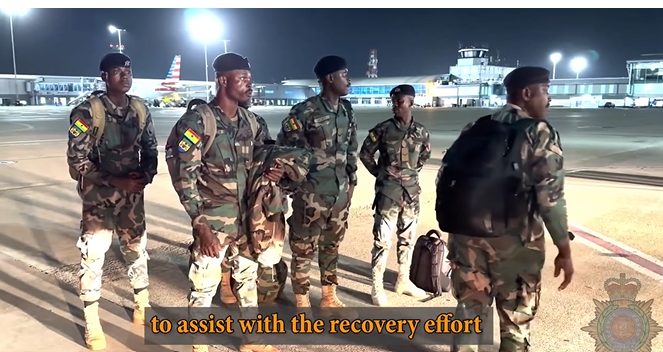
A 54-member engineer contingent from the Ghana Armed Forces (GAF) arrived in Jamaica last evening, stepping directly into the heart of recovery and rebuilding efforts after Hurricane Melissa ravaged the island nation.
The team, drawn from Ghana’s 48, 49 and 50 Engineers Regiments, is set to join efforts with the 1 Engineer Regiment of the Jamaica Defence Force to rehabilitate damaged infrastructure and construct temporary shelters for displaced families.
Lifted to the Caribbean with the help of a United States military airlift, this deployment underscores a growing partnership between Ghana, the United States, and Caribbean nations in crisis response.
Solidarity in Action — Beyond Relief Supplies
Ghana’s support for Jamaica didn’t begin with this troop movement. In the immediate aftermath of Hurricane Melissa — a storm that caused billions of dollars in damage and left thousands vulnerable — Accra dispatched humanitarian relief supplies, including food, blankets, mattresses, medicine, and other essentials.
But when Jamaican Prime Minister Andrew Holness formally requested help with reconstruction and shelter, Ghana stepped up with practical technical support. The engineers are tasked with repairing infrastructure, building emergency housing, and offering logistical and community-oriented assistance over the coming weeks.
This isn’t just aid; it’s a strategic expression of Pan-African and Afro-Caribbean solidarity — a bridge built on shared history, cultural ties, and mutual respect across the Atlantic. President John Dramani Mahama framed the mission as a proud continuation of Ghana’s historic role as a partner in global humanitarian efforts.
Domestic Debate in Ghana: Diplomacy vs. Process
The deployment has sparked a political debate. Critics, including members of the opposition and parliamentary minority, have argued that sending troops abroad — even for humanitarian purposes — should have been deliberated in Parliament, asserting that constitutional and financial oversight processes were bypassed. Some commentators also questioned whether Ghana’s own infrastructure needs might warrant the engineers’ skills.
In response, Ghana’s Foreign Affairs Minister, Samuel Okudzeto Ablakwa, defended the government’s decision as consistent with long-standing foreign policy and humanitarian commitments. In parliamentary briefings, he emphasised that such missions enhance Ghana’s diplomatic standing, reinforce bilateral relationships, and affirm the nation’s role as a compassionate global actor.
“Aid is more than charity — it is diplomacy at work,” the minister noted, arguing that Ghana’s engagement with Jamaica highlights a principled and proactive approach to international cooperation.
Latest Stories
-
Israel-bound flight diverted after fight between pilots
39 seconds -
EchoWave earns praise for sound quality at 10th Women in Worship
10 minutes -
Crackdown on South Africa’s unsafe streets ordered by president to keep women safe
22 minutes -
Banks are responding to improved monetary policy conditions – John Awuah
41 minutes -
Judges’ conference forces further adjournment of Salomey Baffoe case to Oct. 5
53 minutes -
GRA assures Tullow of collaboration to settle $393m tax liability without disrupting its petroleum operations
1 hour -
South Korea demands apology from Pyongyang for landmine blasts that injured three
1 hour -
Carlos Queiroz not the sort of coach Black Stars need – Nii Lante Vanderpuye
2 hours -
AFCON 2027Q: ‘Our Black Stars team is gone’ – Former Sports Minister
2 hours -
Prof. Prempeh calls for public review of draft constitutional reform bills
2 hours -
AFCON 2027Q: ‘I have never seen a poor performance from Black Stars like against Gambia’ – Nii Lante Vanderpuye
3 hours -
Bawumia backs insurance sector reforms after engagement with IBAG
3 hours -
Nigeria set to launch National Digital Address System 9 years after Ghana showed the way
3 hours -
Policy rate decision takes time to reflect in lower lending rates – BoG
3 hours -
Polytanks Ghana supports GNFS with water storage tanks
3 hours