

Audio By Carbonatix
A report by the Centre for Impact Analytics has identified six major areas of concern among the public regarding the conduct of public office holders.
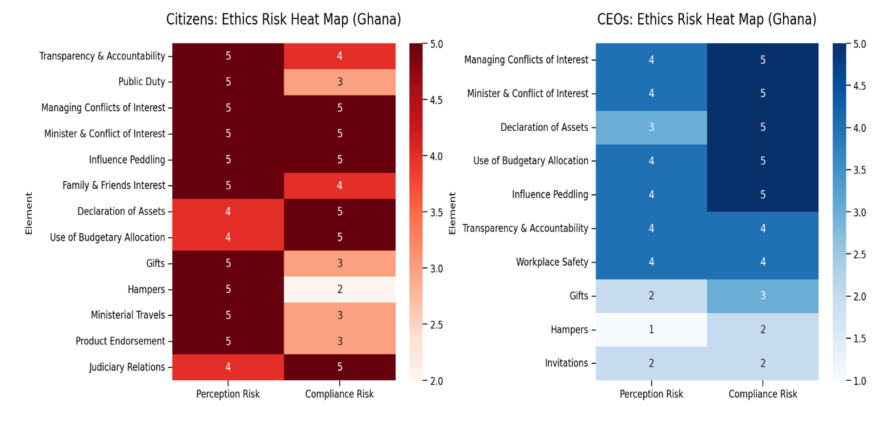
According to the report, which evaluated the effectiveness of the Code of Ethics launched in May 2025 by President John Dramani Mahama, accountability, asset declaration and conflict of interest issues rank among the top concerns of citizens.
The study was conducted to provide evidence-based insights into whether the code resonates with citizens and aligns with institutional risk priorities.
“Roughly six key issues are responsible for between 70 and 75 per cent of public concern. At the forefront are accountability and public duty, followed closely by conflict of interest, the declaration of assets and liabilities, influence peddling, and the need to ensure a safe, fair and respectful workplace,” the report stated.
The report noted that public trust is heavily influenced by visible conduct and behaviour by public officials.
“This pattern underscores a broader reality: citizens are particularly sensitive to what they can see and experience in governance. Their trust is shaped, often rapidly, by visible actions and behaviours, meaning that credibility can be strengthened or eroded in a very short time,” it added.
The report also examined the ethical priorities of chief executive officers of public institutions and found that their concerns, although similar to those of the public, are shaped by different considerations.
“Similar concentration emerges when examining the concerns of chief executive officers, although their perspective is shaped by different priorities,” the report said.
It explained that for CEOs, about five key issues account for nearly 80 per cent of their ethical focus.
“These include conflict of interest, the use of budgetary allocations, accountability, ensuring a safe and respectful workplace, and influence peddling,” the report noted.
According to the study, while public concerns are largely rooted in perception and trust, CEOs tend to approach ethics from a risk management perspective.
“Their attention is directed toward areas most likely to attract audits, regulatory scrutiny, sanctions, or legal consequences,” the report stated.
The report observed that the perspectives of the public and CEOs reveal “an important divide”.
“While citizens focus on visible conduct and integrity as signals of trustworthiness, organisational leaders are more attuned to compliance and institutional risk,” it added.
To bridge the gap, the report recommended not only strong ethical systems but also transparent practices that align with public expectations.
The report involved consultations with citizens across the country as well as chief executive officers of several public institutions.
Latest Stories
-
Auditing the Auditor-General: How special audit understated a COVID-19 expenditure
36 minutes -
A Partnership for Progress: Why the ProMark–KPMG collaboration matters for Africa’s digital assets future
45 minutes -
Catholic Bishops pressure gov’t to sign long-delayed mission schools agreement
2 hours -
Cedi under fresh pressure as Christmas import demand drives dollar surge
2 hours -
Ato Forson eyes first-week November for 2027 Budget, promises jobs and major infrastructure push
2 hours -
Catholic Bishops demand probe into ‘protocol admissions’ amid SHS placement challenges
2 hours -
SHS placement: Catholic Bishops demand probe into alleged payments for school places
3 hours -
Facts about Nigeria’s Dangote oil refinery Initial Public Offering
3 hours -
Trump says AI safety fears a ‘hoax’ as he rejects calls for greater safeguards
3 hours -
Oil climbs as Saudi pipeline outage, fresh attacks heighten supply concerns
3 hours -
Donald Trump Jr and Bettina Trump say Putin ally paid for some wedding festivities as a ‘gift’
4 hours -
Farouk Aliu Mahama supports medical student with GH¢10,000 donation
4 hours -
EU is set to propose ban on social media and AI chatbots for under-15s
4 hours -
No SHS space shortage – GES says 800,000 places available for just over 600,000 students
4 hours -
Emmys 2026: The winners and nominees in full
4 hours