

Audio By Carbonatix
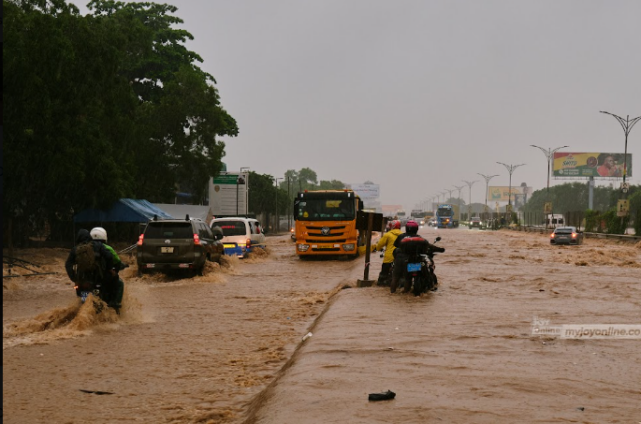
Accra did not wake up on 29th June 2026 expecting to become a city of islands. Yet within hours of relentless rainfall, neighbourhoods that had hitherto rarely seen floodwaters, including parts of Achimota, Atomic, Spintex, Tse Addo, and previously less-affected residential zones, found themselves cut off.
Families watched roads disappear beneath muddy torrents. Motorists abandoned vehicles. Traders saw years of hard work submerged.
As floodwaters threatened critical infrastructure, the Electricity Company of Ghana (ECG) and Ghana Grid Company (GRIDCo) took the prudent step of temporarily shutting down power substations at Mallam and Achimota.
That decision likely prevented a larger catastrophe. But it also laid bare a painful reality: Accra’s flood problem is no longer confined to traditionally “flood-prone” communities.
Areas once considered relatively safe were inundated. Recent flood susceptibility studies highlight districts such as Weija Gbawe and coastal communities as increasingly very high risk, with hundreds of thousands of buildings and millions of residents exposed.
What disturbed me most was not that Accra flooded again; it was that the flood map is visibly expanding.
The impacts stretched far beyond submerged roads. Businesses suspended operations, markets slowed, deliveries halted, and what should have been a normal workday turned into widespread disruption.
Major routes including the N1 Highway, Apenkwa towards Tesano, the Accra–Kasoa stretch, Kaneshie, Darkuman Junction, and areas around the Kwame Nkrumah Interchange were severely affected.
The Ghana School of Law postponed its June 29 examinations, a stark reminder that even planned institutional calendars are vulnerable.
The Interior Minister, Mohammed Muntaka Mubarak, urged residents to stay indoors as emergency responders stretched across the Greater Accra Region.
Hundreds were trapped in homes, vehicles were swept away, and floodwaters reached roads around Jubilee House itself. A fire at a rubber factory in the Circle area added further chaos. This is no longer acceptable.
Between 2013 and 2023, floods across Ghana affected at least 110,813 households. Ghana loses an estimated US$200 million annually to floods and droughts combined.
These figures represent destroyed livelihoods, interrupted education, paralysed commerce, and enormous pressure on emergency services costs that fall heaviest on low-income communities. Many cities worldwide receive heavier rainfall yet do not suffer this scale of annual devastation.
The causes in Accra are well-understood: choked drains filled with waste, indiscriminate dumping, construction on waterways and wetlands, rapid urbanisation that has outpaced drainage infrastructure, and weak enforcement of planning laws.
Successive governments have launched initiatives, including the World Bank-supported Greater Accra Resilient and Integrated Development Project (GARID), which has seen some progress on Odaw River dredging and community drains.
Yet these efforts remain fragmented and insufficient against the pace of encroachment and poor maintenance. The saddest part is our growing acclimatisation. We no longer ask whether Accra will flood but how bad it will be this time.
As the waters recede, so too often does the urgency. Headlines fade, roads reopen, and life resumes until the next downpour. Nothing about this cycle should be considered normal.
Climate change is intensifying rainfall events, while unchecked urban growth amplifies the risks. Without deliberate action, projections show even more residents and infrastructure falling into high-susceptibility zones.
The real question is not if the rain will fall again; it will. The question is whether, by then, we will have summoned the sustained political will, adequate funding, engineering follow-through, and collective discipline required to break this pattern.
What must happen now:
- Aggressive, year-round desilting and drain maintenance.
2. Strict enforcement against building on waterways and indiscriminate dumping, with visible penalties.
3. Accelerated completion of major projects like full Odaw basin works and new retention systems.
4. Relocation support for the most vulnerable households paired with viable housing alternatives.
5. Better integration of waste management, urban planning, and climate adaptation into one coherent strategy.
Accra and Ghana deserve better than managing preventable disasters as routine events. We owe it to families watching their homes flood, students missing exams, and businesses losing everything to finally turn knowledge into lasting action.
The rain will come again. The only question is whether Accra will still be drowning in it, not because nature failed us, but because we failed ourselves.
Latest Stories
-
Ghana’s state-owned enterprises return to profit with GH¢19.8bn gain in 2025 — SIGA
6 minutes -
Fuel prices set to rise again from Sept 1; petrol could hit GH¢16.21 – COPEC
2 hours -
REGSEC restricts Akwasidae celebrations in Denkyira amid security concerns
2 hours -
Eric Adjei distributes free fertiliser to farmers in Jaman North
2 hours -
Akufo-Addo urges NPP factions to unite behind Bawumia for 2028 victory
2 hours -
NDC mourns Western Regional Elections Director Papa Assan
3 hours -
Minerals Commission warns against fake job recruitment schemes
3 hours -
10 recruits dismissed for defying phone ban – Interior Minister
3 hours -
IEAG commends GoldBod, BoG for improving forex stability
3 hours -
Bawumia donates GH¢50,000 to St Jude Catholic Church at Weija
3 hours -
Mahama calls for faster mobilisation of AU Peace Fund resources
3 hours -
Improved roads bring new vehicle options to Tumu-Bolga, Tumu-Tamale, Tumu-Wa routes
3 hours -
Cedi records 7.9% depreciation against US dollar in first half of 2026
3 hours -
GIS launches operation on anti-human trafficking and exploitative street begging
3 hours -
Awutu-Senya District Assembly organises clean-up ahead of Awubia Festival
4 hours