

Audio By Carbonatix
The Ghana Prisons Service says the introduction of the Community Service Act, 2026 and the Parole Regulations, 2026, marks a significant step towards reducing overcrowding in prisons while promoting rehabilitation and reintegration of offenders.
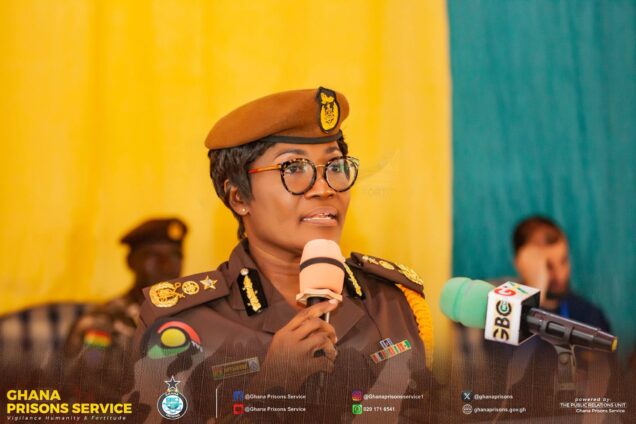
The Director-General of Prisons, Mrs Patience Baffoe-Bonnie, said this in a message marking Nelson Mandela International Day, highlighting the two legal reforms as key developments in Ghana’s justice system.

"The passage of the Community Service Act, 2026 empowers courts to impose supervised community work as an alternative to custodial sentences for minor offences," she said.
The Service explained that the reform would help reduce pressure on prison facilities, save state resources and allow offenders to contribute positively to community development.
"This reduces overcrowding, saves state resources, and channels offenders' labour into community development," the Director-General stated.
The Ghana Prisons Service also pointed to the Parole Regulations, 2026 as another major reform aimed at supporting the smooth transition of inmates back into society.
According to the Service, the regulations provide a structured system that allows eligible inmates to serve the remainder of their sentences under supervision while preparing for full reintegration.
"Complementing this, the Parole Regulations, 2026 provide a structured reintegration process, allowing inmates to serve the remainder of their sentences under supervision."
The Director-General said the reforms reflect a broader shift in Ghana’s correctional system from punishment-focused incarceration towards rehabilitation and second chances.
"Together, these reforms embody justice, dignity, and second chances, while aligning Ghana with global best practices," the statement added.
The reforms form part of the Ghana Prisons Service’s broader Think Prisons 360 Degrees Initiative, which seeks to establish a modern correctional system focused on rehabilitation, restoration and reintegration.
The Service said the measures would complement other interventions, including education, vocational training, healthcare improvements and skills development programmes, to ensure that inmates return to society as productive citizens.
Latest Stories
-
Africa’s dependence on foreign powers betrays Nkrumah’s unfinished vision – P.L.O. Lumumba
2 minutes -
3 suspects shot dead, 2 officers injured in Tilly Forest robbery follow-up operation
4 minutes -
Nkrumah’s unfinished Pan-African project must be completed – P.L.O. Lumumba
6 minutes -
Mysterious illness leaves children struggling to walk, hear as Mafi Kope community appeals for urgent medical help
42 minutes -
Ghana begins free rabies vaccination for 25,000 pets
49 minutes -
Ghana Navy strengthens operational readiness with specialist seaman gunners training
53 minutes -
Nkrumah’s legacy must be measured by action, not ceremonies – Armah-Kofi Buah
58 minutes -
Kwesi Pratt Jnr questions Ghana-US defence cooperation agreement over sovereignty concerns
1 hour -
Nkrumah’s legacy must drive African unity, self-reliance and environmental protection – Armah-Kofi Buah
1 hour -
Nkrumah’s inspiration should unite Africans despite political differences – Dr Opoku Prempeh
1 hour -
Some dissolved NSA board members could be reappointed – Kofi Adams
2 hours -
Mahama leaves for New York to attend 81st UN General Assembly
2 hours -
Aston Villa beat Mohammed Kudus’ Tottenham 3-1 as Spurs struggles continue
2 hours -
Auditor-General’s COVID audit omissions worrying for anti-corruption fight – CDD-Ghana
2 hours -
Bawa-Rock supports over 300 Obuasi Town Hall fire victims with GH¢1.5m package
2 hours