

Audio By Carbonatix
Former National Chairman of the New Patriotic Party (NPP), Paul Awentami Afoko, has attributed the party's declining electoral fortunes to what he described as a deterioration in internal management and party unity since his departure from office.
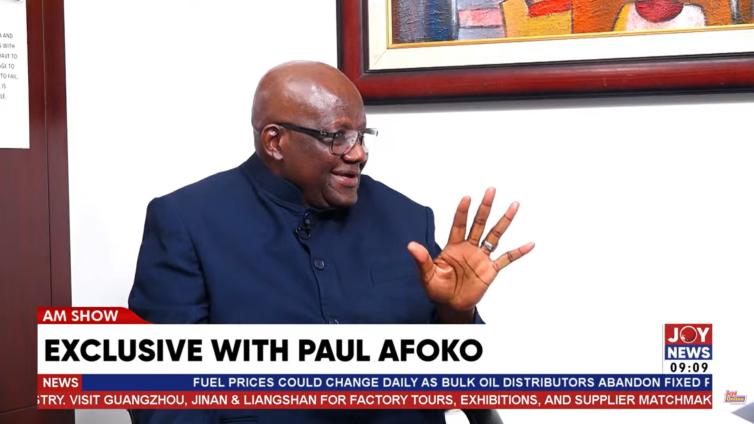
Speaking in an interview with JoyNews' Kojo Brace, Mr Afoko said his decision to re-enter public discussions on the affairs of the NPP was motivated by concerns over the party's current condition rather than any single event.
"My motivation is actually not one single thing. First, I looked at the state of the party today. That was the first thing that triggered me to react," he said.
The former chairman, who is back to compete for the position, explained that after years of remaining largely inactive in frontline party politics, he felt compelled to speak out after observing what he believes has been a steady decline in the NPP's electoral performance and organisational strength.
Mr Afoko reflected on his tenure as National Chairman, arguing that the party experienced one of its strongest electoral performances during that period.
He noted that the NPP secured an unprecedented 169 parliamentary seats and achieved a presidential victory by a margin of approximately one million votes.
While acknowledging those achievements, he was quick to dismiss suggestions that they were the result of his individual efforts.
"I cannot claim to have a magic wand," he said. "It was teamwork. The whole party was involved."
According to Mr Afoko, one of the defining features of his leadership was the manner in which the party conducted its internal parliamentary primaries.
He maintained that fairness, transparency and inclusiveness helped preserve unity even after highly competitive contests.
He recalled that more than 30 sitting Members of Parliament lost their parliamentary primaries under his leadership but accepted the outcomes without resorting to legal action or contesting the elections as independent candidates.
"I managed it in such a way that even though we had over 30 sitting MPs who lost the primaries, none of them went independent and none of them went to court," he stated.
"They all accepted the results because they believed the process was fair and clear. As a result, they continued to work for the party throughout the general election."
Mr Afoko argued that this level of internal cohesion played a significant role in the party's electoral success and contrasted it with developments after his departure.
He lamented what he described as a sharp decline in the party's parliamentary representation, noting that the NPP's seats fell from 169 to 137 during its first general election after he left office, despite the party being in government at the time.
"Our first election after I had left, while we were in government and had everything at our disposal, we dropped from 169 seats to 137," he said.
The former chairman suggested that the decline reflected shortcomings in the party's management of its internal affairs, particularly in handling disputes arising from parliamentary primaries.
As an example, Mr Afoko cited the controversy surrounding the Fomena Constituency, where the NPP disowned its former parliamentary candidate (Andrew Asiamah Amoako) after he contested the election as an independent candidate.
According to him, the party devoted considerable effort to campaigning against its former member in what has traditionally been regarded as an NPP stronghold instead of focusing its campaign against the opposition National Democratic Congress (NDC).
"The very MP we went to his constituency and declared that he was a stranger to our party and that he was out of the party, we campaigned specifically against him," Mr Afoko said.
"Fomena is our stronghold, and we didn't need to campaign against the NDC. We were campaigning against our own."
Despite the party's opposition, the independent candidate won the parliamentary election.
Mr Afoko noted that following the election, the MP aligned himself with the NPP caucus in Parliament, effectively boosting the party's numbers.
"He came to Parliament and said spiritually he is NPP, and so he caucused with us and gave us the 138," he remarked.
The former chairman maintained that his intervention was driven by concern for the party's future, insisting that the NPP must reflect on its recent experiences and strengthen its internal democratic processes if it hopes to regain its previous electoral dominance.
Latest Stories
-
Amb. Edward Boateng congratulates Boadu, Kodua on election wins
18 minutes -
John Boadu pledges to rebuild NPP from grassroots and restore ‘winning machinery’
20 minutes -
Ashaiman Assembly deploys monitoring system to curb dumping in storm drain
32 minutes -
John Boadu must rebuild, unite NPP for 2028 – Edward Boateng
34 minutes -
Executive intimidation of opposition undermines separation of powers – Prof Oquaye
38 minutes -
I have no issue with John Boadu; we’ll work together – Justin Kodua
2 hours -
Adom FM Y2K Jam delivers a night of music, fashion and nostalgia
2 hours -
Lawrence Kobena Nsarko Otoo, Esq
3 hours -
Bel-Aqua intensifies mental well-being campaign ahead of 15th anniversary
3 hours -
From banking to party finances: Alfred Kwadwo Thompson elected NPP Treasurer
4 hours -
George Christian Papa Mends
4 hours -
Ali Suraj elected NPP NASARA Coordinator
4 hours -
Mustapha Hamid misses out on NPP Vice Chairmanship by 31 votes despite early poll lead
4 hours -
Kojo Bamba, Henry Nana Boakye and Nana Akomea elected NPP Vice Chairmen
5 hours -
From Delta Force to NPP First Vice Chairman – Kojo Bamba’s political journey
5 hours