

Audio By Carbonatix
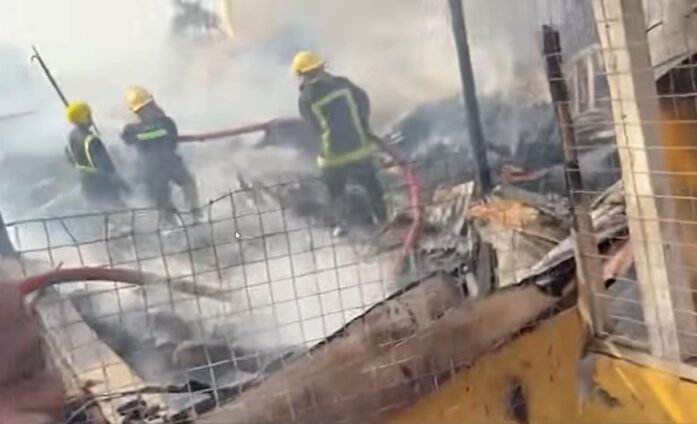
Station Officer Abubakar Mohammed has spent fifteen years running into burning buildings so that other people could get out alive. Now, as he thinks about retirement, one question won't leave him alone: will he leave the Ghana National Fire Service with healthy lungs, or with a disease he can't see?
"Sometimes you sit down and you're asking yourself questions, how are you going to end? Will you retire healthy, or will you retire sick?" he says. "Some retire and they get sick. Some get sick before they retire. It's something that is a serious nightmare to any firefighter."
It's a fear firefighters around the world share. In Ghana, though, it's rarely spoken about, and even more rarely studied.
Abubakar's worry didn't come out of nowhere. It began the way his career did: with too little equipment to do the job safely.
When he was posted to Damango Fire Station as a young recruit, the station's fire engine was already broken. If a call came in, officers had no choice but to improvise.
"If there is a fire call, we have to use our motorbikes. You carry a hose, you go to the scene, then with buckets of water, with the assistance of the community, you do what you can," he remembers. "That was how I started. It has not been easy."
Fifteen years on, breathing apparatus, the equipment that lets firefighters breathe clean air while working inside thick smoke, is still not something every officer in Ghana can count on.
The moment that changed everything for Abubakar happened in a hospital, not at a fire scene.
During a routine check-up, a doctor looked at his lungs and told him, bluntly, to stop smoking. Abubakar had never smoked a cigarette in his life.
"I told the doctor I don't smoke," he says. "I'm just an ordinary fire officer, always at the front line. I only fight fire."
His lungs, it turned out, didn't need cigarettes to be damaged. Years of breathing in smoke on the job had already done that.
When something burns, wood, plastic, rubber, fuel, entire buildings, it doesn't just produce heat and light. It releases a mix of gases and extremely tiny particles into the air, many too small to see.
One of the most dangerous of these is called PM2.5, short for "particulate matter" measuring 2.5 micrometres or smaller, roughly 30 times thinner than a human hair. These particles are so small that once breathed in, they can slip past the body's natural defences, settle deep in the lungs, and in some cases pass directly into the bloodstream.
Smoke from fires, especially when plastics, foam and other synthetic materials burn, as often happens in modern buildings and vehicles, also carries toxic gases like carbon monoxide. A single large dose can cause immediate harm. But it's repeated exposure, year after year, that does the deeper damage: scarring the lungs, weakening how well they work, and in some cases leading to cancer.
This is the air firefighters like Abubakar and his colleagues have been breathing for years, often with only the protection they could improvise for themselves.
The health risks facing firefighters are well studied elsewhere in the world.
In the United States, a landmark study followed nearly 30,000 firefighters over several decades. It found they were 14% more likely to die from cancer than the general public, with especially high rates of cancers affecting the respiratory, digestive and urinary systems.
In the United Kingdom, researchers studied firefighters who battled the devastating Grenfell Tower fire in 2017, which killed 72 people. About one in four of those firefighters later reported long-term health problems, which researchers linked strongly to the smoke they had breathed that night.
In Ghana, no such study exists. What exists instead is the lived experience of officers like Abubakar, men and women quietly carrying years of smoke in their lungs, with no data collected, and no official record connecting their illnesses to their work.
Station Officer Zakaria Yakubu has served for four years, a fraction of Abubakar's time on the job, but he's already breathing the same risks, with much the same outdated equipment.
For Yakubu, the most immediate problem is Ghana's shortage of fire engines, known in the service as "tenders."
"Almost all our tenders are grounded," he says. "This regional headquarters substation, going on a year now, our tender is broken. We don't have one here. If you look at the whole of Tamale, right now there are only two tenders for Tamale and its surrounding villages. The challenges are numerous."
The terrain doesn't make the job easier. In northern Ghana, burning land is part of everyday farming life, and every dry season the region loses large stretches of forest to fire, sending clouds of smoke into the air that officers like Yakubu have to fight through.
At every fire, officers are meant to wear breathing apparatus. But across the Northern Region, there aren't enough sets to go around, so officers share them, sometimes at a cost to their health.
"When I started using some of the PPE [protective equipment] we have here, I was infected with rashes," Abubakar says. "I battled with these rashes and spent a lot of money on treatment before I got medication for it. We share the same PPE, sweaty from the fire ground, and we don't have disinfectants to clean the clothing. The only thing we do is wash or dry it, in most cases, we don't even wash it, just dry it. That's the risk we're all exposed to."
For Yakubu, the deepest fear comes when the air supply itself runs out mid-fire.
"Normally when we get to a fire scene and realise where we need to enter is thick smoke, we use what we call BA [breathing apparatus]," he explains. "But sometimes the oxygen that is meant to save you isn't enough, or it isn't there at all." Asked what happens then, he pauses before answering: "You try to perform magic. And at the end, you inhale the smoke."
Despite the risks he takes on duty, Yakubu says there's no accessible health insurance for him to fall back on. Asked directly whether such cover exists, his answer is blunt: "There is nothing like that."
Professor Adamu Issaka, an associate professor of thoracic surgery at Tamale Teaching Hospital and the University for Development Studies School of Medicine, sees the medical consequences of smoke exposure regularly.
"The impact we are seeing is a spectrum, from benign lung conditions to malignant lung conditions, including lung cancer," he says. "Smoke from bush burning, firefighting, exhaust fumes, they are all causes of that. Especially for our firefighters: when they go into thick smoke without wearing the proper PPE, and they inhale it, there is a short-term impact and a long-term impact."
In the short term, he says, firefighters become more vulnerable to infections like pneumonia. Over time, repeated exposure can lead to a condition called lung fibrosis, where the lung's normal tissue is gradually replaced by scar tissue, leaving patients constantly fatigued as their lungs lose function.
The question that matters most, though, is whether any of this can be undone.
"The exposure is cumulative," Professor Issaka explains. "If you get a few exposures and then it stops, the damage may not be severe, and it's likely to be reversed. But most people have continuous exposure. Once the lung starts losing its functionality and fibrosis sets in, reversing it becomes very difficult, specialist care and dedicated medication might delay the progression, but returning the lungs to normal becomes impossible."
Hudu Baba, the Northern Regional Public Relations Officer for the Ghana National Fire Service, acknowledges the equipment shortage. The region does have a facility to refill breathing apparatus, he says, but there simply isn't enough equipment for every officer to have a dedicated set.
"Ideally, because of sicknesses and diseases, we prefer every fireman has dedicated equipment," he says. "But because of the lack of logistics, we are not able to do that."
Asked whether any officer's illness has ever been officially linked to the job, Baba makes a striking admission: it hasn't happened, not because it hasn't occurred, but because it is so hard to prove.
"To be honest with you, that report doesn't come, and I will associate that with a lack of awareness," he says. "Some personnel can be sick without knowing the cause. Until they are medically proven [to have a condition caused by their work], we are unable to tell. For a personnel to identify that his current state is a result of a fire incident he attended and inhaled smoke, we are yet to receive such a report."
On health insurance, Baba insists cover does exist, through a scheme with the State Insurance Company. But he concedes the process doesn't work the way officers need it to in an emergency.
"The service has provided personnel with this insurance, and a component of the contribution is meant to take care of our health," he says. "But the challenge is when you need the services immediately, and maybe you don't have the money. Ideally, once you get to the hospital, you should be treated free and discharged, but you have to apply to the insurance office at headquarters first. So, in effect, it is there."
That gap, between insurance that exists on paper and help that arrives in the moment, has defined firefighters' experience for years. As recently as 2025, the Fire Service itself acknowledged that its personnel had no real insurance cover beyond the standard workman's compensation available to any public worker, and even that required officers to pay their own medical bills first and apply for a refund afterward.
Then, in July 2025, the government moved. Interior Minister Muntaka Mohammed-Mubarak launched a new insurance scheme with the State Insurance Company: fifty thousand cedis for an officer critically injured on duty, and one hundred thousand cedis for the family of an officer who dies in service. Unlike the old system, it's designed to pay out immediately, rather than forcing injured officers to cover costs upfront and claim a refund later. The minister called it "just the beginning."
In November 2025, the Fire Service and the insurer formally signed the agreement. Ghana's 2026 budget went further still, promising 100 new fire trucks and fresh equipment to re-tool the service, and more than 1,600 new recruits passed out of training last year.
But there is a gap this new support does not close. The insurance scheme covers sudden injury or death on duty, not the slow, silent damage that builds up over years of breathing smoke. By the Fire Service's own account, no officer's illness has ever been formally traced back to the job, because proving that link is so difficult. And as of the middle of 2026, the promised 100 new fire tenders had not yet arrived. The disease quietly developing in lungs like Abubakar's still falls outside the help currently on offer.
For Abubakar, the fix isn't complicated, he's already thought it through.
"Each and every person should get his or her own PPE, and also have insurance," he says. "I truly don't agree with falling sick, footing your own bills, and then applying for a refund. If the service is able to get a standard health insurance card for each officer, then immediately you step into a facility, the card will take care of it. Whatever happens later, you can still deal with that."
The fires in Ghana are not going to stop. Every dry season brings more of them, and every one sends men and women like Abubakar and Yakubu into the smoke. For now, their best protection is often whatever they can improvise themselves, a filtered mask ordered online, a shared and poorly disinfected suit, or simply experience and luck.
Abubakar's hope is simpler than any of that: a policy that will genuinely cover his medical bills on the day he finally steps out of the smoke, for good.
This story is a collaboration New Narratives. Funding was provided by Clean Air Fund which had no say in the story’s content.
Latest Stories
-
How a Ghanaian technology is helping fish farmers detect hidden threats before fish die
2 minutes -
AI tool helps Ghanaian farmers identify crop threats from field observations
7 minutes -
NEIP: Designing a Ghana Startup Agency that builds enterprises, not programmes
13 minutes -
Breast cancer diagnosis is not a life sentence – Gender Minister urges early treatment
15 minutes -
‘How does a bad settlement translate into criminality?’ – Atta Akyea questions EOCO
20 minutes -
Foreign Affairs Ministry launches ‘ECOWAS for All’ campaign to boost public awareness
28 minutes -
Baffour Awuah’s EOCO questioning centred on SIC matter – Bosome Freho MP
31 minutes -
Kwaku Bonsam appeals to Mahama, Ablakwa to facilitate his US travel for skin graft; says he’ll fund it
46 minutes -
Baffour Awuah arrested after surrendering to EOCO
48 minutes -
Baffour Awuah cooperating with investigators after surrender and arrest – EOCO
1 hour -
Destruction of aspirants’ posters breaches democracy—Ashanti NPP Communications Director
1 hour -
BNI investigates Ampofo Ankrah over alleged $623,000 World Cup visa scheme
1 hour -
GoldBod’s $1.87bn boost strengthens Ghana’s path beyond IMF support – Institute of Fiscal Policy Research
2 hours -
NPP National Delegates Conference: Police announce road closures, diversions around Baba Yara Stadium
2 hours -
Agric Committee demands financing plan for Pwalugu Irrigation Project before 2027 Budget
2 hours