

Audio By Carbonatix
"We built extraordinary payment rails. Now we build the credit rails."
At the Distinguished Digital Finance Lecture, held during the National ICT Week, our Deputy Governor Matilda Asante- Asiedu mentioned this in her remarks. The Bank of Ghana has put a number on something the market has felt for years: an #SME financing gap of roughly $4.8 billion, among the most severe on the continent, in a country with one of Africa's more capable financial systems.
Alongside it came a proposition I think is the most important thing said about Ghanaian financial services this year. Access to credit on fair terms should become the benchmark against which financial inclusion is measured, and that open banking reform should be aimed squarely at lending to businesses that cannot offer conventional collateral. This is totally right .
Ghana has spent fifteen years building #retail #payment infrastructure that reaches into markets, farms and lorry parks no branch network ever served. #Interoperability works. Settlement is instant. On the metrics we set for ourselves a decade ago, we succeeded. Those metrics have now outlived their usefulness. Account ownership and transaction volume tell us people can move money. They tell us nothing about whether people can build anything with it. That is the gap. We built extraordinary payment rails. We did not build equally extraordinary credit rails. And the missing rail is not capital. It is Assessment.
The sentence should change how regulated #FSPs think. For anyone working in credit risk or #Data, the operational implication of this agenda is immediate. Institutions already hold transaction history. Cash flow, merchant activity, how frequently money comes in, whether volumes are growing or shrinking, how predictable income is. This is a credit record. The regulator has signalled that it understands this. This means failing to convert that data into credit assessment has moved from a commercial choice to a supervisory concern.
Every institution in Ghana should be asking itself this quarter: why is the five-year cash-flow record of a customer we already serve not sufficient for us to lend to that customer?
3 More Things Worth Endorsing Loudly
Collateral dependence is excluding viable businesses. Enterprises with strong cash flows, contracts and real receivables are declining because they cannot pledge land and buildings. The NIC's own assessment puts the share of SMEs constrained this way at around 95%.
#OpenBanking must be judged by credit extended, not APIs published. This is the most disciplined idea in the whole agenda. It is entirely possible to comply with an #OpenBanking directive without writing one additional loan. Naming the financing gap as the explicit measure of success pre-empts that failure mode. Regulate by risk, not by license category and coordinate. BoG, NIC, SEC and NPRA working together. This matters more than it sounds. Every serious MSME finance product now crosses #regulatory boundaries.
Why This Is An Assessment Problem
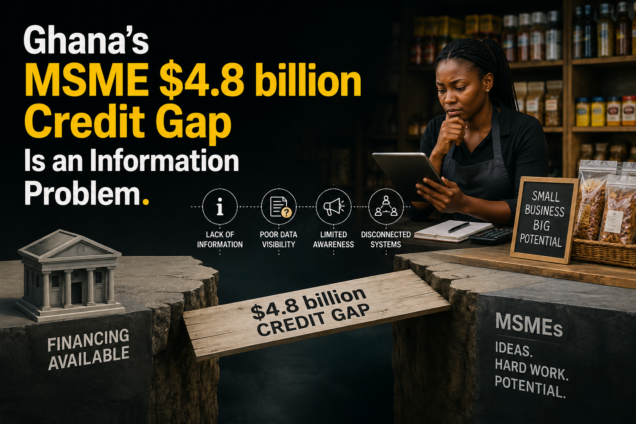
The gap is usually described as a shortage of money. It is more accurately a shortage of information. Lenders cannot see enough of a small business to price its risk, so they substitute collateral for information. ''No collateral, no loan''.
And #MSME assessment is genuinely harder than either consumer or corporate. A poultry farmer in Dormaa, a fabric trader at Makola and a haulage operator in Tema share a size band and almost nothing else. The same wallet pays a supplier and a school fee. Cash flow is lumpy by design. Planting cycles, shipment timing, school term peaks, and a naive model reads legitimate seasonality as risk. Then there is the defect almost nobody discusses publicly.
A model can only learn from the loans you already made.
Most #banks have not built a risk model. They have built an automated, statistically dignified reproduction of your existing credit policy with a collateral bias. Which is why "we're deploying AI in SME lending" is not, by itself, an answer. Digital underwriting without reject inference doesn't close the gap. It enforces it faster.
What #Industry Should Be Doing
1. Start With What You Already Hold
Most institutions can build a cash-flow early-warning capability on their own internal transaction data, today, before a single open banking API is live. Waiting for the infrastructure to be handed over is the most common and least defensible reason for inaction in this market.
2. Fund A Learning Tranche
If you have no data on the population you decline, you will never lend to it. A deliberately funded, controlled volume of lending outside current policy, ideally supported by guarantee or first-loss capital from a #DFI, is the only unbiased source of performance data on the excluded segment. Treat it as the cost of discovering a market, not as a loss. This is a board decision, not a modelling decision.
3. Build The Monitoring Before The Volume
Rather than using the origination scorecard, behavioural early warning on live transaction flows is a good signal. A borrower whose receipts have dropped well below their own trailing baseline, whose counterparty count is shrinking, whose end-of-day balance floor has collapsed that business is visibly deteriorating before it misses a payment. Detected there, the conversation is restructuring. Detected at default, it's #collections.
4. Make Declines Explainable
"The system did not approve it" will not survive Act 843, a supervisor, or a dispute. Generate reason codes at decision time. Store them with the decision. Write them in language a market trader can act on.
''Your recorded receipts over six months are below the level required for this amount''.
Framed that way, a decline becomes coaching rather than exclusion. He/She can close the gap and come back. This is one of the rare places where the compliance requirement and the #Inclusion objective are the same
What The Wider Ecosystem Should Pick Up
The call for coordination deserves a concrete response from each regulator, not just applause. My reading of where the work sits:
#BoG: Continue to publish the #OpenBanking implementation timetable so institutions can plan capital and hiring against it, begin reporting the #SME financing gap as a tracked supervisory statistic, and issue proportionate model risk expectations. The market will build to a published standard far faster than to a principle.
#NIC: Advance the #SME #Credit #Insurance mechanism already under discussion with BoG and the 24-Hour Economy Authority. #Credit #Insurance is the most direct available substitute for the land and buildings collateral that constrains most #SME lending. Clarify how cover interacts with provisioning so #banks can compute the benefit.
#SEC: Build the funding side. # Deposit-taking balance sheets alone will not close USD 4.8 billion. Securitisation of #MSME receivables, #SME focused private credit funds, workable #crowdfunding frameworks, and a realistic alternative market pathway for growth #SMEs.
#NPRA: This is where the patient local currency capital actually lives. #Investment guidelines for Tier 2 and Tier 3 schemes are the levers that determine whether #SME Credit scales beyond bank appetite.
Credit Bureaus: #MSME coverage and identity linkage, anchored on the Ghana Card. Unlinked identity is one of the largest single sources of avoidable exclusion in this market.
#DFIs and Development Partners: the highest-leverage use of concessional capital here is not subsidising interest rates. It is de-risking learning tranches, and funding shared analytics infrastructure for #MicroFinance institutions, Rural and Community Banks, Credit Unions and last-mile providers.
If the largest five or six institutions can build this capability, we will narrow the gap for borrowers while widening it between tiers. Shared infrastructure for the smaller tiers is not charity. It is what makes the system-level number move.
The Measure of Success, And The Honesty It Requires
Something unusual has happened here: A regulator has proposed a measure of success that the regulator itself can be judged against. If the #SME financing gap is the explicit test, then in 2 or 3 years the question will not be how many directives were issued or how many APIs were published. It will be whether the number moved. That is the right test. Industry should say so clearly, and then behave accordingly, which means tracking the following:
- SME credit extension as an inclusion metric, not only a revenue line
- The share of SME approvals still dependent on land or buildings as security
- First-time formal borrowers as a share of originations. Otherwise,e we are just refinancing the same customers with better technology
- Approval rates and average limits by gender, region and sector
- Restructurings initiated before default via early warning
- Models in production versus models independently validated
The Test That Matters
A market trader whose phone already moves money in three seconds should be able to borrow against the business she has spent a decade building, and should be able to choose between competing offers rather than accept whatever her existing provider proposes.
That last part matters more than it appears. #OpenFinance without comparability and switching produces data sharing that benefits incumbents. Delivering on this agenda means accepting that credit rails will make pricing visible. Every technical element of this feature engineering, reject inference, independent validation, credit insurance, pension allocation guidelines, and cross-regulator coordination exists to serve that one outcome.
If we build all of it and Kwesi Mensah or Grace Ama still cannot borrow, we would have built the wrong thing. The diagnosis is correct. The data is already inside our institutions. The techniques are well understood and, at MSME scale, refreshingly unglamorous.
The regulatory direction has been set. What remains is execution. And most of the first six months of it requires permission from no one.
Credit to the Bank of Ghana for giving this market a clear direction. The work now belongs to all of us.
Kojo Dougan, August 2026
Latest Stories
-
Restore order to Ghana’s cities and stop encroachment on public spaces — Mahama to Ayariga
2 minutes -
Ayuda CEO Benjamin Cyanano, Vida Adotey Akweley shine at JoySports CEO penalty shootout
6 minutes -
Mahama tasks Zanetor to put science, technology at the centre of national development
11 minutes -
JoySports Invitational 2026: The Luckiest make a splash, sweep 1st and 2nd in swimming
19 minutes -
Make decentralisation meaningful and assemblies accountable – Mahama charges Ayariga
24 minutes -
Protect freedom of worship, prevent faith-based discrimination — Mahama charges Ayariga
27 minutes -
Ghana’s response to climate change must become practical and urgent — Mahama
29 minutes -
We’ll act firmly against those profiting from destruction of forests and water bodies — Mahama
34 minutes -
Several vehicles stranded at Doli Bridge due to muddy Bole highway
42 minutes -
FDA storms Makola Market, arrests traders over sale of ‘cigarette toffee’
1 hour -
JoySports Invitational 2026: CEOs swap boardrooms for football boots in thrilling penalty shootout
2 hours -
Ghana’s MSME $4.8 billion credit gap is an information problem
2 hours -
Mahama tasks Zanetor to provide decisive leadership in galamsey fight
2 hours -
JoySports Invitational 2026: Multimedia Group flex their football muscles with 3-0 win over GIMPA
2 hours -
Sports growth offers new leadership opportunities – Ghana Sports Fund Administrator
2 hours