

Audio By Carbonatix
Economist Professor Godfred Bokpin is worried about the environmental cost of cedi stabilisation efforts, calling on the Bank of Ghana (BoG) to clarify whether it is buying gold from responsible sources.
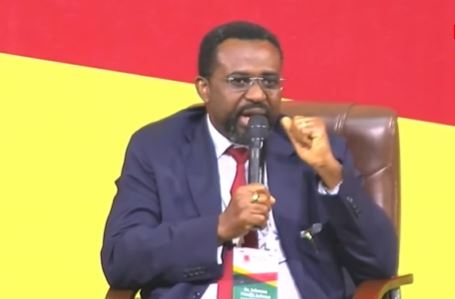
Speaking on Newsfile on Saturday, May 17, he said while the recent strengthening of the cedi is welcome, it is critical to examine the source of the gold being used in the central bank’s interventions.
“How do we consciously move away from this environmentally destructive growth model?” he asked.
“To what extent can the central bank and stakeholders assure us that the gold they are buying in terms of gold for reserves is from responsible miners?”
He warned that if Ghana continues to tolerate irresponsible mining in the name of shoring up reserves, the long-term consequences would be severe.
“Any intervention that causes considerable destruction to the environment in the name of getting more gold is not sustainable. At the end of the day, it will come back to bite us,” he said.
Prof. Bokpin expressed concern that efforts to tackle illegal mining and protect the environment could be undermined if the government’s gold-for-reserves strategy draws from unethical sources.
“We are putting considerable pressure on government to deal with irresponsible mining. But if the central bank’s purchases are indirectly supporting that same illegality, what message are we sending?”
Turning to the recent appreciation of the cedi, Prof. Bokpin acknowledged several contributing factors, including expenditure-based fiscal consolidation and tight monetary policy.
He explained, “Government is not spending. You check across ministries, departments, and agencies — not much is going out. That’s verifiable.”
He added, “When government is not spending and imports are low, the economy’s cash absorption capacity is restricted. Demand is subdued. So with improved FX flows — gold, cocoa, and remittances — the Bank of Ghana can step into the market, and that alone strengthens the cedi.”
However, he cautioned that the strengthening must be assessed for sustainability. “We’ve been in this country. Anytime the cedi strengthens, the real question is: can it last?”
Prof. Bokpin suspects the central bank is using the exchange rate as a tool to reduce inflation.
“They want to bring inflation down from the exchange rate point of view. But if the consideration is that we can’t tackle inflation from the supply side, then I don’t support strengthening the cedi this way.”
He argued that inflation should be tackled through supply-oriented policies instead of artificially pushing down the exchange rate.
“Supply-oriented policies will not coexist with what we are doing right now.”
He also questioned the strategy’s long-term implications. “Dragging down the exchange rate only makes imports cheaper. That doesn’t create jobs. It doesn’t build our economy.”
According to him, the market has largely adjusted to a rate of GHS15 to the dollar.
“If you’re pushing it down, to what point? The Bank of Ghana hasn’t communicated a target rate. That leaves the market guessing, and that uncertainty alone is disruptive.”
Prof. Bokpin advised that the current favourable FX inflows should be used to build reserves rather than just manipulating the exchange rate.
“Let’s build our reserves so that in the next 10 to 20 years, we can ensure long-term currency stability. That would be more helpful.”
He also pointed to inflation trends since November 2023.
“Inflation on locally produced items is now higher than imported inflation. You’re better off importing and paying all the duties than producing here. That’s a problem.”
In his view, without a clear policy direction and sustainable sourcing, the gold-for-reserves initiative risks not just economic distortion, but environmental degradation.
Latest Stories
-
Ghana, Germany deepen cooperation on railways, labour mobility
1 minute -
Huge crowds greet Pope in Paris for open-air Mass
12 minutes -
‘I never said I’ll declare a state of emergency’ – President Mahama on galamsey
52 minutes -
Bobby Banson condemns EOCO’s attempted arrest of Nana Agyei Baffour Awuah
1 hour -
When Kumasi begins to look like somebody is in charge
1 hour -
Parliamentary probe into cocaine seizure would be a waste of time – Inusah Fuseini
1 hour -
Cocaine seizure: Focus on Ghana’s reputation, not partisan blame – Osae-Kwapong
2 hours -
Two Invitations, Three Interrogations: Did Baffour Awuah tell the whole story?
2 hours -
Drug cartels may be seeing Ghana as easy route – Lenin Anane Agyei
3 hours -
Ghana risks gaining notoriety as drug-trafficking hub – Bobby Banson
3 hours -
Government dismissed my drug trafficking warning, then tried to arrest me – Ntim Fordjour
3 hours -
Day Two: 3rd Republic Bank-JoyNews Habitat Fair Clinic underway at Junction Mall
3 hours -
NACOC addressing inherited gaps in fight against drug trafficking – Deputy Director-General
3 hours -
Taekwondo goes to school as GTF launches five-region youth campaign
3 hours -
The issues Mourinho is struggling to fix at Real Madrid
3 hours