

Audio By Carbonatix
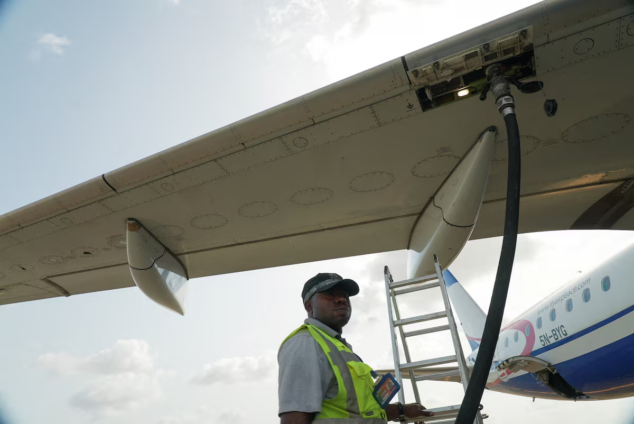
Airlines grappling with soaring jet fuel prices are facing a second blow as supply shortages disrupt flight schedules and crew rotations, industry groups and airlines said, heightening safety and operational concerns across Nigeria’s aviation sector.
The National Association of Aircraft Pilots and Engineers (NAAPE) said persistent scarcity of jet fuel has triggered widespread operational challenges, including flight delays, route adjustments, and extended crew duty periods, as airlines struggle to manage schedules amid rising costs.
NAAPE President Captain Bunmi Gindeh said ongoing fuel shortages were pushing crews beyond planned limits, increasing fatigue and potentially eroding safety margins in an industry governed by strict rest regulations.
Local carrier Rano Air said this week that jet fuel prices, which it said had more than quadrupled, had made some routes commercially unsustainable, forcing operational adjustments.
Other carriers have also begun rescheduling or cancelling flights and cutting unprofitable routes, industry sources said.
This comes at a difficult time for Nigeria’s aviation sector, already strained by foreign-exchange volatility, high aircraft maintenance costs, airport infrastructure strains and fuel price swings, after airlines last month threatened to suspend operations over what they described as crippling and artificially inflated jet fuel prices.
Nigeria’s airline industry carries millions of passengers annually across an extensive domestic network and plays a critical role in connecting cities where road travel is often slow or insecure, making reliable air services economically and socially important.
The Nigerian Midstream and Downstream Petroleum Regulatory Authority said fuel prices would not be capped (nL6N41B0N4), adding that any decisions on deregulated products would be formally communicated.
Fuel is one of the airlines' biggest cost components. While local refining capacity is expanding, with Dangote supplying most of the volumes, operators say prices remain prohibitive.
Analysts warn that prolonged disruption could strain crew scheduling, aircraft turnaround, and maintenance planning, with knock-on risks for safety oversight.
Latest Stories
-
He entered at eight. He is now 16: Ghana’s children growing up in prayer camps
2 hours -
‘Development must not always begin from Accra’ — Anwelle Foundation launched in Jirapa
2 hours -
PKO trio eye victories at Odwira Festival
5 hours -
346 Ghana Navy recruits pass out after 26 weeks of intensive training
5 hours -
Newsfile to discuss EOCO-MP arrest, drug trafficking, speech arrests and $235m water debt
6 hours -
JoyNews gets results as listeners raise GH¢40,000 to help 17-year-old student with cerebral palsy attend SHS
6 hours -
Vice President calls for stronger local pharmaceutical production to reduce medicine imports
6 hours -
The brewing tension at KNUST; Beware the Ides of October….
7 hours -
Health Ministry moves to integrate traditional medicine into mainstream healthcare
7 hours -
550 pupils in Kintampo South get educational lifeline as ‘Seeds of Hope’ reaches farming communities
7 hours -
Opoku Mensah urges Christian Council, House of Chiefs to speak up on democratic freedoms
8 hours -
Teacher unions’ strike: Minority demands immediate payment of teacher arrears, 20% deprived area allowance
8 hours -
The Accra-Kumasi Expressway: Building it right
8 hours -
Beyond gold exports: Building value and economic resilience from Ghana’s gold
8 hours -
2027 AFCONQ: Ghana under pressure as Gambia beat Somalia 2-1
8 hours