

Audio By Carbonatix
The Ghana Centre for Democratic Development (CDD-Ghana) is calling for a new legal framework to regulate political party financing, campaign spending and internal party elections in Ghana.
The organisation says gaps in the current electoral system could undermine transparency and accountability in political party elections and create risks for the country’s democracy.
The call comes less than two months before the New Patriotic Party (NPP) is expected to hold its internal national executive elections, making the regulation of campaign financing and party elections an increasingly important issue.
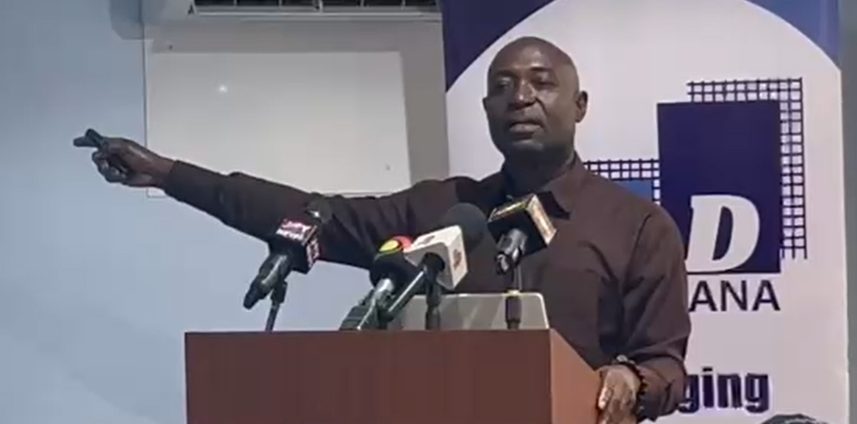
Speaking to journalists in Accra, a consultant for CDD-Ghana on Political Campaign Finance and Executive Director of the African Centre for International Law and Accountability, William Nyarko, said Ghana needs clearer rules governing the financing of political campaigns and internal party contests.
According to him, the absence of comprehensive legislation leaves important aspects of the electoral process insufficiently regulated.
One of the issues highlighted by Mr Nyarko was the high filing and nomination fees charged by political parties to candidates seeking internal party positions.
He questioned the justification for what he described as “astronomical” filing fees, particularly where the state could eventually bear the cost of organising party elections.
“I recognise the filing fees are astronomical,” Mr Nyarko said.
He said that political parties should be able to explain clearly why candidates are required to pay such high fees to contest internal elections.
“Because the state, if it can accept, will be footing the bill for the internal party primaries. You can ask for no justification for having that filing fees,” he said.
Mr Nyarko acknowledged that political parties often argue that the fees are necessary to fund the organisation of their elections.
“But the parties will tell you that they need the filing fees and nomination fees to organise their election,” he said.
He suggested that a proper legal framework should address the issue and establish clear rules on how such elections are financed, particularly when public resources are involved.
Mr Nyarko also pointed to the need for a stronger penalties regime to deal with violations of campaign finance and electoral rules.
He referred to provisions contained in a proposed model law, which he said provides for penalties of up to 5,000 penalty units for certain violations.
“The penalties framework in the model law defines 5,000 penalty units,” he said.
He explained that the value of the penalty could amount to GH¢60,000 based on the applicable penalty unit.
According to Mr Nyarko, the severity of sanctions would depend on the nature of the violation, with some breaches attracting penalties that could be twice the basic amount.
“Depending on the nature of the violation, it can go up to even twice,” he said.
He added that some violations could also result in a person being prevented from filing to contest an election.
“Preventing you from filing for election,” he said, highlighting one of the possible sanctions under the proposed framework.
Mr Nyarko also identified abuse of incumbency as an issue that should form part of the proposed legal framework.
“Of course, as part of it, abuse of incumbency really will be part of it,” he said.
Latest Stories
-
Ghanaian smock showcased at Lesotho Tourism Summit
3 minutes -
Four pupils to one desk: The painful plight of schools in New Juaben North
36 minutes -
Ipswich launch investigation into racist abuse of Abdul Fatawu
40 minutes -
Arrest of Techiman nurse is purely political persecution – ‘Ghana Jollof’
56 minutes -
Isak nets winner as Liverpool edge Bournemouth
1 hour -
I dare gov’t of Ghana to extradite me; they can never do it – ‘Ghana Jollof’ speaks
2 hours -
Semenyo scores twice as Manchester City beat Sunderland 5-3 in eight-goal thriller
2 hours -
Parliament calls for government-private sector collaboration to improve waste management
2 hours -
Volta Region described as cleanest so far in Parliament’s nationwide sanitation monitoring
2 hours -
Parliament urges MMDAs to enforce sanitation bylaws to curb indiscriminate waste disposal
2 hours -
Mohammed Kudus drops out of Ghana squad for AFCON 2027 qualifiers against Côte d’Ivoire and Gambia
3 hours -
Africa World Airlines unveils first Embraer E190 as part of 10-aircraft fleet expansion
4 hours -
Civilian hospitalised after alleged machete attack by prison officers, inmates
4 hours -
Toobu rejects calls to recall Parliament over 3.9-tonne cocaine shipment
5 hours -
Residents in 5 Northern Regions warned of approaching rainstorm
5 hours