

Audio By Carbonatix
Ghana could face a wave of strikes that could bring vital sectors to a standstill. Five unions already on strike are to be joined by five others by the end of September.
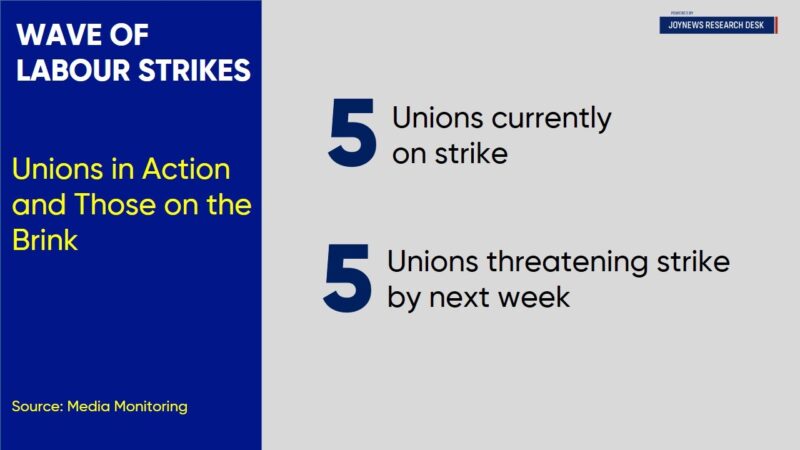
Here is a list of the unions, their dates of strike, and their demands;
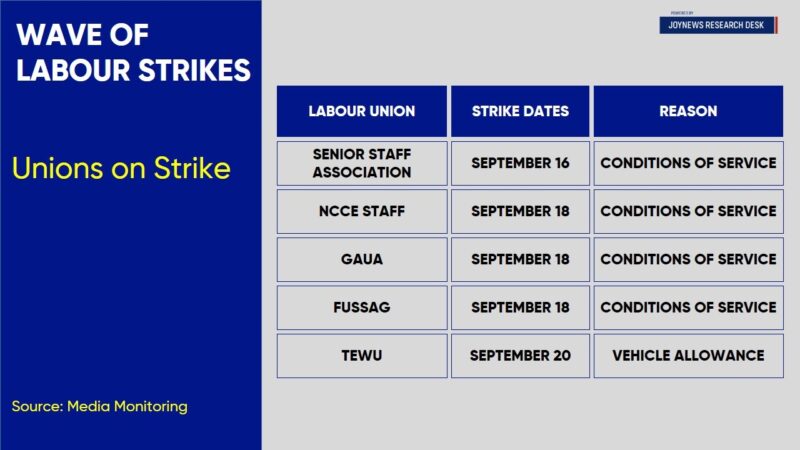
Groups Already on Strike
- National Commission for Civic Education (NCCE): On strike since September 18, 2024, the NCCE demands better working conditions and timely negotiations of proposals by the Fair Wages and Salaries Commission.
- Senior Staff Association of Universities of Ghana: Commenced their strike on September 16, 2024, they are calling for improved working conditions and the fulfillment of government promises made during previous negotiations, including vehicle maintenance allowances and Tier Two pension deductions.
- Teachers and Educational Workers Union (TEWU): TEWU declared an indefinite strike starting September 20, 2024, joining other unions in protesting what they say is the government's failure to meet their demands on the implementation of vehicle maintenance and off-campus allowances, and unresolved issues regarding delayed Tier Two pension deduction.
- Federation of Senior Staff Association of Ghana (FUSSAG): Initiated their strike on September 18th, primarily driven by demands for better working conditions and the fulfillment of previous commitments by the government.
- Ghana Association of University Administrators (GAUA): Also started their strike on September 18, 2024, over unpaid outstanding allowances despite a previous agreement with the government.
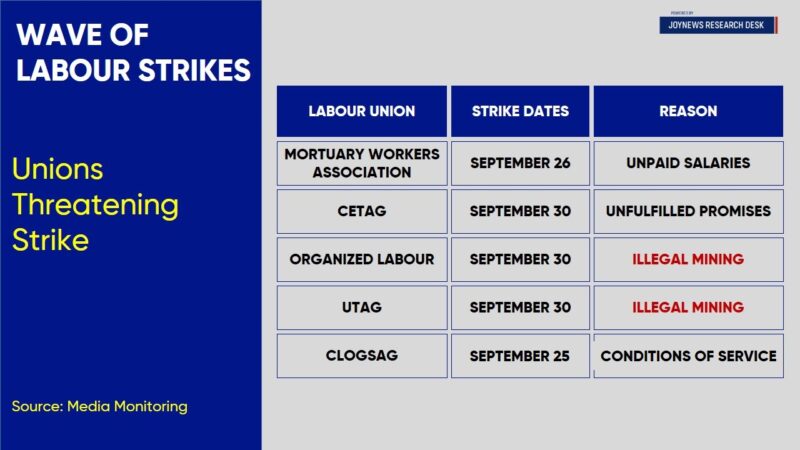
Groups Planning to Strike
- Colleges of Education Teachers Association of Ghana (CETAG): Set to strike at the end of September 2024 over conditions of service and the implementation of the National Labour Commission's (NLC) arbitrary awards.
- Mortuary Workers Association of Ghana (MOWAG): Planning to go on strike on September 26, 2024, due to poor working conditions, unpaid salary arrears, and lack of adequate personal protective equipment.
- University Teachers Association of Ghana (UTAG): Threatening to strike by the end of September 2024, demanding a total ban on all forms of small-scale mining and illegal mining to protect public health and the environment.
- Civil and Local Government Staff Association, Ghana (CLOGSAG): CLOGSAG is set to go on strike on the 25th of September 2024 over conditions of service.
- Organised Labour: Also planning to strike by the end of September 2024, calling for an order to halt all forms of mining in forest reserves and water bodies as well as the evacuation of all mining equipment in forest reserves and around water bodies. They are also calling for the immediate revocation of LI 12462 and withdrawal of all licenses that have been granted for prospecting mining in forest and protected reserves and also around water bodies Organised Labour in Ghana encompasses a variety of unions and groups under its umbrella, primarily coordinated by the Trades Union Congress (TUC). The TUC alone comprises 21 affiliated unions, representing a diverse range of professions and industries. They include;
- Communications Workers Union (CWU)
- Construction and Building Materials Workers Union
- General Agricultural Workers Union (GAWU)
- General Transport, Petroleum and Chemical Workers Union
- Ghana Federation of Labour (GFL)
- Ghana Mine Workers Union
- Ghana National Association of Teachers (GNAT)
- Ghana Private Road Transport Union (GPRTU)
- Ghana Union of Teachers (GUT)
- Health Services Workers' Union (HSWU)
- Industrial and Commercial Workers Union (ICU)
- Local Government Workers' Union (LGWU)
- Maritime and Dockworkers' Union
- National Union of Seamen, Ports and Allied Workers (NUSPAW)
- Public Services Workers Union (PSWU)
- Public Utilities Workers' Union (PUWU)
- Railway Workers' Union (RWU)
- Teachers and Educational Workers Union (TEWU)
- Timber and Woodworkers' Union (TWU)
- Union of Informal Workers Associations (UNIWA)
Potential Impact
The simultaneous strikes by these diverse groups threaten to disrupt essential services, including education, civic administration, and critical labour sectors. If the strikes proceed as planned, the impact on public services, education, and the economy could be profound, potentially leading to a national crisis.
The government and relevant stakeholders must act swiftly to address the concerns of these groups. Failure to do so could result in a nationwide halt, with significant socio-economic consequences. The nation watches and waits, hoping for a resolution that avoids widespread disruption and maintains the stability of essential services.
Latest Stories
-
Two-week strike will not derail academic calendar – GNAT President
6 minutes -
Headmaster detained after BBC investigation into alleged sexual abuse of students
16 minutes -
GNAT pushes for clear implementation procedures of teachers’ conditions of service
35 minutes -
Recurrent strikes threaten quality of education and academic calendars – Prof Bokpin
39 minutes -
‘Cockroach’ group leaders among hundreds detained in Delhi protest
42 minutes -
Don’t let speed of information become your judgement – CJ tells new lawyers
1 hour -
World Cup visa scandal: People have leveraged public office to facilitate fraud – Senyo Hosi
1 hour -
Glut! Farmers count losses as prices crash, customers happy
2 hours -
GSA postpones auction of unserviceable vehicles
2 hours -
Man charged with attempted murder after stabbing
2 hours -
World Cup visa scandal: Senyo Hosi says issue goes beyond calls for Sports Minister’s resignation
2 hours -
Yaw Ampofo Ankrah hasn’t taken or received any money to facilitate visas – Lawyer insists
2 hours -
World Cup visa scandal: Senyo Hosi urges focus on constitutional accountability
2 hours -
La Beach demolition: Senyo Hosi condemns lack of consultation
3 hours -
Russian glide bomb attack on Zaporizhzhia kills at least 15 people
3 hours