

Audio By Carbonatix
In a significant gesture of solidarity, the European Union has reinforced its partnership with Ghana, a country at the heart of West Africa, where both security and development challenges loom large.
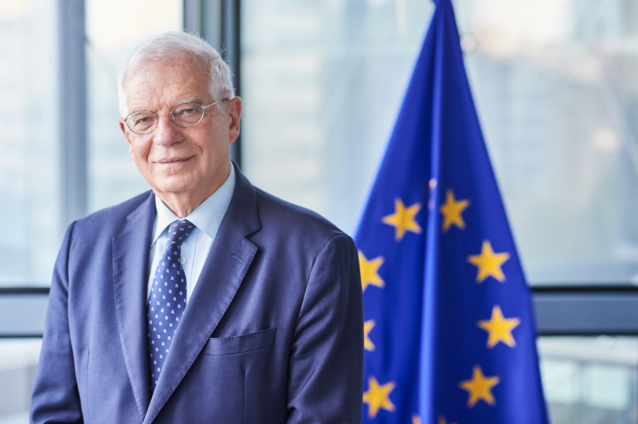
As part of this ongoing commitment, Josep Borrell Fontelles, High Representative of the European Union for foreign affairs and security policy, is embarking on a visit to Accra, bearing a valuable gift – 105 armored vehicles in the first phase.
Additional essential military equipment, including drones, will be provided in a subsequent phase. The combined value of both the first and second phases is €20 million. This tangible support aims to bolster the security of the Ghanaian people, ultimately fostering stability throughout the entire region.
“Of course, tackling Ghana’s security challenges requires more than armoured vehicles and drones. Successful conflict prevention requires improved public services provision and employment, mediation and dialogue. Vulnerable communities, and youth of Ghana in particular, look for a brighter future. The EU is currently investing more than €220M in the Northern regions of Ghana precisely to address that challenge,” he stated.
Josep says, West Africa grapples with the complex interplay of terrorism and political instability, and it is in this context that the EU extends its support. Acknowledging the gravity and vast scope of these security challenges, he states that, President Nana Akufo-Addo, Ghana's leader, has been a steadfast advocate for the rule of law, democracy, and stability in West Africa. His unwavering efforts, including his role as Chairman of ECOWAS, underscore Ghana's pivotal position in the region.
According to him in a statement shared with JoyNews Mahmud Mohammed-Nurudeen, the EU-Ghana partnership has evolved to become a key security collaboration and this partnership transcends security concerns and is fundamentally about building a future that resonates with the aspirations of both African and European generations.
“Since 1957, the EU and Ghana have developed a long-standing and diverse collaboration. Critical infrastructures were part of our first area of cooperation. Together with its Member States, the EU currently serves as the first Foreign Direct Investor in the country, investing in car assembly lines, oil and gas industry, banana plantation, cocoa processing, and much more.
With significant EU support both to public bodies and to the private sector, Ghana is on track to become a major producer of vaccines, including against cholera and malaria. Ghana will provide some of the most needed vaccines, not only for Ghanaian citizens but for the entire African continent and beyond.”
Addressing youth unemployment, a shared challenge for Europe and Africa, remains a focal point. He indicates in the past five years, over 50,000 young Ghanaians and 100,000 small and medium-sized enterprises have benefited from EU programs spanning various sectors, from agribusiness to e-waste recycling and renewable energy solutions.
“In our digital age, access to reliable information is paramount. This involves EU investments in digital infrastructure, digital literacy programmes, and initiatives to promote digital innovation. In 2022, the EU and Ghana launched a “Pact for Skills” that will offer new digital solutions and training packages to more than 10,000 Ghanaians, to help break glass ceilings. Last July, a first group of students received training in state-of-the-art 3D character animation in Accra.
Besides, the EU Erasmus+ program allowed close to 2,000 Ghanaians to acquire world-class higher education. This year alone, we sent 60 Ghanaian students to cities like Vilnius, Lisbon, Lyon, and Hamburg in renowned universities across Europe. Erasmus+ offers a unique opportunity to create bonds between future leaders, who will shape the Europe and Ghana of tomorrow.”
As Josep Borrell Fontelles highlights, the EU-Ghana partnership is not only about the present but also about building a future that transcends boundaries and fosters prosperity, hope, and a sustainable shared destiny. This enduring partnership signifies a commitment to unity, resilience, and progress, both in Africa and in Europe.
“Climate change is a shared area of concern. Our partnership actively invests in climate mitigation and adaptation, making Ghanaian cities “smarter”, focusing on renewable energy projects, reforestation initiatives, and sustainable agricultural practices. Three weeks ago, Ghana made great strides towards more sustainable management of forests, becoming soon the first African country to issue FLEGT licences.”
Latest Stories
-
‘There is no competition’ – Justin Kodua confident of NPP General Secretary re-election
2 hours -
J100 Accra Doubles Champions : Kolesolva/ Ndukwa, Agarwal/Patel seal title victories
2 hours -
Sydney Wright crowned J100 Accra Champion
2 hours -
J100 Accra Boys’ Singles: Verma denies Beckles back-to-back titles to claim crown
2 hours -
Two friends fined GH¢12,000 for stealing
2 hours -
Son jailed for threatening to stab mother
2 hours -
Drive constitutional reform – GJA urges journalists
3 hours -
NPP Delagates Congress: Confusion delays voting at Ashanti Region TESCON centre
3 hours -
Fire ravages shops, houses near Koforidua Central Police Station
4 hours -
NPP Delegates conference: The wisdom of the masses will prevail – Napo
4 hours -
Flydubai co-pilot attacked captain with axe, UAE official says
4 hours -
NPP Bosome Freho Constituency Chairman reportedly arrested over ballot paper incident
5 hours -
Medical plane with 6 on board missing off Massachusetts coast
5 hours -
Bolt driver jailed 25 years for robbing beautician
5 hours -
Happy 76th Birthday to the Daily Graphic!
5 hours