

Audio By Carbonatix
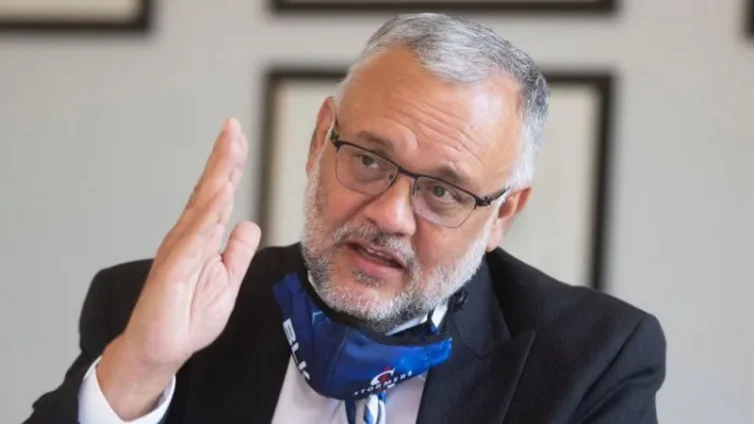
South Africa's former ambassador to the US has told the BBC it is “self-evident” that there is racism within the Trump administration.
Ebrahim Rasool, 62, was ordered to leave the US last week after Secretary of State Marco Rubio called him a "race-baiting politician who hates America".
This came after Rasool accused President Donald Trump of trying to "project white victimhood as a dog whistle".
Asked by the BBC's Newshour programme whether he believed the Trump administration was racist, Rasool said: "I think it is self-evident rather than anyone needing to be called out.”
The BBC has asked the White House for comment.
In one of his first interviews since being expelled from the US, Rasool added: "I'm saying when a piece of wood has a hinge, you begin to suspect it's a door."
The diplomat cited the administration's emphasis on deportating migrants as well as the targeting of foreign students who had supported pro-Palestinian protests. He also accused Trump's team of mobilising "certain far-right communities".
The Trump administration has denied accusations of racism. The president says he has a mandate to deport thousands of migrants who entered the US illegally after it formed a central part of his election campaign last year. Secretary of State Rubio has defended revoking student visas for those who "cause chaos" on college campuses.
US-South Africa relations have deteriorated sharply since Trump returned to power in mid-January.
Since taking office, Trump and his ally, South-Africa born Elon Musk, have singled out South Africa for special criticism, in particular over its land reform policies.
Trump has cut all aid to the country, and despite his hard-line stance on most refugees and asylum seekers he says that members of South Africa's white, Afrikaner community would be granted refugee status in the US, because of the persecution he said they faced at home.
South Africa's government says it is trying to correct the country's racial and economic imbalances following decades of white-minority rule, by passing measures to help the country's black majority.
Rasool denied that the Afrikaner population was facing discrimination.
"It is an unadulterated lie because it tries to besmirch the very DNA of a new South Africa that was born under the leadership of someone like Nelson Mandela," he told the BBC World Service in one of his first interviews since arriving back in South Africa.
When questioned whether his language was undiplomatic, Mr Rasool said: "It's not as if being a good boy warded off any punishment. It was that at some point South Africa's dignity is also at stake – you can't smile through too many untruths being told about your country."
After returning home to a hero's welcome on Sunday, Rasool said he had no regrets about his remarks.
Asked by the BBC on Friday whether he was surprised by the reaction to his utterances, Rasool said the surprise for him was the "thinness of the skin" of the US administration and its "ability to dish out and not to accept an intellectual dissecting of what is [said]".
"We've smiled through a lie about white genocide, we've smiled through the punishment of cutting all aid... we've smiled through all of that.
"We've tried all the conventional ways to get [to] them until you hit a brick wall and you begin to say: This is not the normal phenomenon of diplomacy."
While he accepted that his role as a diplomat was to try and "maintain a line of communication" and integrity, Rasool said: "Diplomacy is not to flatter your host into into liking you. Diplomacy is not lying along and making as if lies are truth.
"I think what I did was to the best of my intellectual capacity to describe a phenomenon back home in order for me to alert them that it cannot be business as usual."
Relations between the US and South African, characterised by ups and downs over the years, hit rock bottom earlier this year when Trump cut aid to the country citing the new Expropriation Law, which allows the government to confiscate land without compensation in certain circumstances.
Another bone of contention for the US has been the case lodged by South Africa against Israel at the International Court of Justice (ICJ) in December 2023.
South Africa has accused Israel of committing genocide against Palestinians living in Gaza, an allegation Israel denies.
Rasool returned to the US last year after having previously served as US ambassador from 2010 to 2015, when Barack Obama was president.
Latest Stories
-
SSNIT says La Beach clearance was to protect hotel investments, beaches to remain public
32 minutes -
APSU congratulates St Augustine’s College after back-to-back National Investment Quiz wins
36 minutes -
Renewed flood intervention at Mallam Junction raises hopes among residents, businesses
1 hour -
St Augustine’s College retain National Investment Quiz title after nail-biting grand finale
1 hour -
Education infrastructure investment will drive Banda’s development – Ahmed Ibrahim
2 hours -
Teacher unions strike: Gov’t presents fresh proposals as talks end inconclusively
2 hours -
51,000 teachers’ promotion arrears to be validated for October payment – Education Minister
3 hours -
Kwabena Boamah appointed Board Chair for Impact Investing Ghana
3 hours -
Striking teacher unions to meet Fair Wages and Salaries Commission on October 6
3 hours -
EOCO working with AG to arraign Nana Baffour Awuah before weekend court
3 hours -
Duraplast reassures customers after fire, announces October 5 reopening
3 hours -
Call off strike, gov’t will not renege on promotion arrears pledge – Haruna Iddrisu to teacher unions
3 hours -
Committee set up to validate teachers eligible for 20% deprived-area allowance – Education Minister
3 hours -
Five-member committee to search for new Black Stars coach after Sports Ministry-GFA meeting
4 hours -
Pinktober: Breast cancer survival exceeds 90% when detected early – Breast Society of Ghana
4 hours