

Audio By Carbonatix
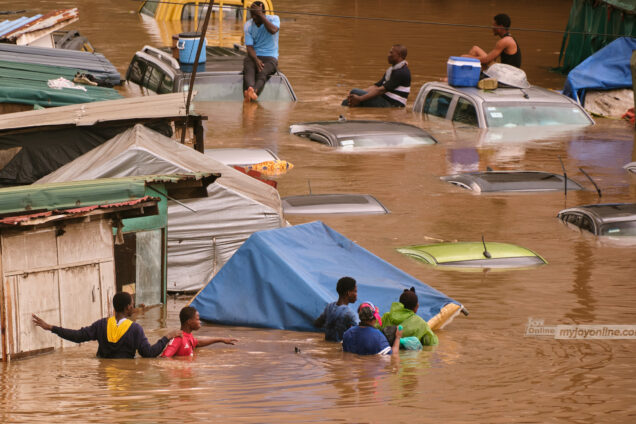
The Minister for the Interior, Muntaka Mohammed-Mubarak, has disclosed that the number of people who lost their lives in recent devastating floods that struck parts of the country in June has risen to 35, with six others still unaccounted for, as the government intensifies relief and recovery efforts.
Providing an update to Parliament on Tuesday, July 7, the Minister said the fatalities were recorded across the Central, Greater Accra and Volta regions, which bore the brunt of separate flood disasters during the month.
According to him, the Central Region recorded the highest number of deaths after severe flooding occurred about a week before the June 29 downpour that devastated parts of the Greater Accra Region.
"If you recollect, for the Central Region, a week before the 29th, that's when they had their biggest disaster, where, in the Central Region, we lost 18 people," he told Parliament.
He explained that the flooding in Greater Accra on June 29 initially claimed 12 lives, with seven persons reported missing.
However, the discovery of another body on Monday has increased the confirmed death toll in the region to 13, while the number of missing persons has reduced to six, subject to official confirmation.
"I was told that yesterday a body was found. If that was found dead, that means it takes the dead to 13, missing six," the Minister stated.
He further indicated that the Volta Region also recorded fatalities from flood incidents earlier in June.
"Volta also had some deaths before the 29th and there the record we have is that four people lost their lives," he said.
Based on the latest figures, the Minister said the cumulative number of deaths arising from the June flood disasters now stands at 35.
He added that if the latest body recovery is not formally confirmed, the figures would remain at 34 deaths and seven missing.
58,000 displaced in Accra
Mr Mohammed-Mubarak also painted a grim picture of the humanitarian impact of the disaster, revealing that approximately 58,000 people were displaced in Accra alone following the June 29 floods.
"The terms of displacement, I mean, it's really massive because Accra alone those who were displaced were 58,000," he told the House.
The floods, triggered by torrential rains on June 29, inundated several communities across the Greater Accra Region, destroying homes, businesses and public infrastructure while forcing thousands of residents from their homes.
The disaster also affected parts of the Central and Volta regions, with emergency agencies continuing search, rescue and relief operations.
Government prepared shelters
The Interior Minister disclosed that government had established several temporary shelters to accommodate displaced residents, including facilities managed by the Ministry of Gender, Children and Social Protection, the National Disaster Management Organisation (NADMO), the National Security Secretariat and other state agencies.
He said one shelter under the Gender Ministry could accommodate about 200 people, while another at Ashaiman had the capacity to house 1,000 displaced persons.
The government had also prepared an additional bunk-bed facility capable of accommodating another 1,000 people, with plans to expand capacity further by converting office spaces into temporary accommodation centres.
"In fact, we were preparing additional mattresses that could give additional places... because there were offices that we could use for people," he said.
Another National Security facility, he added, was capable of housing approximately 300 people.
Victims preferred relatives' homes
Despite the availability of temporary shelters, Mr Mohammed-Mubarak said many flood victims declined government's offer of accommodation, opting instead to stay with relatives and friends.
According to him, officials encountered resistance while encouraging affected residents to relocate to the designated shelters.
"We were going around asking people, 'Come and let's go,' and people said, 'No, just give me the relief item. I have a cousin who is assisting me. I have a niece or I have a brother,'" he recounted.
He stressed that government could not compel displaced persons to move into shelters against their wishes.
"They refuse, and you can't say that because you are displaced, I'm going to use the ability to force you into a bus and go and keep you where you don't want," he added.
The latest figures come as government, through NADMO, the Ghana Armed Forces and other emergency agencies, continues relief distribution, debris clearance and flood mitigation measures in affected communities.
Authorities have also stepped up public health surveillance amid concerns about possible outbreaks of waterborne diseases following the widespread flooding, while engineering teams continue work to desilt drains, clear waterways and restore damaged infrastructure.
Latest Stories
-
Mobile Money Fintech LTD, UMB train hairdressers and beauticians
18 minutes -
Asylum votes show people want help, says Kemi Badenoch
1 hour -
Badenoch welcomes expanded grooming gangs inquiry
1 hour -
GACL MD sues Samuel Buabeng over alleged Facebook defamation
2 hours -
Christa Pike in critical condition after surviving two lethal injections, lawyer says
2 hours -
Kemi Badenoch backs face covering ban at protest
2 hours -
Man City not ‘above the rules’, says No 10 after backlash to Burnham remarks
2 hours -
Real Madrid submit ‘substantial’ dossier in Barca payments case
2 hours -
Messi completes purchase of second Spanish club
2 hours -
Government must engage horticulturists on tomato crisis – GhIH
2 hours -
King Promise’s ‘Can’t Tame Us’ becomes official Chelsea anthem
2 hours -
Afenyo-Markin demands Baffour Awuah’s release from EOCO’s custody, end to alleged political intimidation
2 hours -
Rapper Rick Ross arrested on domestic violence charges
3 hours -
Minority demands security review of Ghana-Colombia visa waiver and port deals
3 hours -
Pursue drug kingpins, not persecute political opponents – Afenyo-Markin tells EOCO
3 hours