

Audio By Carbonatix
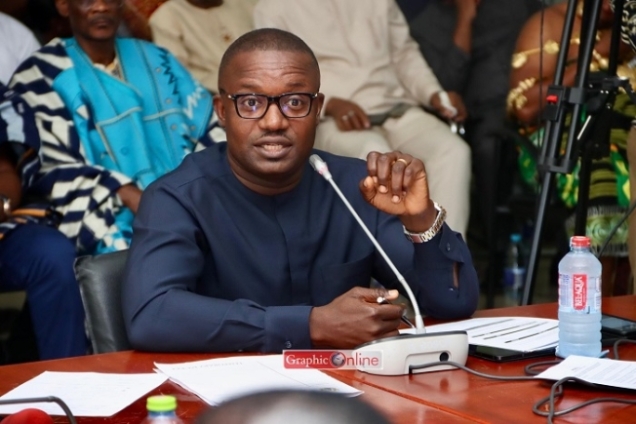
Ghana’s energy sector has attained stability with surplus power being exported to neighbouring countries, the Minister of Energy and Green Transition, John Abdulai Jinapor, has disclosed.
He said government was now turning its attention to expanding renewable energy and bridging energy access gaps across the country.
Speaking at a press conference during the 7th Regional Committee Meeting of the International Solar Alliance (ISA) for Africa in Accra on 4 September, Mr Jinapor stressed the importance of ensuring every Ghanaian household has access to electricity.
“Our power supply is fairly stable. We have enough, and we are even exporting. Our vision is to have a minimum of 10 per cent of our energy mix emanating from renewables, and that even excludes our hydro potential,” he stated.
The minister revealed that government plans to roll out solar-powered irrigation pumps nationwide to promote all-year-round farming, particularly in the dry season. According to him, India has agreed to partner Ghana in this initiative, which will also include the training of local artisans.
“India has pioneered it, and we want to learn from them. They have agreed that they will collaborate with us,” he said, noting that a Memorandum of Understanding would soon be signed.
At the ISA summit, which brought together 19 African Energy and Power Ministers alongside representatives of 39 member states and seven signatories, delegates examined solutions to Africa’s widening energy crisis.
Mr Jinapor lamented that over 600 million Africans still lacked access to electricity while nearly one billion people had no clean cooking options.
Despite being the sunniest continent, he observed, Africa generates only four per cent of global solar power and attracts less than two per cent of clean energy investment.
“Universal access to energy is not merely a development goal, it is a moral imperative,” he said.
The Director-General of ISA, Ashish Khanna, announced the ratification of the Africa Solar Facility—a $200 million catalytic fund designed to mobilise over $800 million in private investment for decentralised renewables, beginning in Nigeria.
He further revealed that 12 solar technology education centres would be set up across Africa, including one in Ghana, to build technical expertise, youth innovation, and research capacity in solar energy.
Latest Stories
-
Zonda Tec launches HOWO T3M truck to support agric and logistics
6 minutes -
Obuasi SHTS scandal: Eduwatch calls for sex offenders’ register and mandatory background checks for teachers
18 minutes -
GloMeF CEO urges intensified public education on new road traffic regulations
30 minutes -
‘Any tax on ChatGPT is an attack on education and innovation’- Akim Swedru, MP
33 minutes -
Obuasi SHTS sexual abuse scandal exposes systemic failure in child protection – Moving Masculinity
34 minutes -
Hubtel CEO calls for national data-sharing framework to boost AI development
36 minutes -
Twelve Golden Rules of real estate development in Ghana, Africa
41 minutes -
Five new telephony cell sites in Ashanti Region to be activated in October 2026 – Sam George
41 minutes -
Mahama cuts sod for Afienya Industrial Park, targets 120 enterprises
46 minutes -
Rush for fuel from accident tankers is stealing, punishable by law – NPA boss, Edudzi Tamakloe
52 minutes -
GhIG pushes for legislation to regulate geoscientists’ activities
58 minutes -
Mfantsipim @150: Ace Anan Ankomah leads project to preserve school’s musical heritage
1 hour -
Gov’t launches rCOMSDEP in Ahanta West, Mpohor Fiase to promote responsible community mining
1 hour -
AI is forcing professionals to rethink how they deliver value – Hubtel CEO
1 hour -
Daily Insight for CEOs: Strengthening the CEO’s Leadership Legacy
1 hour