


Audio By Carbonatix
The Land Use and Spatial Planning Authority (LUSPA), under the Ministry of Local Government, Chieftaincy and Religious Affairs (MLGCRA), has launched a revised Manual for the Preparation of Spatial Plans and Zoning Guidelines and Planning Standards to promote coordinated and sustainable spatial development across Ghana.
The launch, held in Accra on November 3, 2025, marks a major milestone in Ghana’s efforts to improve land use and spatial governance for resilient and well-planned communities.
Speaking at the event, Deputy Minister for Local Government, Chieftaincy and Religious Affairs, Rita Naa Odoley Sowah, reaffirmed government’s commitment to structured spatial planning as a key driver of Ghana’s sustainable development agenda.
“Effective spatial planning is fundamental to how land is used and managed to create safe, inclusive, resilient and vibrant human settlements,” she said.
The revised manual and guidelines outline a clear step-by-step process for preparing spatial plans and applying zoning standards in land development and infrastructure delivery. They align with key national legal frameworks, including the Land Use and Spatial Planning Act, 2016 (Act 925), the Land Use and Spatial Planning Regulations, 2019 (L.I. 2384), and the Local Governance Act, 2016 (Act 936).
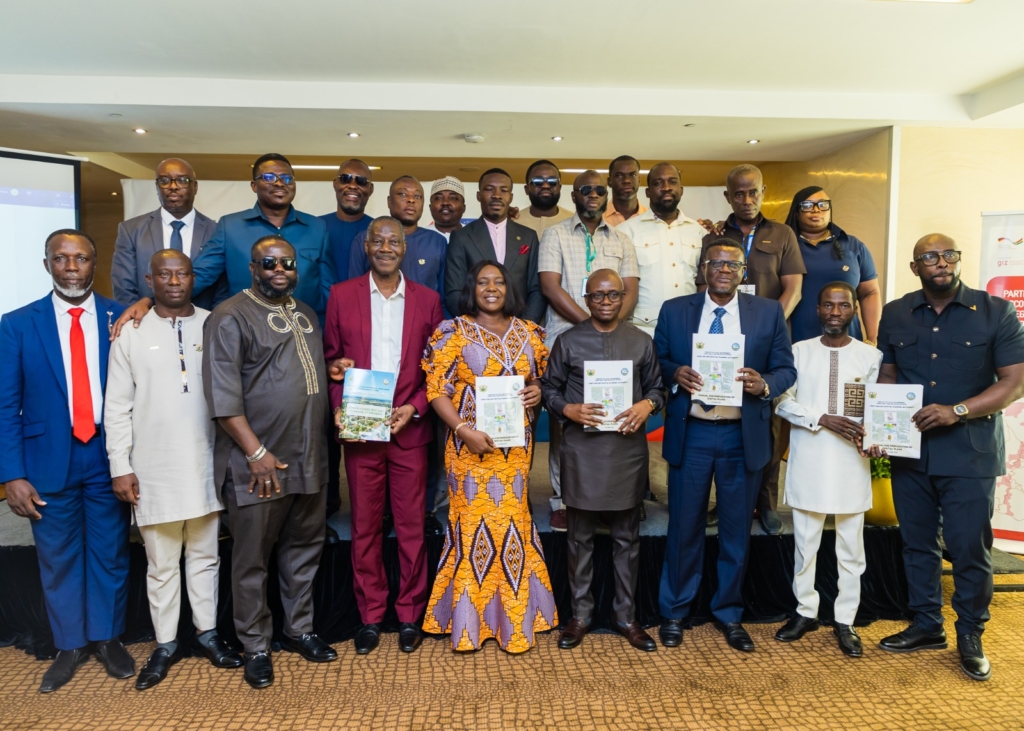
The documents are designed to help districts integrate spatial and development planning to ensure efficient use of resources, equitable access to social amenities, and protection of the environment. They also aim to make land use planning more participatory by involving traditional leaders, local authorities, professionals, and community members.
Revised Documents to Transform Spatial Planning
LUSPA’s Chief Executive Officer, Dr. Kwadwo Yeboah, said the revised documents will help transform spatial planning practices across the country.
“They provide direction and guidance to all stakeholders, particularly Metropolitan, Municipal and District Assemblies, to prevent issues like industrial pollution in residential areas and to promote economic stability and environmental protection,” he noted.
The revision process involved extensive desk studies, technical reviews, regional consultations, and validation workshops with stakeholders from the public and private sectors.
The initiative received support from the Participation, Accountability and Integrity for a Resilient Democracy (PAIReD) programme, commissioned by the German Federal Ministry for Economic Cooperation and Development (BMZ), co-funded by the European Union (EU) and the Swiss State Secretariat for Economic Affairs (SECO), and implemented by GIZ in collaboration with Ghana’s Ministry of Finance.
Speaking on behalf of PAIReD, Laetitia Erny, Component Manager of the programme, emphasized the need for coordinated and transparent spatial planning.
“The absence of data-driven and coordinated planning creates room for overlapping claims and inefficiencies in land and natural resource management. That’s why all stakeholders must work together to ensure sustainable spatial, economic and environmental development,” she said.
With the launch of the revised manual and guidelines, Ghana is reinforcing its commitment to efficient land use, participatory governance, and environmentally sustainable development for all communities.
Latest Stories
-
Ghana to host high-level conference on scaling education initiatives in emergencies
2 minutes -
Democracy must not be for sale: Who pays for Ghana’s politics, and how do we confront money, influence and accountability?
18 minutes -
Aburi Amanfrom landowners appeal for government support for Atwapim development project
22 minutes -
Cargill Ghana and International Cocoa Initiative celebrate 111 young graduates building skills for the future
44 minutes -
Video: Madina MP Francis-Xavier Sosu collapses while addressing students at GIMPA
46 minutes -
Hunnyboy reveals how social media landed him Shatta Wale feature
51 minutes -
I am a perfectionist – Actor William Lamptey
55 minutes -
No room for another false start as Ghana begin AFCON qualifying campaign
1 hour -
“We are grateful for what you have achieved” – AGI President tells Finance Minister
1 hour -
“No Nation is Inferior”: Mahama champions human dignity and security council reform at the UN
2 hours -
Manhyia South residents, NPP executives fume over botched EOCO arrest of MP
2 hours -
Mahama unveils new deal with global philanthropy
2 hours -
Daily Insight for CEOs: Building customer-centric leadership
2 hours -
Democracy must deliver food, jobs and healthcare, not just elections – Mahama
2 hours -
Capacity constraints must never be a barrier to restitution – Mahama
2 hours