

Audio By Carbonatix
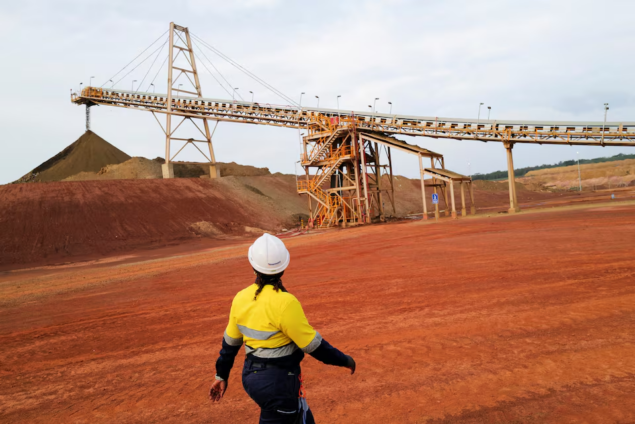
Ghana’s union of mineworkers has warned it would continue to oppose a government policy that requires international companies to hire local firms as mining contractors, even though many large miners have already complied with the regulation introduced last year.
The union president, Abdul Moomin Gbana, told Reuters on Friday that local contractors pay lower rates to workers and offer less job security than foreign firms, and that the legislation will hurt ordinary miners.
The union, which represents about 14,000 workers, vowed to mount stiff resistance to the policy, including possible strikes and protests.
Africa's top gold producer has directed companies, including Newmont (NEM.N), opens new tab, Zijin (601899.SS), opens new tab and AngloGold Ashanti (AU.N), opens new tab, to fully shift mining activities - blasting, loading, hauling and dumping - to local contractors by December 2026 or face sanctions, as part of reforms to boost local participation, Reuters reported.
Rules introduced in January 2025 require surface mining to be carried out by fully Ghanaian‑owned firms, while underground mining must be handled by companies with at least 50% local ownership.
Mining executives have criticised the policy as anti‑business and unlawful, arguing it conflicts with Ghana’s mining law, which allows leaseholders to determine how mining is conducted.
Previous resistance failed
Ghana’s mineworkers in 2017 to 2018 failed to stop Gold Fields' (GFIJ.J), opens new tab voluntary shift from owner mining to local contract mining, including through a court challenge, Gbana said. This opened the door for more companies.
The mineworkers' union was not consulted on the current regulation, he said. He accused authorities of sidelining labour concerns.
“The growing reliance on contract mining is reversing hard‑won labour protections,” he said, adding that the changes would have a “huge impact on workers.”
The group has petitioned the mining regulator and the lands ministry, according to a letter seen by Reuters on Friday.
"Any attempt to proceed with this policy in its current form will be met with strong, coordinated and sustained resistance," the letter said.
Wage gap fuels worker concerns
Gbana said local contractors typically pay lower wages and offer weaker job security, with some workers already raising concerns over unpaid statutory deductions such as pensions and provident funds.
Contractor workers typically earn around 50% less in basic pay than employees directly hired by mine operators, a staff member at a local contractor told Reuters.
Gbana said even if staffing levels were maintained, wages and benefits would fall, eroding gains secured over years of collective bargaining.
He added that some established local contractors had failed to meet workers’ expectations.
Latest Stories
-
‘There is no competition’ – Justin Kodua confident of NPP General Secretary re-election
53 minutes -
J100 Accra Doubles Champions : Kolesolva/ Ndukwa, Agarwal/Patel seal title victories
55 minutes -
Sydney Wright crowned J100 Accra Champion
59 minutes -
J100 Accra Boys’ Singles: Verma denies Beckles back-to-back titles to claim crown
1 hour -
Two friends fined GH¢12,000 for stealing
1 hour -
Son jailed for threatening to stab mother
1 hour -
Drive constitutional reform – GJA urges journalists
2 hours -
NPP Delagates Congress: Confusion delays voting at Ashanti Region TESCON centre
3 hours -
Fire ravages shops, houses near Koforidua Central Police Station
3 hours -
NPP Delegates conference: The wisdom of the masses will prevail – Napo
3 hours -
Flydubai co-pilot attacked captain with axe, UAE official says
3 hours -
NPP Bosome Freho Constituency Chairman reportedly arrested over ballot paper incident
4 hours -
Medical plane with 6 on board missing off Massachusetts coast
4 hours -
Bolt driver jailed 25 years for robbing beautician
4 hours -
Happy 76th Birthday to the Daily Graphic!
4 hours