

Audio By Carbonatix
President John Mahama has announced reforms to enable Ghana to buy cocoa in Cedis and to stop exporting raw mineral ores by 2030, marking a shift toward economic sovereignty.
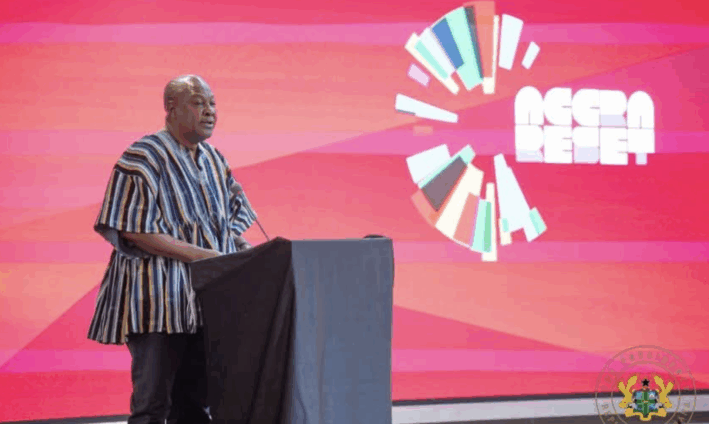
A statement issued by Ghana’s Presidency said the President made the announcement at the closing of his high-level side event, “Accra Reset’s Addis Reckoning,” held on the sidelines of the 39th African Union Assembly of Heads of State and Government in Addis Ababa, Ethiopia.
President Mahama outlined immediate steps to end what he described as exploitative financing arrangements that have long constrained Ghana’s cocoa sector.
“One of the key decisions we’ve made is to stop accepting foreign funding for the purchase of our cocoa. We will raise domestic bonds. We have enough Cedis in Ghana to pay for our cocoa,” he declared.
He said Ghana’s cocoa crisis had exposed structural weaknesses. After a producer price was set when international cocoa traded at $ 7,200 per tonne and the Ghanaian cedi stood at 11.5 to the dollar, subsequent market shifts led to losses when prices fell to $4,200 per tonne, and the cedi appreciated to 10.7 per dollar.
President Mahama explained that under existing foreign financing arrangements, cocoa beans are used as collateral.
“You know what the collateral for the funding is? Our own cocoa beans. You collateralise the beans with the financier, buy them, ship them, and they pay you the international market price,” he said.
He noted that although Ghana has the capacity to process 400,000 tonnes of cocoa locally, the collateralisation arrangement prevents allocation of beans to domestic processors. “We must ship all the beans outside,” he added.
Under the new plan, Ghana will raise domestic bonds in Cedis to purchase cocoa directly from farmers, eliminating the need to pledge beans as collateral and unlocking 400,000 tonnes for local processing, with the potential to create thousands of jobs and retain more value within the economy.
The President also set a firm deadline to end the export of unprocessed minerals.
“I say by 2030, there won’t be any raw mineral ores leaving Ghana. You’re not going to ship raw manganese ore out of Ghana. You’re not going to ship raw bauxite ore out of Ghana. You’re not going to ship raw iron ore out of Ghana. You must process all that locally,” he stated.
He said the measures form part of the broader Accra Reset philosophy, a continental initiative aimed at scaling up development by asserting sovereignty over natural resources and expanding domestic processing capacity.
President Mahama linked the reforms to rising expectations among Africa’s youthful population.
“That is the only way we can provide opportunities for our young people. Our young people are less patient than our generation. They want to see that progress and prosperity today,” he said.
He connected the urgency to migration pressures, stating that implementation was necessary to stop young Africans from “braving the dangers of the Sahara and the Mediterranean” in search of opportunity.
Emphasising the need for swift action, he endorsed moving ahead with willing partners if consensus delays progress.
“We come with the decisions. We agree. We do the frameworks. What is missing is urgency and implementation. We take time. And we behave like time is waiting for us,” he said.
“That is why Accra Reset is a good idea. But let’s implement urgently. If parts of the continent are not ready, let’s form a coalition of the willing to move this as quickly as possible. And let all the others follow and join.”
The Accra Reset initiative envisions restructuring Africa’s economic relations with global powers by prioritising value addition, industrialisation, and resource sovereignty as pathways to prosperity for the continent’s 1.4 billion people.
The announcements in Addis Ababa signal Ghana’s intention to lead by example with concrete measures that other African nations may replicate.
“From Addis, we must stop talking and start implementing,” President Mahama concluded, describing the gathering as “the Addis reckoning.”
Latest Stories
-
MTN set to deploy 5G services after winning spectrum licenses worth US$202m
1 hour -
NPP national elections: 3,000–4,000 police to handle security, traffic in Kumasi – Karbo
3 hours -
Atta Akyea fumes as Manhyia MP is to spend another night in EOCO custody
4 hours -
SSNIT says La Beach clearance was to protect hotel investments, beaches to remain public
5 hours -
APSU congratulates St Augustine’s College after back-to-back National Investment Quiz wins
5 hours -
Renewed flood intervention at Mallam Junction raises hopes among residents, businesses
5 hours -
St Augustine’s College retain National Investment Quiz title after nail-biting grand finale
6 hours -
Education infrastructure investment will drive Banda’s development – Ahmed Ibrahim
6 hours -
Teacher unions strike: Gov’t presents fresh proposals as talks end inconclusively
6 hours -
51,000 teachers’ promotion arrears to be validated for October payment – Education Minister
7 hours -
Kwabena Boamah appointed Board Chair for Impact Investing Ghana
7 hours -
Striking teacher unions to meet Fair Wages and Salaries Commission on October 6
7 hours -
EOCO working with AG to arraign Nana Baffour Awuah before weekend court
7 hours -
Duraplast reassures customers after fire, announces October 5 reopening
7 hours -
Call off strike, gov’t will not renege on promotion arrears pledge – Haruna Iddrisu to teacher unions
7 hours