

Audio By Carbonatix
Ghana’s urban water supply system is under severe financial and operational strain, with the Ghana Water Limited (GWL) grappling with a widening supply deficit, a massive debt burden, and more than half of treated water lost before reaching customers, according to a new situational analysis.
The February 2026 report, which synthesises data from the Public Utilities Regulatory Commission (PURC) and GWL’s tariff proposals, shows that the state-owned utility currently produces about 945,275 cubic metres of water daily, far below the national urban demand of 1.19 million cubic metres, resulting in a daily deficit of 244,725 cubic metres, equivalent to 21% of demand.
This shortfall has forced many urban communities across Ghana’s 16 regions to rely on intermittent supply and rationing schedules, affecting households, businesses, and essential services.
Half of treated water lost
One of the most alarming findings is the scale of non-revenue water (NRW) — water that is produced but never billed due to leaks, theft, illegal connections, and metering failures.
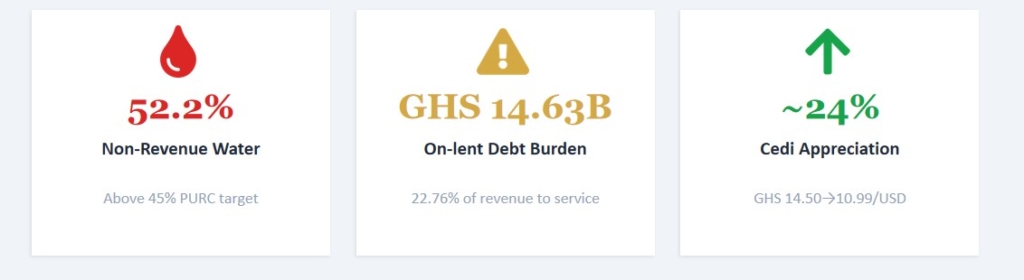
The report indicates that 52.2% of all water produced in 2024 was either lost or unaccounted for, significantly exceeding the PURC’s target benchmark of 45%.
These losses stem from ageing pipelines, some more than 50 years old, burst transmission mains, illegal connections, and widespread meter tampering. Commercial losses are compounded by unbilled consumption by public institutions and illegal suction pumps drawing water directly from distribution lines.
GH¢14.63 billion debt burden
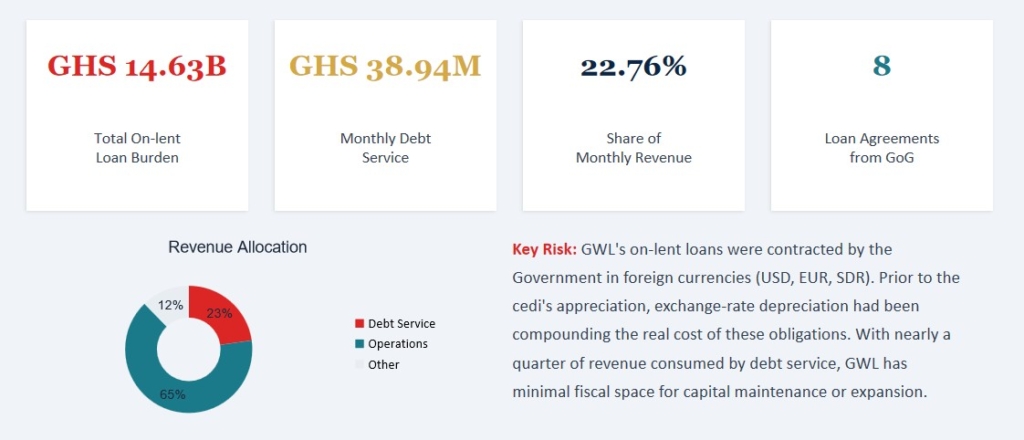
GWL is also facing a major financial crisis, with a total on-lent loan burden of GH¢14.63 billion, equivalent to nearly a quarter of its revenue.
The utility spends approximately GH¢38.94 million each month servicing debt, representing 22.76% of its monthly income, leaving limited funds for infrastructure expansion, maintenance, and system upgrades. GWL Situational Analysis
These loans, contracted in foreign currencies such as US dollars and euros, were originally secured by the government and passed on to GWL, exposing the company to exchange rate risks.
Government institutions failing to pay water bills
Another major challenge is the collapse in payment compliance by Ministries, Departments and Agencies (MDAs).
The report shows that government institutions’ payment rate fell sharply from 92.53% in 2022 to just 18.40% in 2024, creating a massive revenue gap.
Many public institutions reportedly claim they lack budget allocations for water bills, while enforcement measures remain difficult due to the sensitive nature of disconnecting state facilities.
Illegal mining threatening water sources
Illegal small-scale mining, widely known as galamsey, has emerged as the single greatest environmental threat to Ghana’s water supply system.
The analysis identified more than 11 water treatment plants affected by pollution from mining activities, including those drawing from the Birim, Pra, Bonsa, Offin, and Black Volta rivers. GWL Situational Analysis
The pollution increases treatment costs, forces plant shutdowns, and reduces production capacity, while posing long-term risks to water quality and public health.
Ageing infrastructure and energy costs
Much of Ghana’s water infrastructure dates back to the colonial period, with average system utilisation at just 60% of installed capacity.
Additionally, electricity accounts for 50% of water production costs and 27% of total operational expenses, making the utility highly vulnerable to energy price fluctuations and power supply disruptions.
Cedi appreciation offers temporary relief
Despite these challenges, the recent appreciation of the Ghana cedi, which strengthened by about 24% against the US dollar between end-2024 and February 2026, has helped ease the burden of foreign debt servicing and reduce the cost of imported chemicals and equipment.
However, the report cautions that this relief does not address underlying structural issues such as ageing infrastructure, water losses, and weak revenue collection.
Nearly one million customers affected
GWL currently serves 986,078 active customers across 86 water systems nationwide, making it Ghana’s sole urban water provider.
Experts warn that without urgent reforms, including tariff adjustments, infrastructure upgrades, improved billing systems, and stronger enforcement against illegal mining, Ghana’s urban water security could face worsening shortages in the coming years.
The report concludes that while recent macroeconomic improvements provide a window of opportunity, decisive structural reforms will be essential to ensure sustainable water supply for Ghana’s growing urban population.
Latest Stories
-
Over 200,000 children yet to be captured in Volta NIA registration exercise – Interior Minister
15 seconds -
Accra Metropolitan Assembly opens applications for 400 revenue collectors to boost IGF
3 minutes -
From Ghana to Global Health Leadership: How Dr Godfred Boateng is transforming health equity and saving lives across the world
4 minutes -
Wilmar and Ghana Armed Forces secure spots in UGCFL Season 2 Final
8 minutes -
NADMO, Zoomlion Unveil ‘No Do No Do’ Flood campaign
16 minutes -
We are fully committed to protecting current gains – BoG Governor
21 minutes -
Bagbin’s decision to reconsider Anti-LGBTQ+ Bill unprecedented – ACEPA Boss
23 minutes -
Ghana-UK Investment Summit signals fundamental transition from foreign aid to trade partnerships
25 minutes -
Unidentified man found dead near Cathedral Clinic in Accra
33 minutes -
VRA CEO named energy sector Chief Executive of the Year at 10th Ghana CEO Summit
35 minutes -
Ghana to establish West Africa Hyundai Manufacturing Plant under South Korea partnership – Ablakwa
44 minutes -
Burning waste worsens chronic diseases – Eco Impact Network warns
46 minutes -
Tema West MCE tours WASSCE centres, urges candidates to avoid malpractice
48 minutes -
Accra erupts in worship as Atarah Praise 2026 ignites Bayview Village
49 minutes -
Thomas-Asante takes the 10; Boakye takes 20 – Find out Ghana’s squad jersey numbers for World Cup 2026
1 hour