

Audio By Carbonatix
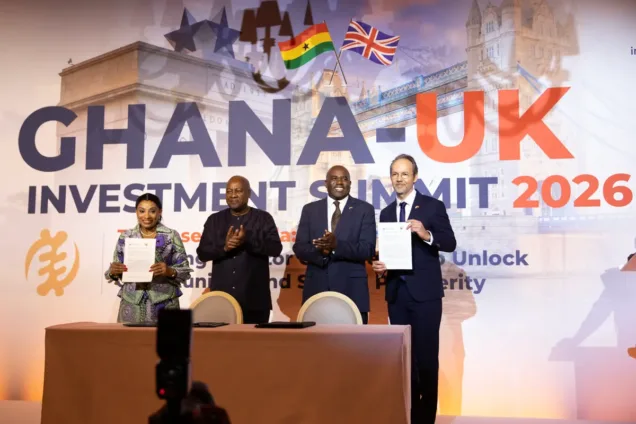
The signing of the UK–Ghana Growth Partnership marks a significant shift in the bilateral relationship between Accra and London. Moving away from traditional aid frameworks, this roadmap outlines an investment-led strategy valued at up to £215 million (approximately 3.39 billion GHS). It positions Ghana as a pivotal gateway for British capital entering West Africa while supporting Ghana's domestic economic transformation agenda.
Maritime Infrastructure and Regional Dominance
A £101 million (approximately 1.59 billion GHS) UK-backed allocation for the Takoradi Floating Dock Project serves as the cornerstone of this agreement. Establishing the first commercial-scale ship repair and dry-docking facility in the Gulf of Guinea directly addresses a critical infrastructural deficit in West African maritime logistics. By capturing regional shipping maintenance traffic, Ghana stands to consolidate its status as a premier maritime hub. Furthermore, the project addresses domestic labour formalisation by projecting the creation of up to 430 direct jobs. A targeted mandate reserving 30 per cent of these roles for women introduces a structural mechanism for gender inclusion within a traditionally male-dominated sector.
Climate Finance and Environmental Sustainability
The agreement integrates environmental stewardship into economic planning through a combined £94 million (approximately 1.48 billion GHS) allocation. An £85 million (approximately 1.34 billion GHS) reforestation fund, supplemented by a £9 million (approximately 142.1 million GHS) forest restoration project in the Oti Region, balances heavy infrastructure spending with ecological preservation. These initiatives function as dual-purpose economic instruments. They generate rural employment while mitigating the impacts of climate change, aligning Ghana with international climate finance standards and protecting critical biodiversity.
Technological Advancement and Institutional Innovation
A £6 million (approximately 94.7 million GHS) technology and innovation portfolio focuses on long-term systemic capability. The funding primarily targets the implementation of Ghana’s Artificial Intelligence Strategy and fosters deeper collaboration in science and technology across British and Ghanaian universities. By anchoring technological growth within academic institutions, the partnership aims to develop a sustainable pipeline of high-tech skills, preparing the local workforce for digitising the global economy.
Human Capital Development in Health and Education
A £4 million (approximately 63.2 million GHS) commitment explicitly links human capital to economic growth. The fund targets specialised clinical engineering training to improve healthcare infrastructure management. Simultaneously, the introduction of new Transnational Education guidelines creates structured pathways for Ghanaian students to access international-standard training. This educational framework helps bridge local skill gaps without causing immediate brain drain, offering global standard qualifications within Ghana.
Strategic Realignment and Investor Commitments
The political architecture of the deal, finalised by President John Dramani Mahama and UK High Commissioner Christian Rogg, signals a mutual desire for deeper diplomatic and economic alignment. Closing the Ghana-UK Investment Summit in London, President Mahama emphasised a transition toward durable economic integration.
"Ghana is open for business," the President said. "We are open to partnerships that create jobs, transfer technology, develop skills, support industrialisation, expand exports, and deliver sustainable growth."
This rhetoric deliberately reframes Ghana from a recipient of development assistance to an equal market partner. Mahama explicitly pressured the assembled manufacturing, technology, and financial services executives to formalise their interest.
"This is a time for us to move from conversations to commitments. This is a time to invest in Ghana," he said.
The strategy targets long-term, structural capital inflows rather than volatile, short-term portfolios. By leveraging the physical presence of his cabinet ministers to facilitate direct negotiations, Mahama attempted to bypass bureaucratic friction, presenting a unified, investor-friendly state apparatus.
Broader Implications for Continental Markets
The partnership carries strategic weight beyond immediate bilateral returns. By connecting British investors to opportunities in agribusiness, renewable energy, and the digital economy, the agreement positions Ghana as a lower-risk entry point into the wider African market. The successful execution of these projects will likely serve as a benchmark for how post-Brexit Britain structures its economic diplomacy with emerging African economies, balancing commercial returns with sustainable development.
Sustainable Bilateral Integration
The ultimate success of the UK–Ghana Growth Partnership will depend on the transparent execution of its capital allocations and the timely mitigation of bureaucratic bottlenecks. By transitioning from transactional aid dependencies to structured, commercial co-investment, both nations are establishing a contemporary model for bilateral diplomacy. If these infrastructure, technology, and climate initiatives achieve their stated benchmarks, this framework could offer a highly effective blueprint for future economic pacts across sub-Saharan Africa.
Latest Stories
-
Libya’s military seizes narcotics after firefight with smugglers
2 hours -
At least 139 migrants dead, including some children, after boat from Djibouti to Yemen capsizes, UN agency says
2 hours -
“US Embassy introduced TRIBE Culture Fest to NSA, GTA” – Kofi Adams
2 hours -
“NSA did not tell us of any embassy arrangement” – Kofi Adams
3 hours -
Kumasi records third commercial fire in three days
4 hours -
Trump faces growing backlash over plans to import diesel from Russia
4 hours -
AI is less regulated than milk, says Microsoft president
4 hours -
Boots sold in £7bn deal to Canadian billionaire family
4 hours -
Glasner suffers loss on Selhurst return as Palace beat Forest
4 hours -
WAFU B U17: ‘We won but I expected more from my boys’ – Kassim Ocansey
4 hours -
Royal Mail plans to cut 2,500 jobs
4 hours -
Man City cruise to statement win over 10-man Liverpool
4 hours -
Citroen revives the 2CV for an electric age
4 hours -
Blind guide dog owner says quiet EVs put lives at risk
5 hours -
Hamilton apologises to Ferrari as Antonelli moves to brink of title
5 hours