

Audio By Carbonatix
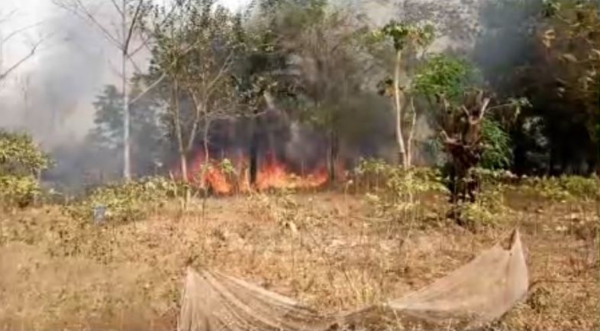
The Ghana National Fire Service (GNFS) has launched a National Bush-fire Prevention campaign with the assurance by the government to protect the country's natural landscape from the destructive forces of bush-fires.
The Director of Finance and Administration at the Interior Ministry, Doreen Payin Annan who read a speech on behalf of the Interior Minister, Ambrose Dery called for collaborative efforts to continuously reduce bush-fires while calling for the enforcement of the Control and Prevention of Bush-fires Act – 1990 (PNDCL 229).
"The government, on its part, is not sparing any effort to protect our natural landscape from the destructive forces of bush-fires. The protection of our environment, our communities, and the safety of our citizens is our solemn duty.”
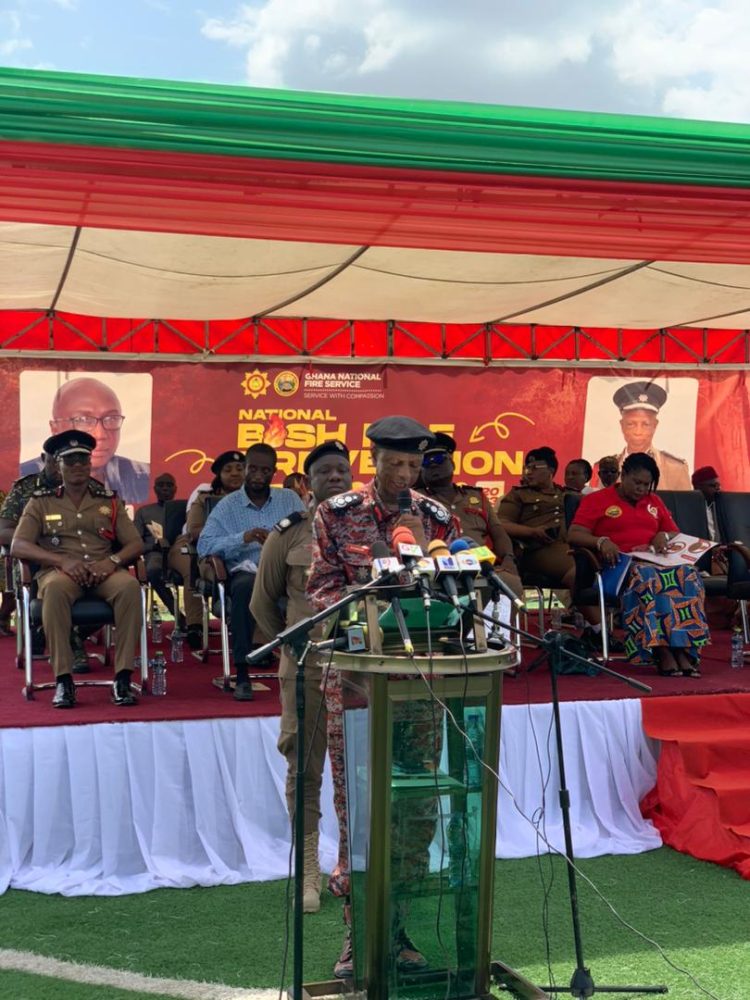
"I will further urge the Ghana National Fire Service to give life to the Control and Prevention of Bush-fires Act-1990 (PNDCL 229). Defaulters of this law do not have any more excuses after 33 years of sensitisation and education for which they cannot be held responsible for their actions if they go contrary to the law,'' she said.
The Chief Fire Officer, Julius Aalebkure Kuunuor said the service recorded a reduction of bush-fires by 27.5 per cent for the 10-month period of the year 2023.
In spite of this progress, according to him, over 75,000 hectares of vegetation and forest cover across the country were destroyed through bush-fires annually.

"The loss of vegetation according to the Service contributes to a three percent loss to the country's gross domestic product.
However, this year, a significant reduction of 218 representing 27.5 percent has been recorded for the first three quarters.
From January to October 2023, 583 bush-fires were recorded as against 791 for the same 10-month period in 2022," he revealed.
He explained that 60 percent of the country's population relied on agriculture, adding that disruption to the sector can have severe implications for the economy.

“Bush-fires pose a significant threat to our environment, destroying vast areas of vegetation, wildlife habitats, and farmlands. The consequences of these are far-reaching, affecting not only natural resources but also our food security.
"Ghana relies heavily on agriculture, as 60 percent of the population is involved in it. Any disruption has severe implications on the economy and well-being of our people,” he stated.
Latest Stories
-
President Mahama ends Resetting Ghana tour of Ahafo Region
2 hours -
African negotiators seek delivery of climate commitments at COP31
2 hours -
BoG develops AI rules for financial sector
2 hours -
‘Big Push’: Government assures contractors of prompt payments
2 hours -
Court fines miner for breaking into gold buying shop
2 hours -
Tarkwa court jails labourer for three years over GH¢123,000 theft
3 hours -
GAEC must retain nuclear scientists for Ghana’s nuclear ambitions – Minister
4 hours -
Man reportedly mistaken for game and shot by hunter dead in forest
4 hours -
19-year-old mason jailed 15 years for defiling seven-year-old pupil
4 hours -
Ghana’s banking sector assets rise 20.47% to GH¢500.2bn – BoG Governor
4 hours -
22 injured as Sprinter bus overturns at Sege after tyre burst
4 hours -
UN housing expert urges Ghana to strengthen Rent Control Department amid housing affordability concerns
4 hours -
Delta-BCI partnership reaches 166,000 people with breast cancer education
4 hours -
Power restoration fault suspected in Kumasi Central Market fire
9 hours -
The 7-foot giant of Ngleshie Amanfro: Seven-foot Ghanaian Ephraim Saawa dreams of joining the national basketball team
10 hours