

Audio By Carbonatix
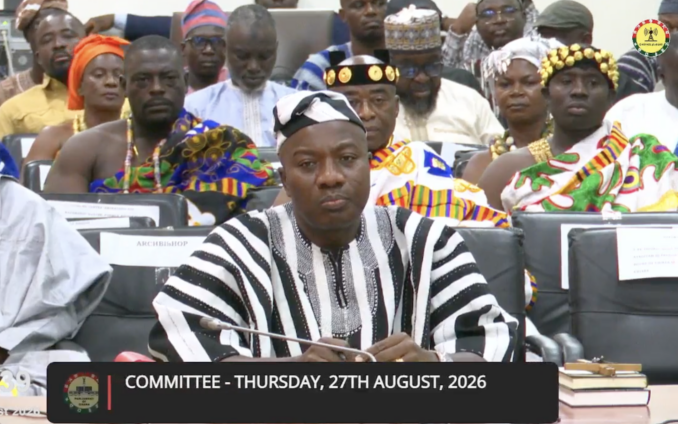
Minister-designate for Local Government, Chieftaincy and Religious Affairs, Mahama Ayariga, has pledged to work towards securing increased government funding for the Chieftaincy Institution if approved by Parliament.
Speaking before Parliament’s Appointments Committee on Thursday, August 27, the Bawku Central MP described the Chieftaincy Institution as one of the most important constitutionally guaranteed establishments in Ghana.
According to him, the Constitution assigns significant responsibilities to traditional authorities, making adequate resourcing of the institution necessary to enable it to perform its functions effectively.
He noted that the chieftaincy institution operates at various levels, from traditional councils and paramountcies to the regional and National Houses of Chiefs.
“The Chieftaincy Institution is perhaps, if not the most important, constitutionally guaranteed establishment. And we have in the Constitution assigned very important responsibilities to the Chieftaincy Institution,” he said.
Mr Ayariga explained that traditional authorities play both legislative and adjudicatory roles within the traditional governance system.
“They are both a legislative body and an adjudicatory institution, from the traditional council level to the paramouncy to the regional House of Chiefs to the National House of Chiefs,” he added.
Push for increased funding
The minister-designate said adequate financial support for the Chieftaincy Institution could contribute significantly to improving governance at the local, regional and national levels.
He therefore promised to engage the Minister for Finance to ensure that sufficient budgetary allocations are made to support the institution.
“What I can assure you is that I will try and get the Minister of finance to make adequate budgetary provision for the chieftaincy institution," Mr Ayariga told the committee.
He, however, said government funding would not be the only avenue through which resources could be generated to support institutions operating at the local level.
Revenue mobilisation
Mr Ayariga said there was significant potential for revenue mobilisation within the local government system, which, if properly harnessed, could provide additional resources for critical sectors.
“There are so many fees, levies, charges, rates that we are supposed to be collecting that we are not collecting,” he said.
He argued that improving the collection of such internally generated funds would provide assemblies with additional resources to support institutions and sectors that perform important functions within local communities.
“If we collect those ones, there will be enough resources to support all sectors that are performing critical roles at the local level,” he said.
Support for traditional authorities
Mr Ayariga also stressed the important role chiefs play in supporting local governance.
He said traditional authorities contribute to the management and governance of communities within areas that fall under the responsibility of local government authorities.
“Chiefs do perform a very critical role at the local and regional level up to the National House of Chiefs level,” he said.
He therefore outlined a two-pronged approach to supporting the Chieftaincy Institution.
First, he said, he would explore increased allocations from central government to provide the institution with the resources it needs.
Second, he would work to improve revenue mobilisation by local government authorities, particularly the collection of fees, levies, charges, and rates that are legally due to the assemblies.
According to him, strengthening the financial position of local government authorities would also enable them to better support traditional authorities in their respective areas.
“I will explore getting increased government allocation. I will also explore getting the local government authorities to mobilise the revenues that are supposed to be collected at the local level and support the traditional authorities because they really do help them in the governance of the spaces that the assemblies are responsible for,” he said.
Mr Ayariga is seeking approval from Parliament’s Appointments Committee as Minister-designate for Local Government, Chieftaincy and Religious Affairs.
Latest Stories
-
Premature to call for Sports Minister’s removal while CID probe is ongoing – Ernest Norgbey
8 minutes -
NPP mourns Samuel Arthur Odoi-Sykes
25 minutes -
Stay out of World Cup visa probe to avoid interfering with CID investigations – Ernest Norgbey to politicians
36 minutes -
Bono East Minister inspects ‘Big Push’ roads; contractor on Tankor-Fiema-Busunya road ahead of schedule
39 minutes -
Scrutiny is not disloyalty – Chief of Staff defends serious journalism at 30th GJA Awards launch
40 minutes -
Abuse case: Nana Akua’s husband Harold unable to appear in court after hospital admission – Police
59 minutes -
Mahmud Kabore picks NDC Ashanti Regional Communication Officer nomination forms
1 hour -
KNUST Career Services pioneer Selina Doe Angmor named among 2026 40 Under 40 honourees
1 hour -
Nana Akua domestic abuse case: Police to arraign husband after hospital discharge
1 hour -
NHIS coverage rises to 70% after government uncaps levy – Health Minister
1 hour -
World Cup visa scandal: I’ll go after anyone who dents Mahama’s gov’t – Ernest Norgbey
1 hour -
GCNM calls for a permanent office complex, more funding for specialist nursing training
1 hour -
Salomey Awiti Baffoe reunites with family after GH¢100k bail
2 hours -
We’ll modernise Accra without losing its heritage – Roads Minister assures Ga Mantse
2 hours -
Rent Control urges Parliament to expedite amendment of outdated rent laws
2 hours