

Audio By Carbonatix
A joint study by the University of Port Harcourt, Nigeria and the Kwame Nkrumah University of Science and Technology, Kumasi has unveiled alarming findings regarding the presence of cancer-causing substances in meats singed with different fuel sources.
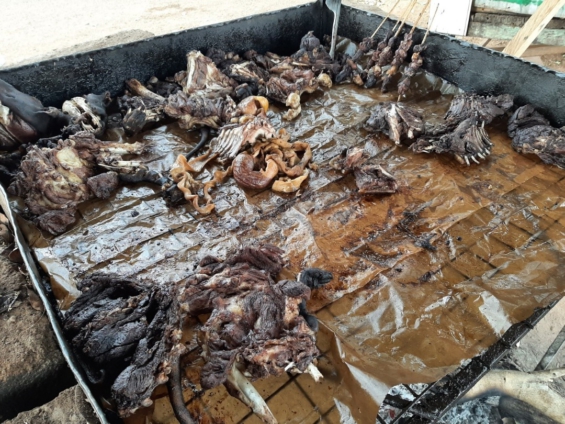
The study published in the journal Environmental Health Insights has found that meats singed with tyres in Ghana contain high levels of harmful chemicals called polycyclic aromatic hydrocarbons (PAHs). These chemicals can increase the risk of cancer.
The study led by Prosper Manu Abdulai from the University of Port Harcourt tested meats singed with tyres, firewood, and LPG gas in Ghana’s five largest cities: Kumasi, Accra, Koforidua, Tamale, and Ho.
The researchers collected 180 samples of cattle and goat meat singed using three different fuel types: firewood, liquefied petroleum gas (LPG), and tyres.
They found that meats singed with tyres had the highest levels of PAHs, especially a dangerous chemical called Benzo[a]pyrene.
Children and older adults are more at risk from these chemicals.
“We did a health risk assessment and we realise that kids and adults who take this meat whether singed with firewood or tyre are at serious risk of getting cancer,” he warned.
The study recommends using safer methods like LPG gas for singeing meat and calls for stricter rules to prevent the use of tyres. This is especially concerning as the levels of this harmful substance in tyre-singed meats exceeded regulatory limits set by the European Food Safety Authority (EFSA).
The researchers call for the urgent need to explore and promote alternative singeing methods that minimise PAH formation.
LPG, which demonstrated the lowest PAH levels among the tested fuels, could be recommended as a safer alternative to traditional fuels like firewood and tyres.
Moreover, the study advocates for stricter regulations regarding the use of tyres for meat singeing, urging authorities to impose heavy penalties for non-compliance to protect public health and ensure that consumers are not exposed to harmful substances.
“The stakeholders should have something to do at the abattoirs so that all of them will use the LPG,” he recommended.
Latest Stories
-
World Bank affirms Ghana’s growth rate at 4.8% in 2026
4 minutes -
Cedi was worst African currency in quarter 2, 2026 – World Bank
20 minutes -
AI gains can lift three times as many people out of poverty in Ghana – World Bank
48 minutes -
Police arrest suspect over jewellery theft during fire outbreak
3 hours -
EOCO returns Hanan’s £6,700, GH¢2,750 and devices after defence challenge
3 hours -
Opplift Youth Entrepreneurs Summit 2026 equips entrepreneurs with skills, mentorship and support
4 hours -
Rival clubs want range of punishments for Man City
4 hours -
Tear gas in Paris and Marseille as school protests grow across France
4 hours -
Kane inspires England to win over Czech Republic in UEFA Nations League
4 hours -
Finland orders halt to work on two Google data centres
4 hours -
Substitute Merino scores twice as Spain win in Croatia
4 hours -
Ronaldo wants Portugal ‘punishment’ but not retiring
4 hours -
White House defends Trump comment to let Iran ‘take out’ LA and San Diego
5 hours -
Asos confirms hackers sent ‘unauthorised’ notification to app users
5 hours -
US televangelist Jim Bakker, disgraced from sex scandal and fraud, dies at 86
5 hours