

Audio By Carbonatix
The National House of Chiefs has renewed its appeal for increased financial support from the government, noting that inadequate funding is adversely affecting its ability to resolve chieftaincy disputes across the country.
According to the House, the lack of adequate resources has slowed down arbitration processes, causing several cases that could have been settled within days to drag on for months and, in some instances, years.
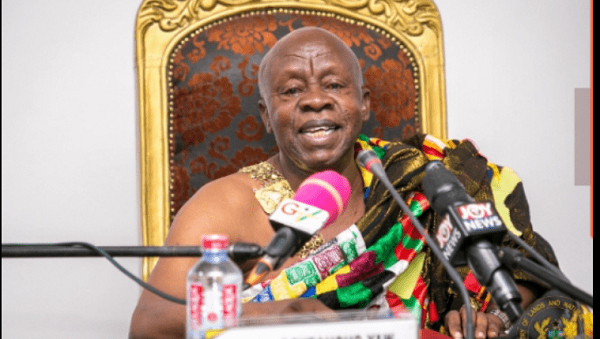
The President of the House, Ogyeahoho Yaw Gyebi II, made the appeal when the Parliamentary Select Committee on Chieftaincy and Religious Affairs paid a courtesy call on the House.
Speaking during the meeting, Ogyeahoho Yaw Gyebi II expressed concern over the growing number of unresolved chieftaincy disputes in various parts of the country, stressing that the situation continues to threaten peace, unity and development in affected communities.
He explained that although the House remains committed to promoting peace and settling disputes through traditional arbitration mechanisms, the lack of financial resources has become a major obstacle to its operations.
“Cases that can be resolved within three, four or five days sometimes take months or even years because of limited funds,” he stated.
The President, therefore, appealed to the Parliamentary Select Committee to support efforts aimed at improving funding for the House to enable it to effectively carry out its constitutional mandate.
He noted that adequate funding would help facilitate investigations, transport committee members to dispute areas, organise hearings and speed up adjudication processes to ensure timely justice in chieftaincy matters.
Chairman of the Parliamentary Select Committee on Chieftaincy and Religious Affairs, Dr. Fred Kyei Asamoah, acknowledged the concerns raised by the House and assured traditional authorities of the committee’s commitment to engaging the appropriate state institutions to address the challenges.
According to him, chiefs played vital governance roles long before the introduction of modern democratic systems, adding that the 1992 Constitution also recognises and assigns important responsibilities to traditional leaders.
He further noted that chieftaincy disputes have remained a major challenge in some parts of the country, often leading to tensions, violence and prolonged litigation, thereby affecting development and social harmony within communities.
He therefore appealed to all stakeholders to support efforts aimed at resolving such disputes peacefully.
The National House of Chiefs plays a key role in adjudicating and mediating chieftaincy disputes while also preserving Ghana’s cultural and traditional heritage.
Latest Stories
-
NDC threatens sanctions over oversized campaign posters, gives aspirants 5 days to comply
4 minutes -
Star Oil paid GH¢2.7bn in taxes, levies in nine months of 2026
18 minutes -
Samson’s Take: The rule of law is cheaper before the bulldozer
19 minutes -
GRA blames system failure for delay in issuing receipt over passenger’s customs duty
40 minutes -
Livestream: Newsfile discusses World Cup visa scandal, beach demolitions, education strikes, BRICS bid
44 minutes -
NC-PTAs welcomes end of teachers’ strike, urges parents to prepare children for Monday
54 minutes -
Government procures over 2,000 transformers as Ghana’s electricity access hits 89.13% – Energy Minister
1 hour -
UTAG-UG threatens strike on October 19 over unpaid allowance
1 hour -
Let The Constitution direct Chieftaincy to deliver “All Development Is Local”
3 hours -
John Jinapor outlines renewable energy, nuclear power priorities for 2027
3 hours -
Ghana explores centre of excellence for hearing, communication and cochlear implant care
4 hours -
Schizophrenia-related disorders lead mental health cases recorded in Ghana
4 hours -
Dutch authorities enlist Ghana in hunt for fugitive drug lord Bolle Jos
5 hours -
Ghana housing finance conference adopts communiqué to improve affordable housing access
9 hours -
Special Initiatives Minister urges Wa Technical Institute to enrol more girls as EU-backed solar training lab opens
10 hours