

Audio By Carbonatix
The Ashanti Region has recorded eight polio cases in six districts, more than any region in the country since the beginning of this year.
The cases, all vaccine-derived polio virus Type Two represent more than 80 per cent of 12 cases recorded nationwide.
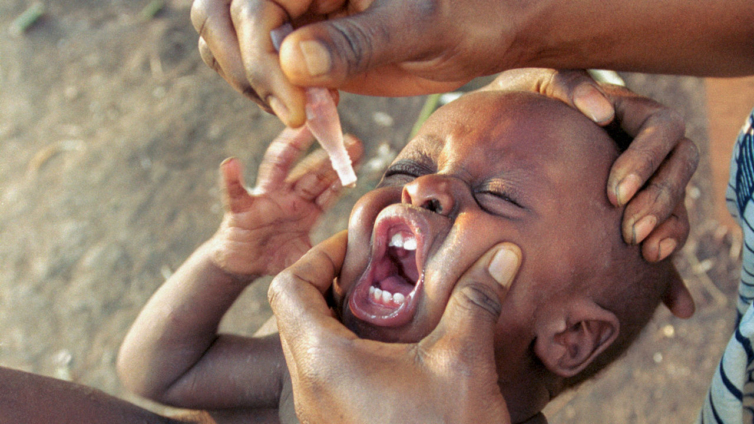
Though health authorities will not give details of affected districts, they say the situation calls for public support as it rolls out an ambiguous three-day immunisation programme targeting about 1.2 million children under five-years.
"The Ashanti Region recently recorded in six districts in what we call vaccine-derived poliovirus Type Two. And in accordance with established protocol, the region, together with other regions in the country would be embarking on massive polio immunization exercise," Deputy Regional Health Director in charge of Public Health, Dr Yaw Ofori Yeboah told the media in Kumasi.
The situation has prompted health authorities to roll out a three-day immunisation programme across the Region from September 10 to 13..

Deputy Regional Health Director in charge of Public Health, Dr. Yaw Ofori Yeboah asked parents to avail their children under 5-years for administration of safe vaccine in all 43-districts of the Ashanti region.
"The focus would be for children under the age of five-years. In Ashanti region, we would be targeting 1,184,860 children aged below five-years."
The affected districts are said to be areas noted for low immunization and insanitary conditions.
Dr. Ofori Yeboah admits the advent of Covid-19 which has affected routine health services in the region could be blamed for the situation.
He want all hands on deck to kick start the immunization exercise.
Meanwhile, the World Health Organisation says some polioviruses have been discovered in Greater Accra and Eastern region.
Immunization Officer, Fred Osei Sarpong revealed poliovirus were found in environmental sewage in those areas and speak of investigations into the virus.
"What we are also doing is aside from the fact that the virus can infect an individual and get that individual paralyzed; the virus is usually in the environment so, in order to satisfy ourselves that we don't have the virus with us, we do pick samples from environmental sewage, send to the lab and then we test."
Latest Stories
-
Kojo Antwi and Meiway set London ablaze with historic live concert at Dominion Centre
49 minutes -
Arrive three hours before flight home, airline boss tells UK holidaymakers
57 minutes -
US, UK and Australia to develop underwater drone technology
1 hour -
Prisons Service launches investigation after inmate linked to murder of Abamba Queen Mother
1 hour -
Akatsi Police launch full investigation into shooting, arson incident in Deti
1 hour -
Government commissions shelter for domestic violence survivors
1 hour -
Xenophobia: “I am very free now” – Ghanaian evacuee recounts 18-year stay, robbery ordeal
1 hour -
Excessive Bail Conditions in Ghana: A threat to the presumption of innocence and the right to liberty guaranteed under the 1992 constitution
2 hours -
Petrol, LPG prices set to go up, but diesel to decline from June 1
2 hours -
Hitz FM’s ‘Rep Ur Jersey’ underway at Aviation Social Centre
2 hours -
Xenophobia: Minority commends government on Ghanaian evacuation from South Africa
3 hours -
Gov’t reaffirms commitment to expanding shelter services for domestic violence survivors – Gender Minister
3 hours -
Fisheries Ministry intensify efforts to protect premix fuel subsidy
3 hours -
Liverpool sack head coach Slot
3 hours -
Xenophobia: Disregard Malema’s comments on Ghana’s evacuation – Minority urges gov’t
3 hours