

Audio By Carbonatix
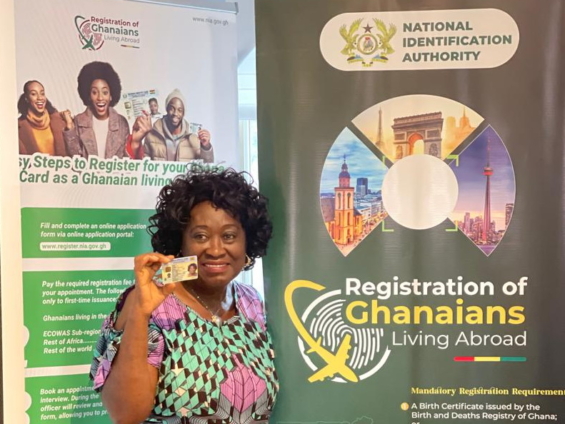
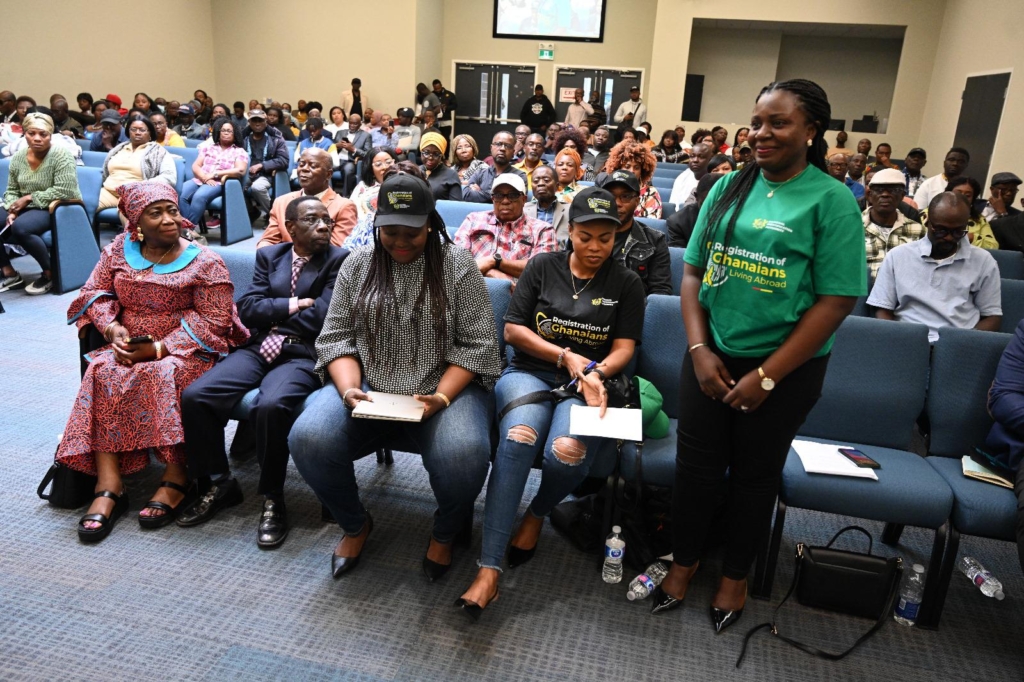
In a major step to extend Ghana Card services to Ghanaians living outside the country, the National Identification Authority (NIA) has begun issuing cards to Ghanaians in Ottawa and Ontario in Canada under the first phase of the pilot exercise.
Pilot phase locations
The pilot phase has commenced in Ottawa and Ontario in Canada and will be extended to Washington, D.C., and New York in the United States of America.
Last week, officials from the NIA and its technical partner, Identity Management Systems (IMS), held public engagements in Ottawa and Ontario after which they trained selected officials of Ghana’s mission in Canada.
These staff are working as registration officers in the first phase of the pilot exercise to register Ghanaians abroad.
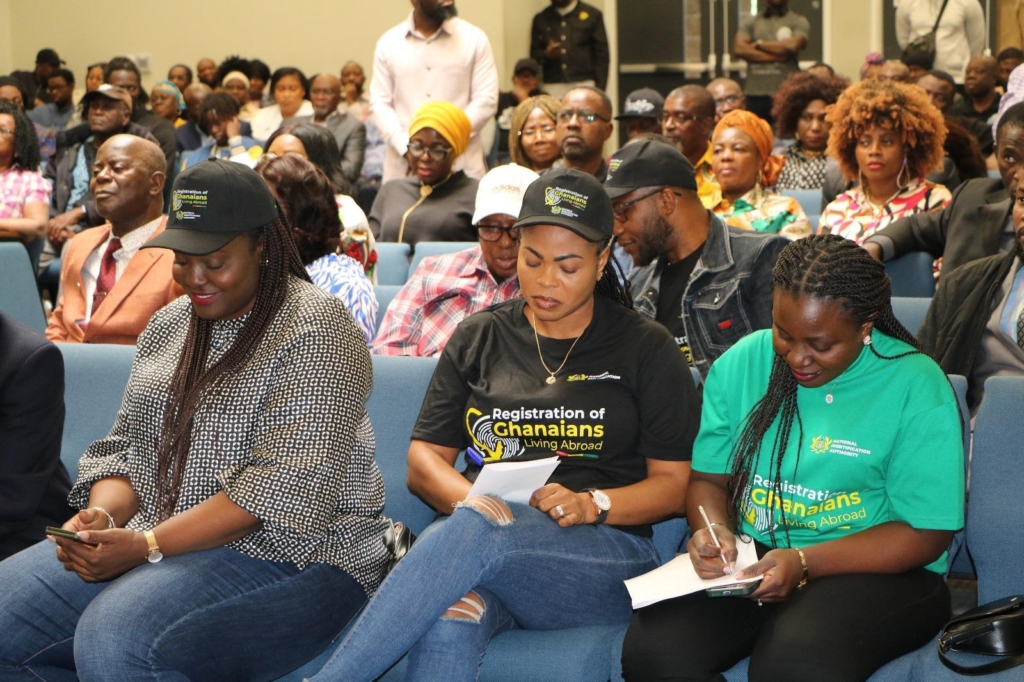
Officials from the NIA and IMS, are currently in New York to hold public engagements and train embassy staff to serve as registration officers.
Simplified registration
Ghanaians abroad are able to fill out forms online and pay the required fees to book appointments from the comfort of their homes.
Applicants and persons vouching for them are interviewed online.
Applicants only go to the mission at their appointed date and time to donate their biometrics and be issued their cards.
This process is projected to take only 10 minutes making the process more flexible.
Fees for registration
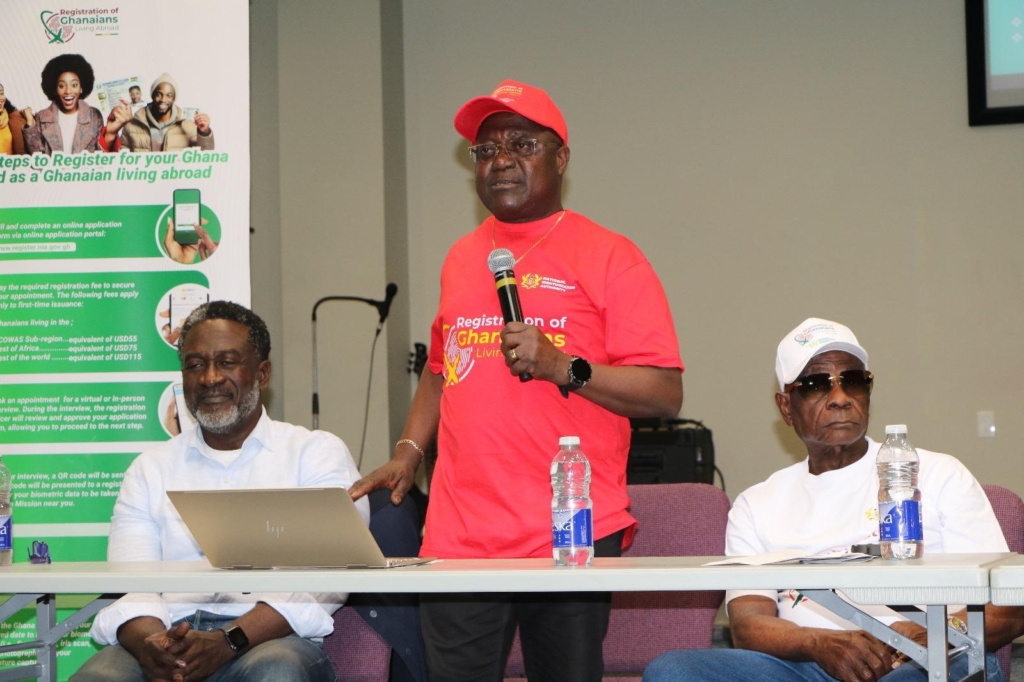
Fees approved by parliament for the registration vary by region, with ECOWAS nationals paying $55, the rest of Africa $75, and the rest of the world $115.
The foreign registration covers individuals aged six and above.
Valid passports and birth certificates are required, but applicants without these documents can be vouched for during the interview process. However, those who have renounced Ghanaian citizenship or are non-Ghanaian spouses cannot register.
Dual citizens who can prove their Ghanaian heritage are eligible to acquire the Ghana card.
NIA’s global initiative
NIA Board Chairman Mr. Abel Edusei described the engagement as a major milestone in the NIA’s work to identify Ghanaians around the world.
He noted that the engagement in Ottawa is historic and a significant step in the NIA's effort to extend the Ghana Card beyond the borders of Ghana.
Training for mission staff
NIA Executive Secretary Prof. Kenneth Agyemang Attafuah announced plans to train the staff of Ghana’s missions to handle registrations, explaining that NIA is legally mandated to train these officials as registration officers.
Prof. Attafuah also took participants through the NIA’s mandate, its achievements, and the integration of the Ghana Card into the ECOWAS system to avoid the need for a separate ECOWAS identity card.
Security features of the Ghana Card
Prof. Attafuah highlighted the security features of the National Identification System (NIS) and clarified that first-time registration for the Ghana Card is free at NIA district and regional offices in Ghana.
However, he said registration at premium centres and for institutions or groups attracts a fee.
Additionally, he stated that cardholders would need to pay for a new card when their existing one expires after 10 years.
Prof. Attafuah explained to the gathering that the Ghana Card’s Personal Identification Number (PIN) serves as a replacement for various identification numbers, including the Social Security and National Insurance Trust (SSNIT) number, Tax Identification Number (TIN), and National Health Insurance Scheme (NHIS) number.
Data security assurance
Responding to questions, Executive Director of IMS, Mr. Emmanuel Selby assured participants that all data is stored in Ghana and not in the cloud.
He explained that private virtual networks are used from the registration centres and NIA’s site.
According to him, the primary site is located at NIA’s Head Office in Accra, with a secondary disaster recovery site in Kumasi.
He said real-time synchronisation occurs between the two sites.
Mr. Selby also noted that only specific subsets of data are shared with institutions, as mandated by law, and biometric data is not shared with user agencies.
Mr. James Cantamantu-Koomson, Chief Operating Officer of IMS, explained that biometric verification is done for every transaction to prevent identity theft, as relying on visual inspection of cards poses risks.
Community engagement in Ottawa
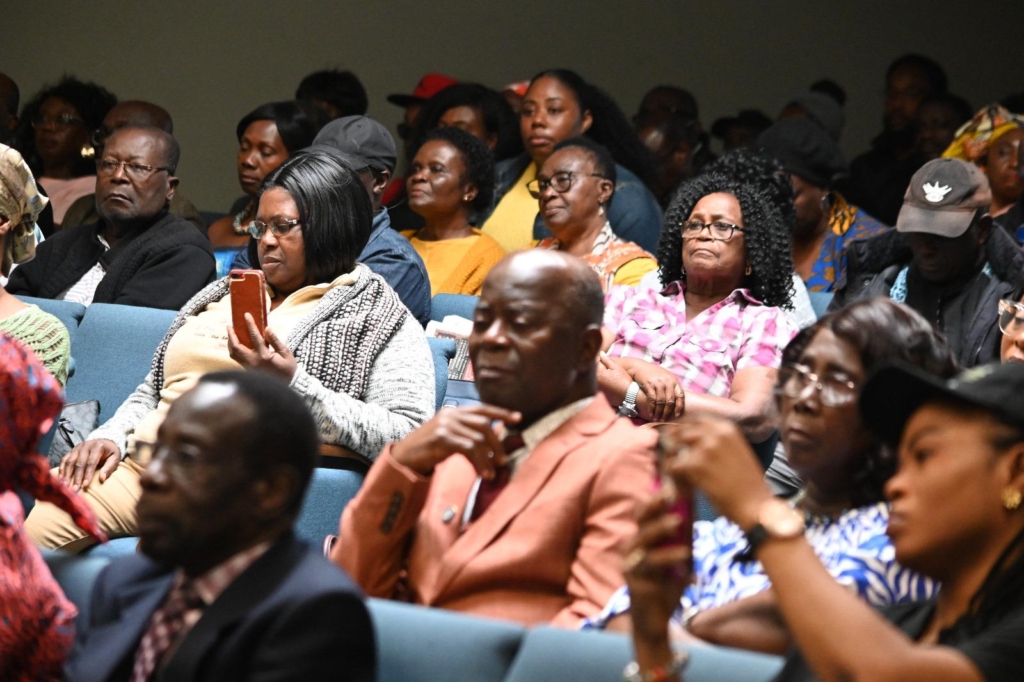
Ghana’s Ambassador to Canada, Anselm Ransford Adjetey Sowah, organized the interaction in Ottawa.
Participants expressed their gratitude for the education about the Ghana Card registration process, describing it as very useful.
Latest Stories
-
Kwaku Azar writes: A-G vs OSP
10 minutes -
Mfantsipim–Adisadel rivalry built excellence, not division – Sam Jonah
35 minutes -
Vice President launches Mfantsipim’s 150 years of shaping Ghana’s greatest mind
52 minutes -
I assure Otumfuo, Mahama will join him to commission KNUST Teaching Hospital by end of this year – Haruna Iddrisu
2 hours -
Gov’t to roll out free special education for persons with disabilities from July 1 – Education Minister
2 hours -
“We used it to test our officiating officials’ readiness” – Bawah Fuseini after CAA Athletics event
2 hours -
Volleyball emerges as Ghana’s fastest rising sport
2 hours -
National Sports Fund needs strong leadership from the top – Administrator David Wuaku
3 hours -
JoySports Exclusive: Steve McLaren in talks with GFA after expressing interest in Black Stars job
3 hours -
Fire guts auto parts warehouse at Bubuashie, one fire officer injured
3 hours -
I owe my victory to coach Ofori Asare – Allotey after winning WBA Africa Gold Super Flyweight belt
3 hours -
Church of Pentecost supports over 2,000 BECE candidates in Obuasi with career guidance seminar
5 hours -
Brandon Asante and Coventry all but promoted to Premier League despite Sheffield Wednesday draw
5 hours -
GPL 2025/26: Late Kwartemaa strike downs Hearts in Tema
5 hours -
Ghana Faces Sierra Leone Moment as Prosecutorial Powers come under strain
5 hours