

Audio By Carbonatix
During my usual scan of stories one of my favourite online news portals last weekend, one headline stopped me cold:
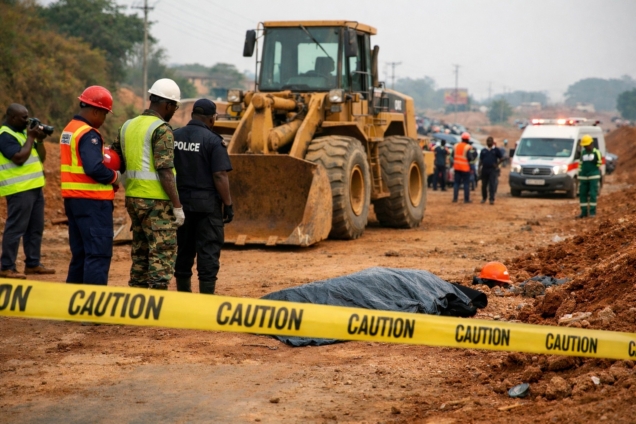
“Two engineers killed in bulldozer accident at ‘Big Push’ project site in Ayensudo.”
Sadly, this is not shocking to anyone who has paid attention to occupational injuries linked to plant and machinery in developing economies. In many such countries, the construction sector employs 6–10% of the workforce, yet accounts for 25–40% of work-related deaths, most of them involving equipment and machinery.
So, I read the full story.
According to the report, the accident involved a heavy-duty bulldozer operated by a primary contractor working on the dualisation of the Takoradi–Agona road under the government’s Big Push agenda. One engineer reportedly died on the spot after being run over by the equipment. The other succumbed to injuries later at the hospital.
Two engineers. Two lives. Gone, needlessly.
What made the story even more troubling was not just the accident itself, but the familiar narrative that followed. Instead of a call for a thorough investigation, eyewitness accounts leaned quickly toward spiritual explanations, claims that the bulldozer “moved by itself,” interpreted as a spiritual “push back” because traditional authorities were allegedly not consulted before work began.
This line of thinking is not only dangerous but a disservice to safety, professionalism, and learning. Any contractor worth their salt must resist such explanations. Construction accidents are not acts of the gods; they are failures of systems, decisions, procedures, and controls. Painful as they are, these accidents must be treated as critical learning opportunities. Accident investigations exist for one reason: prevention. Accidents are rarely simple. While the most obvious focus is often on the direct cause (in this case, the impact of heavy equipment striking the engineers), that is merely the final link in a much longer chain. Direct causes are often the easiest to identify and address through design changes or personal protective measures.
But the deeper questions lie elsewhere. What caused the contact in the first place?
These indirect causes may include unsafe acts or unsafe conditions, such as ignored equipment defects, failure to secure machinery, poor communication, inadequate supervision, or procedural lapses, such as failing to apply parking brakes. Unsafe acts create unsafe conditions, and unsafe conditions encourage unsafe acts.
Yet even these are symptoms. True prevention comes from identifying the underlying causes, i.e., weak or poorly enforced safety policies, flawed decisions and risk assessments, inadequate training or experience, attitudinal and behavioural factors, unsafe equipment design or ageing machinery, environmental conditions, weather, site-specific conditions, and many more. Until we confront these root issues honestly and rigorously, we will keep burying colleagues and offering excuses.
I sincerely hope that the contractor involved in this case, as well as others facing similar tragedies, will reject the convenient comfort of spiritual explanations and insist on independent, professional accident investigations, not as a formality, but as a moral obligation. Investigations must lead to actionable recommendations that prevent recurrence, not reports that gather dust.
My heartfelt condolences go to the families of these two comrades, engineers who went to work and never returned. Sad, painful and unacceptable. May their deaths not be in vain. May they harden our resolve to make construction sites safer. And may they ignite a renewed urgency among us academics, researchers, practitioners, and policymakers to do more. There is a glaring data gap in Ghana regarding the safety of machine workers on construction sites. Critical questions remain unanswered. What is the age and condition of the plant and machinery used in the sector? What types of machinery-related accidents are most common? Under what circumstances do these accidents occur? What are the typical outcomes in terms of injuries, fatalities, and equipment damage? These questions are not academic curiosities. They are matters of life and death. May the loss of these two engineers stir us to seek answers urgently, honestly, and relentlessly.
Emmanuel Adinyira (PhD)
Professor and Dean
Faculty of Built Environment
KNUST
Latest Stories
-
CUTS welcomes VAT collection on cross-border digital services, urges fair treatment of Distance Learning students on overseas programmes
53 seconds -
Leave the Chiefs and fix the Galamsey Problem: Dr Solomon Owusu Advises President Mahama
4 minutes -
Pay attention to teachers and give them what is due – Ho District GNAT tells government
7 minutes -
Authorities knew of abuse allegations against Obuasi headmaster months before suspension – JoyNews investigation
12 minutes -
US teenager appears in court over alleged Hindu temple shooting plot
14 minutes -
Services drive 7.4% expansion in Ghana’s economic activity
30 minutes -
‘I don’t make music for awards, I make it to connect people’ – Rocky Dawuni
42 minutes -
Farmer jailed for three months over assault on wife in viral video
47 minutes -
Police arrest eight in Okaishie operation targeting illicit drugs and medicines
50 minutes -
David Agyemang Yeboah: Marriage is not the problem; your approach is
53 minutes -
Lawyer sues Standards Authority over used-vehicle import restrictions
56 minutes -
Ukraine to restart strikes on Russian oil refineries, Zelensky says
56 minutes -
CIMG awards drive competition among Ghanaian businesses
1 hour -
NSA regional director Emmanuel Reagan files nomination to contest NDC Ashanti Regional Organiser position
1 hour -
Obuasi SHTS: Number of students alleging sexual abuse rises to 16
1 hour