

Audio By Carbonatix
Amid the warm dusk breeze of a Saturday evening in Accra, an extraordinary concert unfolded, one that celebrated the vibrant tapestry of Ghana’s musical heritage, spirituality, and culture. On an open‑air stage nestled within a garden of brightly lit palm trees and gently swaying tables of guests, the atmosphere hummed with anticipation and reverence.
As the sun dipped into the horizon, the audience gathered on lawn chairs and mats, beneath a canopy of string lights, outside a venue near Osu in Accra. The event had been billed as a fusion of gospel music and Ghanaian traditional folk rhythms, a bold blending of sacred praise and ancestral beats. Instruments at the forefront of the concert were talking drums, kpanlogo, gyil (a wooden xylophone), shekeres, ready beside a full live band of guitars, keyboards and drums. Costumed drummers in kente cloth and adinkra‑printed vests stood in waiting, poised to bring the rhythms of Ga, Akan and Ewe cultural dance to life.
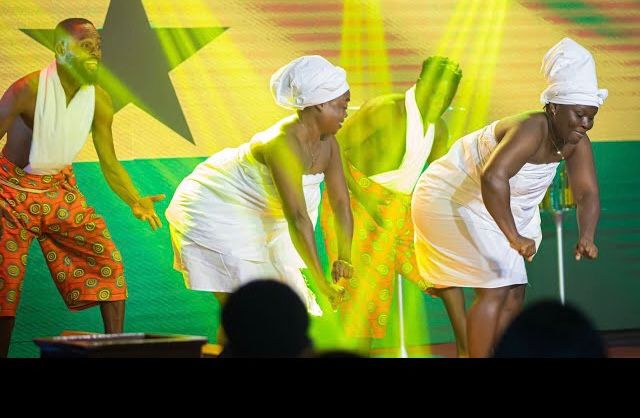
Then came the moment the crowd had waited for, the entrance of Noble Nketsiah, the award‑winning gospel artist renowned for weaving Ghana’s traditional rhythms into his worship‑filled sound. He strode on stage, microphone in hand, flanked by the celebrated cultural group, Manklalo Cultural Group. The cultural group consisted of singers, drummers, dancers and instrumentalists specialized in Ghana’s folk traditions.
Noble began softly with one of his worship songs, his voice clear and resonant, while behind him the Manklalo group began subtle background vocals, their harmonies rooted in Twi and Ga, weaving together with English refrains.
At first gentle, the traditional percussion emerged, the pulsating kpanlogo beats of the Ga people, the deep drum of the Ewe, the kora melodies of the north. The dancers of the cultural group, showed up in colourful cloth and beads, moved into motion, performing steps from Ghanaian dance traditions such as Adowa, Kpanlogo dance, Agbadza, and Bamaya. Their arms rose, feet stamped the earth, and cloth swirled.
As the performance built, Noble raised his hands in worship and praise; the band lifted the volume; the cultural rhythms took centre stage. The group provided call‑and‑response vocals while the dancers shifted into higher gear, and the drummers accelerated their rhythms.
The fusion was seamless; gospel lyrics of hope and salvation met the ancestral rhythmic heartbeat of Ghana. At one point, Noble stepped aside and gestured toward the dancers. He himself participated in a short Adowa sequence, much to the delight of the crowd, then returned to his microphone to deliver a triumphant chorus.
The program was crafted like a journey. It began with gentle worship, then shifted into a mid-tempo cultural‑gospel fusion set, Ghanaian folk instruments underpinning gospel songs, Ghanaian dialects (Twi, Ga and a bit of Ewe) braided into the lyrics, and traditional dances punctuating the music. The aim was to portray Ghana’s musical heritage as living and breathing, not just archived in museums but present in worship, in celebration, in the merging of sacred and cultural.
In the second half, the tempo rose, the band introduced electric guitar riffs over traditional patterns, the dancers performed more energetically, whipping the audience into movement. Noble invited the crowd to rise, to clap, to participate, as the cultural group chanted, and traditional percussion joined. One highlight was a medley that started with a slow worship ballad and transitioned into a full‑blown folk‑music dance number, complete with audience members being invited to join in the circle dance.
This concert did more than entertain; it celebrated identity. By having Noble Nketsiah, a gospel artist of wide acclaim, share the stage with Manklalo Cultural Group, the event underscored that Ghana’s gospel music is enriched by its cultural roots. Traditional rhythms and dances were not relegated to the margins but were integrated into worship and praise. The outdoor setting added to the experience, under the open sky, the fusion of spiritual melody and cultural rhythm felt expansive, freeing and deeply Ghanaian.
From the moment the first drum roll echoed, the audience was engaged, standing, clapping, and some dancing in the aisles. Elderly guests nodded in recognition of the familiar traditional steps, whilst younger ones recorded videos with their phones. When the dancers invited the crowd to join a communal circle, clusters of people from all walks moved into the space and followed the basic rhythm steps of the Adowa and Kpanlogo dances. Applause and cheers erupted between songs; smiles and tears met each other in the glow of the lights.
At the final song, Noble Nketsiah invited the band downward into a subdued mode while the cultural ensemble’s drumming swelled alone, then he sang a final worship refrain in Twi, his voice soaring above the drums. The night ended with a standing ovation, the performers holding hands and bowing, the crowd erupting in cheers with songs of “Aseda!”
Latest Stories
-
Afoko can give NPP ‘new identity’ ahead of 2028 to overcome NDC – Political scientist, Dr Amakye-Boateng
2 minutes -
2 injured amid gunshots during raid at Nawara Mining office at Nsuapemso
7 minutes -
St Augustine’s College retains 2026 National Investment Quiz title
11 minutes -
KNUST Nursing and Midwifery School staff recognised at 2026 Health Ministry Excellence Awards
19 minutes -
JoyNews’ Esther Esi Nkrumah selected for UK Media Excellence for Emerging Technology Fellowship
24 minutes -
Five NDC youth organisers in Western Region pay courtesy call on Armah-Kofi Buah
37 minutes -
NACOC demands tighter port controls to prevent Tema Harbour drug trafficking
40 minutes -
Ghana’s startup ecosystem must build sustainability into innovation – Ghana Hubs Network
51 minutes -
Friday’s beachfront demolition was carried out at Labadi Beach Hotel’s request, not for flood mitigation – Stan Dogbe
52 minutes -
LA 2028: Mukarama returns to Black Queens squad for Olympic Games qualifiers
54 minutes -
Fusaini Yakubu Abanga leads NPP National Youth Organiser race with 45% in Global InfoAnalytics poll
1 hour -
Suame Methodist JHS marks 120 years with a call for STEM innovation
1 hour -
Global fashion coalition launches in the heart of Kantamanto Market
1 hour -
‘No concrete commitments from government’ – Brong Ahafo teacher unions maintain strike
1 hour -
Finance Minister demands greater returns from NLA after GH¢10 million dividend presentation
2 hours