

Audio By Carbonatix
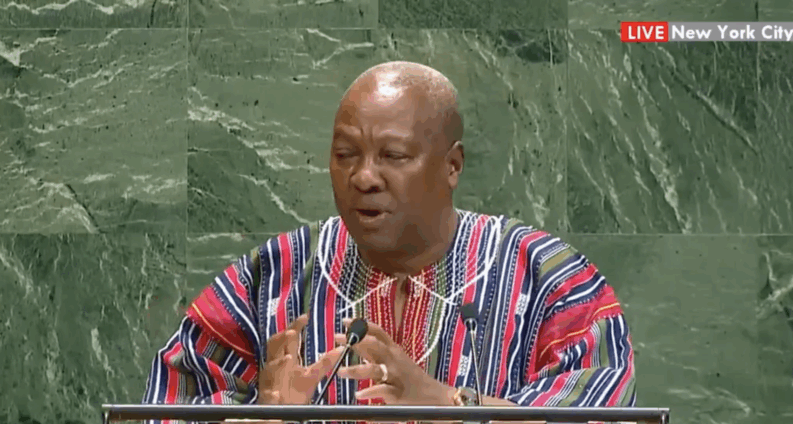
President John Dramani Mahama has declared that Africa will play a pivotal role in shaping the future of the world.
Addressing the General Assembly on Thursday, September 25, President Mahama reflected on Africa’s historical role in global governance and its growing significance for the future.
“Of the 51 Member States involved in the founding of the United Nations in 1945, only four were African: Egypt, Ethiopia, Liberia, and South Africa,” he said.
He explained further: “It is important to point out that the United Nations came into being in the aftermath of World War 2 because of the inability of its precursor, the League of Nations, to avert a large-scale global conflict, which had been its guiding purpose when it was founded in 1920 on the heels of World War 1.”
“Out of the 42 founding member states of the League of Nations, only three were African: Liberia, the Union of South Africa, and Ethiopia. Egypt joined later in 1937. Africa’s overall participation in the organisation’s founding was minimal and relatively unimportant,” President Mahama added.
READ ALSO: Full text: Mahama’s address at the 80th United Nations General Assembly meeting
He traced Africa’s early exclusion to European colonisation: “That’s because, before all the other talks and meetings, representatives from a group of 14 nations gathered in Berlin for a series of discussions that began in 1884, which led to the partition and formal colonisation of the continent—also called the Scramble for Africa.”
Reflecting on the lessons of history, President Mahama observed: “It has famously been written that ‘past is prologue.’ Well, in the past, the majority of the 54 nations that now comprise Africa were never offered a seat at the table where plans for a new World Order were being drawn.”
Turning to Africa’s future, he said, “As fate would have it, the tables have turned, and Africa’s role in the authorship of whatever is yet to come for this world will be huge, and it will be consequential.”
Highlighting the continent’s demographic potential, he said, “According to this organisation’s own projections, by the year 2050, more than 25% of the world’s population is expected to come from the African continent. Additionally, by 2050, one-third of all young people, aged 15 to 24, will be residing on the African continent.”
“So, you see, the future is African. Allow me to say this once again, a little louder for the people in the back. The future is African!" he concluded.
Latest Stories
-
Obuasi SHTS case: Eduwatch calls for sex offenders’ register and mandatory background checks for teachers
1 minute -
GloMeF CEO urges intensified public education on new road traffic regulations
13 minutes -
‘Any tax on ChatGPT is an attack on education and innovation’- Akim Swedru, MP
16 minutes -
Obuasi SHTS sexual abuse scandal exposes systemic failure in child protection – Moving Masculinity
17 minutes -
Hubtel CEO calls for national data-sharing framework to boost AI development
19 minutes -
Twelve Golden Rules of real estate development in Ghana, Africa
24 minutes -
Five new telephony cell sites in Ashanti Region to be activated in October 2026 – Sam George
24 minutes -
Mahama cuts sod for Afienya Industrial Park, targets 120 enterprises
29 minutes -
Rush for fuel from accident tankers is stealing, punishable by law – NPA boss, Edudzi Tamakloe
35 minutes -
GhIG pushes for legislation to regulate geoscientists’ activities
41 minutes -
Mfantsipim @150: Ace Anan Ankomah leads project to preserve school’s musical heritage
45 minutes -
Gov’t launches rCOMSDEP in Ahanta West, Mpohor Fiase to promote responsible community mining
46 minutes -
AI is forcing professionals to rethink how they deliver value – Hubtel CEO
49 minutes -
Daily Insight for CEOs: Strengthening the CEO’s Leadership Legacy
50 minutes -
Jimmy Aglah’s ‘When the River Testified’ approved by NaCCA as Supplementary Reader
59 minutes