

Audio By Carbonatix
Paschal Donohoe, Managing Director and Chief Knowledge Officer at the World Bank Group, has reaffirmed the Bank’s commitment to supporting Ghana’s human capital development through sustained investment in education.
He described the Ghana Accountability for Learning Outcomes Project (GALOP) as one of the World Bank’s most impactful education programmes globally, aimed at improving foundational learning and the quality of basic education.
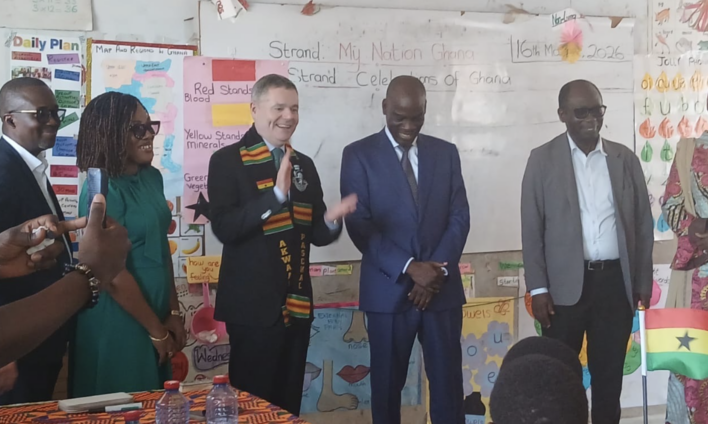
Mr Donohoe gave the assurance during a visit to the Osu Manhean Basic School in Accra to inspect the implementation of the GALOP as part of his official visit to Ghana.
The project is a US$174 million initiative implemented between 2019 and 2025 with funding support from the World Bank and the United Kingdom’s Foreign, Commonwealth and Development Office (FCDO).
It seeks to improve the quality of education in more than 10,000 low-performing basic schools across the country.
The programme supports teachers through training, provides school grants for teaching and learning materials, and strengthens accountability systems in schools to improve literacy and numeracy outcomes for more than 2.9 million pupils.
Mr Donohoe said investing in education was essential to securing the future of Ghana and its children, noting that strong education systems were critical for national development and long-term economic growth.
He commended the Government, the Ministry of Education, and teachers across the country for their dedication to improving learning outcomes and ensuring that children received quality education.
Mr Haruna Iddrisu, Minister of Education, expressed appreciation to the World Bank for its continued support to Ghana’s education sector, particularly through the GALOP programme aimed at strengthening foundational learning.
He said the Government was prioritising investment in basic education to improve learning outcomes and return more out-of-school children to the classroom.
The Minister also disclosed that the World Bank was expected to support Ghana with about US$300 million under the Secondary Education Transformation for Results project to enhance skills development and job creation.
Mr. Joshua Nortey, Head Teacher of Osu Manhean Basic School, expressed gratitude to the World Bank and the Ministry of Education for the GALOP initiative.
He said although the school was yet to be fully enrolled in the programme, it benefited from related workshops and other forms of support.
Mr. Nortey said the school’s enrolment had increased from about 250 to 425 pupils, while academic performance remained high, with Basic Education Certificate Examination (BECE) results consistently between 95 and 100 per cent over the past five years.
He expressed the hope that Phase Two of the GALOP programme would address the remaining challenges facing the school.
Latest Stories
-
There is no time to waste – Bawumia orders NPP to begin 2028 work
58 seconds -
Sarkodie visits MobileMoney Fintech LTD
3 minutes -
John Boadu unveils new NPP strategy to win back youth and modernise party
9 minutes -
Hawa Koomson elected NPP National Women’s Organiser
11 minutes -
John Boadu begins NPP rebuild from grassroots ahead of 2028 election
12 minutes -
Titus Glover wins NPP National Organiser race on second attempt
15 minutes -
Winning 2028 election won’t be easy; we must work harder – Bawumia
16 minutes -
You’ll be part of 2028 campaign; there’s enough work for all of us – Bawumia to NPP aspirants
24 minutes -
John Boadu moves to unite NPP after heated leadership contest
26 minutes -
Today is not a day of victory but a day of responsibility and great unity – John Boadu
27 minutes -
Let us choose unity over division – John Boadu to NPP
30 minutes -
Our task is to build a renewed NPP – John Boadu
33 minutes -
Teamwork, discipline will drive NPP’s 2028 victory – Justin Kodua after retaining General Secretary position
40 minutes -
John Boadu elected National NPP Chairman
49 minutes -
Justin Frimpong Kodua retains position as NPP General Secretary
50 minutes