

Audio By Carbonatix
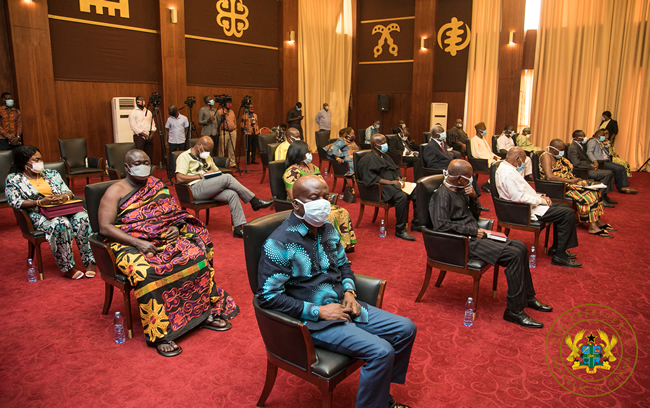
In Ghana, the Council of State is often described as a council of elders—a group of wise heads tasked with guiding the president through the thorny thickets of governance.
Established under Article 89 of the 1992 Constitution, this 31-member body is meant to provide guidance and advice to the president, parliament, the judiciary, and other state institutions on issues of national importance.
But as the country holds elections for new members, many Ghanaians are left wondering: is this council a powerhouse of influence or merely a ceremonial echo chamber?
The council’s composition is a curious mix of elected and appointed members. Sixteen regional representatives are elected by delegates from district assemblies, while the president appoints 11 members and, in consultation with parliament, selects three high-profile figures: a former Chief Justice, a former Inspector General of Police, and a former Chief of Defence Staff. Rounding out the group is the President of the National House of Chiefs, who serves as a de facto member.
In total, 14 of the 31 members—45% of the council—are directly or indirectly appointed by the president, raising questions about its independence.
This structure has not gone unchallenged. In 2011, the Constitutional Review Commission, set up by the National Democratic Congress (NDC) under President John Atta Mills, submitted its review report.
While the committee recommended maintaining the council, it also proposed reducing the president’s appointees from 11 to 5 to enhance its independence. The government, in its white paper, accepted the recommendation to retain the council but rejected the reduction of presidential appointees, leaving the balance of power unchanged.
The council’s tenure lasts until the end of the president’s term, ensuring continuity but also tying its fate to the executive’s political cycle.
Its role, however, is far from ceremonial. The council is consulted on key decisions, including the appointment of the Bank of Ghana Governor, the Chief Justice and Supreme Court Justices, the Inspector General of Police, and the Chairperson of the Electoral Commission.
It also advises on presidential pardons, diplomatic appointments, the removal of certain public officials, and legislative bills.
Yet, for all its advisory responsibilities, the council’s influence is not absolute. The Supreme Court has ruled that while the president is required to seek the council’s advice on certain matters, they are not bound to follow it. In other words, the council can advise, but the president can politely—or not so politely—ignore.
This has led critics to argue that the council risks becoming a rubber stamp, especially given the significant number of presidential appointees. Supporters, however, see it as a stabilizing force, offering experienced counsel and a layer of oversight in a young democracy.
As Ghana continues to strengthen its democratic institutions, the role of the Council of State remains a topic of lively debate. Is it a vital check on presidential power, or merely a ceremonial body with a fancy title?
The answer may lie in how future presidents choose to engage with it—or how often they choose to ignore it. For now, the council remains a curious blend of tradition and politics.
Latest Stories
-
Salomey Baffoe bail denied: Cyber-related investigation poses risk of witness interference – High Court
7 minutes -
Court is being too ‘high-handed’ by keeping Salomey Awiti Baffoe in custody – Criminologist
8 minutes -
Lawyer for Salomey Baffoe appeals bail refusal, petitions CJ to intervene
13 minutes -
Washington State delegation explores healthcare partnership with Ghana Medical Trust Fund
17 minutes -
BoG backs cedi payments for Ghana-China trade
18 minutes -
EPA shuts down Earl International mining operation at Gbane over environmental breaches
20 minutes -
GoldBod resumes significant gold shipments, supporting reserves – BoG
23 minutes -
FX interventions are rules-based, not discretionary-BoG
27 minutes -
DVLA explains delinquency charges related to expired driver’s licences
35 minutes -
High Court denies bail application for Salomey Awiti Baffoe
37 minutes -
GES urges communities to help provide kitchens for school feeding programme
43 minutes -
Mahama invokes Nkrumah, says Ghana’s freedom must serve Africa
44 minutes -
From Cotonou to Bata: Ghana and Côte d’Ivoire’s rivalry enters a new chapter
46 minutes -
UN Charter must reign supreme over ‘might makes right’ – Mahama
48 minutes -
BoG to introduce new Heritage Series banknotes in November 2026
49 minutes